
By Ambassador Justice Piitso
Five hundred and thirty three years ago, when the European explorer and navigator, Christopher Columbus, set his foot at the shores of the beautiful Island of Cuba, in the Caribbean archipelago, little did he know that thousands of years before, existed a monumental civilisation in the city of Caral-Supe, situated in the coastal desert of the republic of Peru.
The renowned ancient city of Caral-Supe, is amongst the oldest civilisations in the western hemisphere, long before the era of the pyramids in Egypt and Ziggurats of Mesopotamia. The historical significance of its foundations and architectural peculiarities stand to be amongst the most powerful ancient civilisations.
The simulacrum is against the backdrop of empirical evidence from archaeological discovery and research, demystifying the theoretical doctrine from the European scholarly and philosophical school, perpetuating the myth that Christopher Columbus, was the first in the history of human civilisation, to have discovered the Antilles of the Americas.
The hypotheses unmasks the hypocrisy transfused by the pioneers of imperialism colonialism, against the overwhelming scientific corroboration, confirming the existence of thriving cultures and civilisations, long before his adventurous journey into the Americas.
The scramble for the colonisation of the world by the European superpowers, heralded a new era, of systematic extermination of the indigenous population in the former colonies and semi colonies, subjugating them to horrendous genocidal crimes. The system of political oppression and socio-economic exploitation of the indigenous populations became a basis for the widespread violations of serious crimes against humanity.
The scourge of untold gruesome acts of abuse of the indigenous population, led to the scarcity of human capital to drive the material source of production to the European markets, leading to a period of a large-scale enslavement of African people into the Americas. Millions and millions of African slaves perished through the crossing of the notorious Trans-Atlantic route.
The rampant exploitation of the natural resources and imposition of free labour became the primary driving force for the development of the European industrial capitalism. Flourishing capital markets and accumulation of profits was the basis for the greater impetus on the expansion and consolidation of the world capitalist system, during the eighteenth and nineteenth century.
Throughout the historical period, many heroic battles were fought against imperialism and colonialism domination, many of our heroes and heroines fought relentlessly against the brutality of the oppressive system, fighting against slavery and all its manifestations, confident that freedom of humanity shall triumph over adversity. We count on the versatility of their encounters, heroism and determination for the freedom and dignity of humanity.
My epistle enumerates the day of great historic significance in the calendar of the struggles for the independence of the Cuban nation. The day of the 4th of August 1868, when the father of the homeland, Carlos Manuel de Cespedes, convened an all-important convention at Tirsan, making a clarion call to his nation, to take up arms against the brutality of the Spanish colonial power.
Bequeathing to his mother nation, the sacred ideals of freedom and equality, he made a clarion battle cry:
“Gentlemen, the hour is solemn and decisive. The power of Spain is spent and worm eaten. If it still seems solid and tall to us, it is because we have been contemplating it on our knees for more than three centuries. Let get up.”
On the 10th October 1868 at his plantation in La Damajagua, he launched his battle cry of Grito Yara, proclaiming the independence of Cuba and calling for an insurrection against the brutality of the Spanish colonial power. He said:
“Rising up arms against the oppression of the tyrannical Spanish government, we are demonstrating to the world the causes which forced us take this step. Spain imposes on us an armed force on our territory, which has no other goal than to submit us to the implacable yoke which degrades us.”

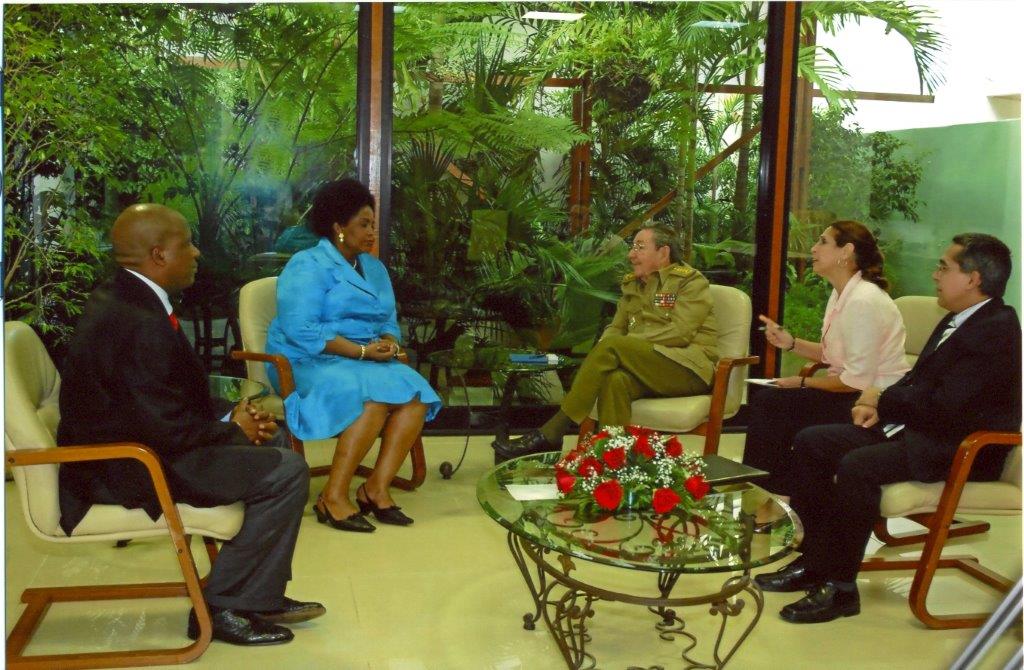
*** Amb Piitso supporting HE Maite Nkoana-Mashabane, then South Africa’s Minister of International Relations and Cooperation, in a meeting with the then Cuban president, commander Raul Castro Ruiz ***
He unambiguously declared abolition of slavery in Cuba, by first granting freedom to his own slaves at the family plantations. Inviting the slaves to join the struggles against colonial oppression, he called on them as new free men of the struggles of humanity, declaring that…
“We believe that all men are equal. We admire universal suffrage which ensures the sovereignty of the people. We want gradual and after compensation emancipation from slavery. We demand religious respect for the inalienable rights of the human being, constituting ourselves as an independent nation, because in this way, we realise the greatness of the future destinies and because we are convinced that under the yoke of Spain, we will never enjoy the free exercise of our rights.”
Inspired by the ideals of Carlos Manuel des Cespedes to forge struggles for the territorial sovereignty and independence of Cuba, the Apostle of the homeland of humanity, Jose Marti, in his poem, ‘To my Mother’, dedicated to ‘October 10’, the day of the cry for the independence of Cuba, expresses the following profound words: ”Thanks to God that, at last with integrity, Cuba breaks the nose that oppressed her. And active and free lifts its head”.
Later in his life, Apostle Jose Marti, following great pathways of luminaries of the time, imbued by the ideas of Simon Bolivar and Carlos Manuel de Cespedes, became instrumental in the formation of the Cuban Revolutionary Party, urging that a revolution is not merely a passionate outburst of integrity, or the gratification of a need to fight or exercise power, but rather, a detailed understanding dependent on advanced planning and great foresight.
His great views about the achievement of a free and democratic republic, was the cornerstone for the formation of the Cuban Revolutionary Party, outlining its strategies and tactics, calling for the unity of all revolutionary formations both in and outside of Cuba, the renewal of the armed struggles and the creation of a republic capable of assuring its durable nation to its children.
The magnanimous ideas of the struggles for the total independence of Cuba free of oppression and exploitation, is what came to influence the young heroes and heroines of the July 26 Movement, under the leadership of the Commander-in-Chief Fidel Castro. The attack on the Moncada garrison was part of the continuation of the epic struggles, determination to die for the ideals of the freedom of humanity.
The grandma expedition and the heroic battles fought by the Cuban combatants in the battles of Sierra Maestra mountains, were watershed events in the making of history, demonstrating on the importance of the fundamental principle of unity of our people, for the success of the revolution. The epic feats inspired by the implacable journey of the rich history of struggles of the heroic people of the beautiful Island.
On the historic day of the triumph of the revolution, on the occasion of the 1st January 1959, addressing thousands and thousands of the citizens of the city of Havana, the Commander-in-Chief comrade Fidel Castro said the following profound words:
“I believe that this is a decisive moment in our history. The tyranny has been overthrown; the joy is immense and yet much remains to be done. We do not deceive ourselves believing that everything will be easy, from now on, perhaps everything will be more difficult in the future.”
The victory of the heroic nation at the battle of Playa Giron and the subsequent declaration of the socialist character of the revolution, at the doorstep of the US empire, is what will define the eternity of your generation. You have given freedom to millions of the people of the world, demonstrating outstanding feats of courage, bravery and resilience.
In Africa you were there in Guinea Bissau, Mauritania, Cape Verde, Ethiopia, Somalia, Algeria, Congo Brazzaville, Congo Kinshasa, Mozambique, Angola, Zimbabwe, Zambia, Namibia, South Africa and many other parts of the world. You have illuminated the horizons of humanity, representing the greatest virtuosity of our revolutionary struggles.
The entire history of human civilisation beacons the Cuban revolution, the only one to have paid back the debt to humanity, extending a gesture of solidarity to the African people, taking responsibility to what the masters of crime against humanity could not do, those who have slandered millions of people as slaves, building their economies on the carcasses of the downtrodden.
Thousands of men and women from your revolutionary Island, volunteered to fight side by side with the African people, during the difficult times of the dark hours of struggles for freedom and democracy. The greatest episodes of history, distinguish them the most outstanding revolutionaries of our epoch, having demonstrated the most remarkable feats of human solidarity and internationalism.
Your fellow countrymen and women perished their being in the trenches of our continent, fertilising our soil with the blood of liberty, contributing towards our struggles for freedom and independence. They did so highly convinced that when millennium finds the world, humanity shall breathe freedom on every shore from the fountain to the river.
Many became standard bearers of international solidarity, raising the flag of the revolutionary republic on the horizons of the world community of nations, giving to the world the best ideas the revolution represents. In the pathway of Jose Marti, the sacred ideals of the freedom of humanity.
Your revolutionary words of solidarity and internationalism during the first congress of MPLA in Luanda, Angola, will continue to blossom the minds and hearts of many generations to come. The people of Africa will always be inspired by your humble words, when you said:
“The day our presence is no longer necessary, only the people of Angola will be able to issue that order. And when the Cubans here withdraw from Angola, we will take with us neither oil, nor diamonds, nor coffee, or anything else. All what we will take, with us is the indestructible friendship of this great people, and the remains of our dead.”
This true spirit of generosity and devotion to the cause of the struggles for the freedom of humanity is what defines the exemplary leadership of your generation. Taking lessons from the father of the homeland, Carlos Manuel des Cespedes, when after his son being taken prisoner by the Spanish troops, when called to surrender his arms in exchange for the life of his son, said: “Tell General Caballero de Rodas that Oscar is not my only son. I am the father of all Cubans who fell for the revolution.”
Like the Father of the Homeland, your generation never had doubts about the certainty of the triumph of our revolutionary struggles, you have always cherished the noble idea of the victory of the struggles for the freedom of humanity. Cespedes was always convinced that humanity shall break the bondage of oppression and exploitation:
“The Cuban revolution, now vigorous, is immortal. The republic shall defeat the Monarchy. The people of Cuba, full of faith in their destiny of freedom and animated by unwavering perseverance on the path of heroism and sacrifice, will be worthy of being, masters of their fate, among the free people of America. Our unchanging slogan is and always will be: ‘Independence or Death. Cuba must not simply be free, it cannot become a slave again’.”
I take the opportunity on behalf of the millions of the young generation of my country, the African continent and the world, thanking the tremendous contribution of the 26 July Movement, for changing the paradigm of the world revolutionary struggles, illuminating the horizons of our continent which was engulfed by colonial darkness. Your generation indeed was born out of the love of the struggles for the freedom of humanity.
In the wake of the insurmountable obstacles along our odious journey to freedom, we have vowed: freedom or death, humanity shall triumph against adversity. The theatre of our struggles for freedom has been like a river which does not want to argue with rocks, flowing around them.
In the horizons of the beautiful African continent, we have risen to the hopes of our freedoms. On the mountain peak of Kilimanjaro, as the blossoming sun rises on the horizons, as the sunset at the bosom of the Cape Point where Atlantic and Indian oceans meet, we have triumphed against adversity.
***
Phatse Justice Piitso is a former South Africa’s Ambassador to Cuba and a member of the African National Congress, writing this article in his personal capacity.