
By Staff Reporter
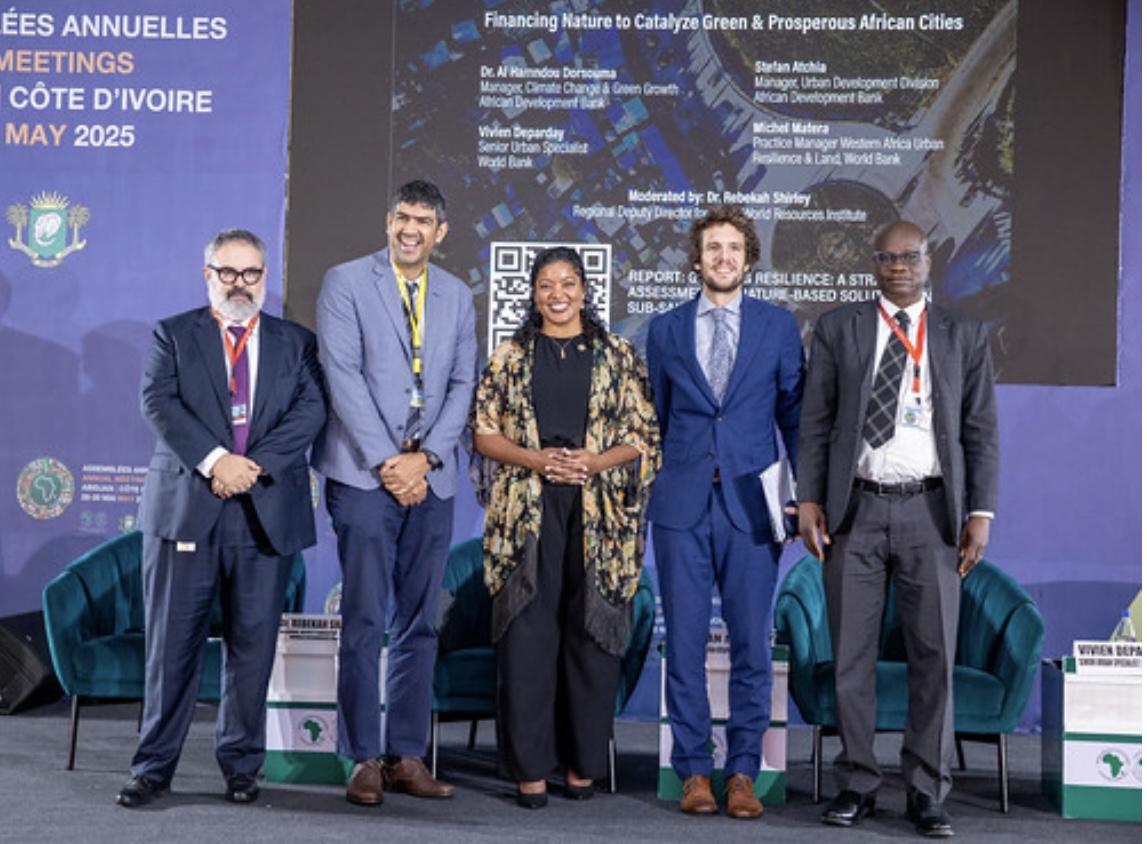
On the closing day of the African Development Bank Annual Meetings in Abidjan, a dynamic roundtable was held under the theme: “ Financing Nature to Catalyze Green & Prosperous African Cities”, with the aim of highlighting the urgent need to bring nature into the heart of Africa’s urban planning and development agenda.
As cities across the continent grow at unprecedented rates, they face mounting climate risks—from flooding to heatwaves—while grappling with aging infrastructure and significantly contributing to Greenhouse gas emissions.
Co-hosted by the African Development Bank, World Resources Institute (WRI) Africa, and the World Bank’s Global Facility for Disaster Reduction and Recovery (GFDRR), the event held on 30 May, made a compelling case for scaling up nature-based solutions and Green-Grey Infrastructure in African cities.
Currently, the nature-based solutions model is gaining significant momentum in Africa as an important approach to address pressing urban challenges posed by climate change, biodiversity loss, infrastructure gap, and rapid population growth. In this regard, the notion of Nature-based solutions implies that Africa should work with nature instead of destroying it as is currently the case in most African cities.
GGI blends traditional built infrastructure with natural systems such as wetlands, forests, and rivers—offering more cost-effective, resilient, sustainable and inclusive solutions.
At the event two major new reports were presented: Africa’s Urbanisation Dynamics 2025—from the African Development Bank, OECD and Cities Alliance; and Growing Resilience: Unlocking the Potential of Nature-Based Solutions for Climate Resilience in Sub-Saharan Africa, a collaboration between the World Bank, WRI and the African Development Bank.
Africa’s Urbanisation Dynamics 2025 presents an in-depth overview of future urbanisation patterns, featuring detailed data on population growth and the spatial development of over 11,000 urban centres across all 54 African nations.
“Africa’s population is projected to grow by 900 million by 2050—with 700 million of that growth occurring in cities,” said Stefan Atchia, Manager, Urban Development Division, African Development Bank. “Planning for this urban expansion must start now. Two out of three Africans will live in cities by 2050.”
Analyzing nearly 300 projects over the past decade, the “Growing resilience” report identifies what works, key barriers, and strategies to scale up green, resilient development. It found a heavy reliance on grants—used in 84% of projects—while loans, although accounting for over 70% of total funding, were used in just 32% of projects. Expanding the use of blended finance and innovative instruments will be critical, participants heard. The report clearly indicated the sharp increase in new nature-based solutions projects and financing in Africa over the recent years, with Multilateral Development Banks accounting for over 70% of this investment.
“At WRI, we are committed to driving Africa’s urban transition onto sustainable and livable pathways,” said Dr. Rebekah Shirley, Regional Deputy Director for Africa, WRI. “Through our Green-Grey Infrastructure Accelerator, we’re helping 11 cities in seven countries access funding, strengthen policies, and design projects that deliver tangible resilience benefits.”
Yet, there is room for improving nature-based solutions investment, providing technical assistance for early project preparation and diversifying financing mechanisms.
“We are working to restore degraded land, boost resilience, and create green jobs across the Sahel through initiatives like the Great Green Wall,” said Al Hamndou Dorsouma, Manager, Climate Change and Green Growth, African Development Bank, further emphasizing that “Building on the Report’s insights, the Bank will continue scaling up nature-based solutions support beyond traditional gray infrastructure finance through adopting a Green-Gray Infrastructure approach”.
Participants also heard from Muungano wa Wanavijiji, a grassroots movement in Nairobi’s Mathare settlement working to protect rivers and rehabilitate open spaces. Their testimony reinforced the need to be responsive to community needs and integrated local leadership in nature-based solutions projects.
Closing the session, Michel Matera, Practice Manager for Western Africa, Urban, Resilience, and Land at the World Bank, reminded the audience:
“African cities are growing rapidly. Let’s make sure they also grow sustainably, equitably, and resiliently—with nature as a key partner in that journey.”