

I still remember the first time I wandered through Johannesburg’s Maboneng district — the name itself means “Place of Light” in Sesotho, and it couldn’t be more fitting. There’s something electric about it, something soulful. It’s not the kind of place you merely visit; it’s a place you feel. Over the years, it’s become my personal go-to destination when I have friends visiting from Europe. I always bring them here — not to show off a tourist attraction in the conventional sense, but to introduce them to the heartbeat of Johannesburg.
Maboneng is more than just a creative precinct; it’s a canvas of African expression. The streets are alive with colour and rhythm, from striking murals on crumbling warehouse walls to the strains of jazz and amapiano weaving through the air. There’s a palpable energy that grabs you — the kind that says, “This is where art meets rebellion, and history meets now.” On any given weekend, you’ll find young fashion designers showcasing bold, Pan-African garments, street musicians serenading passers-by, and photographers capturing it all for the world to see. It’s where creativity refuses to be tamed.
Whenever I have guests in town, I make sure to take them to Pata Pata — not only for its rich soul food, but for the experience it offers as a time capsule of South African cultural memory. The name, paying homage to the legendary Miriam Makeba, sets the tone. The interior hums with a retro elegance, and the menu offers a deep dive into our culinary roots: steaming dumplings, tender sheep’s head, creamy samp and beans, and earthy morogo, all paired with an impressive range of South African wines — from robust Pinotages to citrusy Chenin Blancs. But it’s the music that seals the magic.
Pata Pata isn’t just a restaurant. It’s a stage, a living tribute to the golden era of Sophiatown. Live jazz performances fill the room almost nightly, evoking the spirit of Hugh Masekela, Thandi Klaasen, and the many other legends who once lit up township shebeens with brass and soul. Every note that emerges from the saxophone or upright bass feels like a resurrection of a heritage nearly silenced by history. Occasionally, the velvet tones of poetry take over the mic — especially during nights curated by Julius “Makweru” Moeletsi, a poet and cultural activist who brings voices of struggle, love, and identity into the spotlight. In those moments, the walls breathe; the past and present collapse into each other.
In recreating the original vibe from Sophiatown, Pata Pata honours a legacy born in the 1920s in Queenstown — fondly nicknamed “the little town of jazz.” That idiom of South African jazz, as Tokyo Sexwale, former Gauteng Premier, said to me our kind of jazz was “perfected here.” Maboneng, and Pata Pata in particular, keeps that flame alive — not in a museum-like way, but in a lived, breathing, improvisational rhythm that’s felt in every cymbal crash and stanza recited.
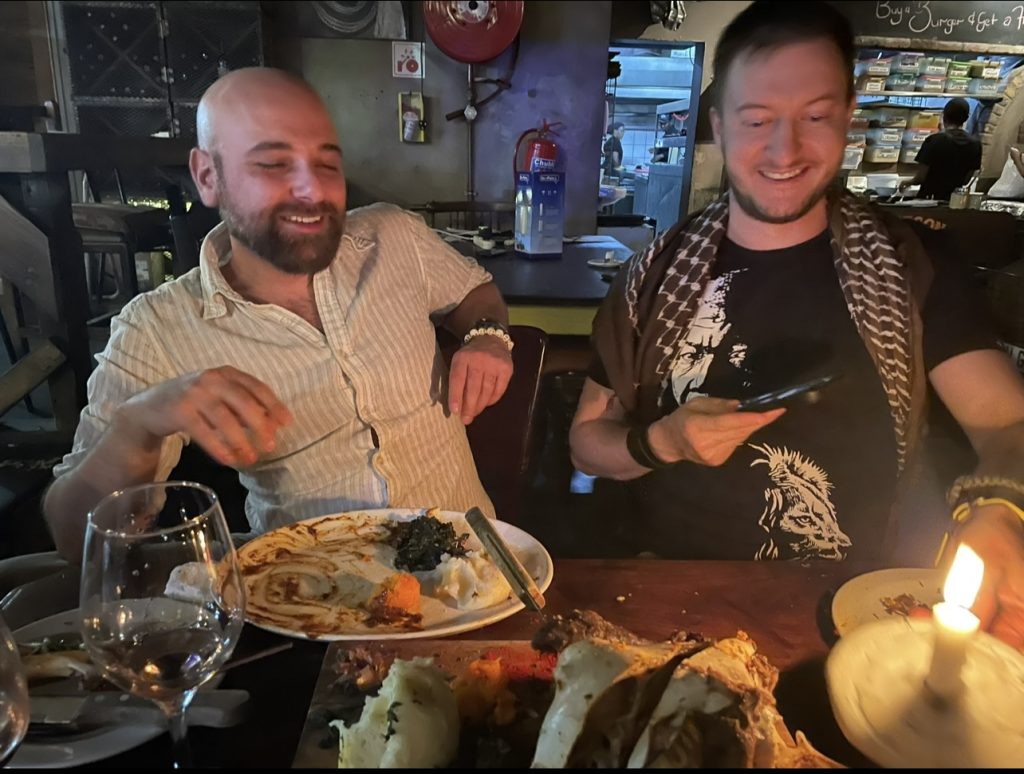
Here’s an anecdote I rarely share — usually reserved for close friends, and always with a sigh. My author friend once called to say I should join him and our journalist friend for a night out. I hesitated. My finances were tight; a client hadn’t paid as promised, and I’ve always lived by a principle: I only accept social invitations when I can afford to carry my own weight, especially when invited by fellow artists or colleagues. That rule, I must admit, is rooted in a very particular experience.
Back in 2004, on my final day at the Department of Trade and Industry, a group of my talented former subordinates — people who had made me look good in the job — insisted they take me out for a farewell dinner. We ended up at a lovely restaurant in Pretoria. The mood was warm; we dined, drank, reminisced, and I even lit up a celebratory puff. Then came the bill. Suddenly, they were all pretending to be far more intoxicated than they were. The waiter, having observed me as the evening’s focal point, placed the bill squarely in front of me. My colleagues shuffled out, and I was left to explain — rather awkwardly — that I’d merely been invited. But I paid. With a mixture of grace and quiet fury. Since then, I’ve always made sure I either stay home or come prepared.
Fast forward to 2024. My author friend invites me out again. I decline, citing my same rule. He assures me, “It’s on me.” I add, half-jokingly, that we should Uber — it’s safer that way. He replies that our mutual friend has already dispatched an Uber to pick him up. I tell him I have a friend visiting and ask if we can be dropped off at Pata Pata in Maboneng afterwards. Sensing my hesitance, he insists they’ll fetch me directly.
They arrive. A car packed with five people, six with the driver: our journalist friend, a visiting guest from Cape Town, and two women I don’t know. My anxiety creeps in. I quietly ask my author friend if he’s sure he’ll cover the bill — Pata Pata holds me in high regard, and I don’t want any drama. He assures me it’s handled. To prevent overloading the car, he hops into my friend’s vehicle and we drive together to Maboneng.
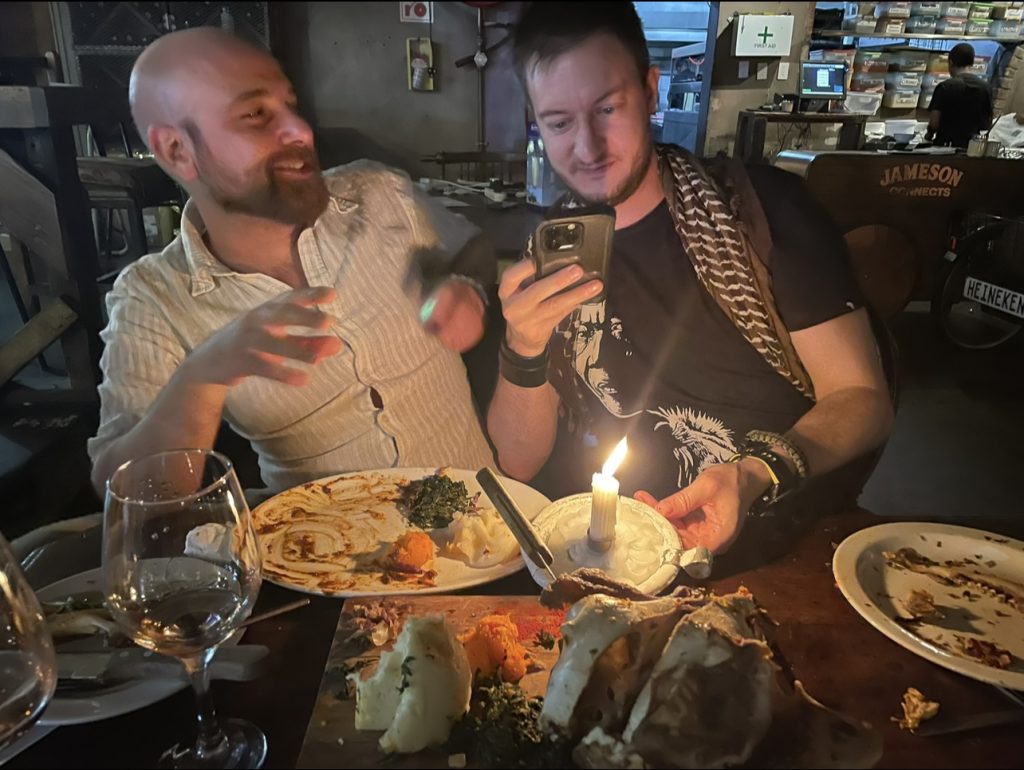
At Pata Pata, I take precautions. I order the cheapest bottle of red wine on the menu — just in case. My author friend orders his own bottle. The others go big: a bottle of Glenfiddich 18, twelve lemonades, twelve Savannas, a hubbly bubbly for the ladies, and a massive platter to nibble on. My nervousness spikes. I try to console myself: maybe the Cape Town visitor is on business and using a corporate entertainment card. But the incongruity of pairing 18-year-old whisky with lemonade rattles me further. It doesn’t add up.
Within two hours, the whisky is gone. So is the food. The women order two more rounds of hubbly. Then, my author friend decides to take them next door to the William Kentridge exhibition for an impromptu tour. I stay behind, guarding handbags.
They return, beaming. My author friend lights a cigarette on the pavement. Our journalist friend announces that the Uber has been ordered — they’re ready to leave. I raise my eyebrows. I ask, cautiously, whether the bill has been settled. My author friend seems surprised. The waiter confirms: no, they haven’t paid.
I don’t even need to say anything — my look says it all. Furious, my author friend calls the others back. The bill is tallied. He swipes his card. I hold my breath, praying it goes through — the thought of being charged for that full bottle of Glenfiddich in single tots terrifies me. The transaction is approved. Relief floods my chest. He doesn’t even say goodbye as they vanish into the Jozi night.
And that, right there, is why I live by that golden rule: never go out unless you can pay your own bill. Some lessons are paid in whisky. Others, in dignity.
Beyond its cultural richness, Maboneng contributes tangibly to Johannesburg’s tourism economy. It’s helped rebrand the inner city as a destination of choice — edgy yet welcoming, raw yet refined. Market on Main, The Bioscope, rooftop lounges like Hallmark House, boutique hotels, street art tours — all of it creates a gravitational pull for international tourists and local urbanites alike. It has brought jobs, investment, and hope to an area once dismissed as derelict.
For me, though, it remains deeply personal. Watching my European friends marvel at the blend of grit and glamour, history and innovation, I see Johannesburg anew each time. Maboneng is where the city’s contradictions find harmony — and where its dreams are dressed in denim, painted on walls, sung from balconies, and served hot on a plate of dumpling and lamb stew. It is not just a district; it’s a feeling. And as long as Johannesburg breathes, I will keep leading people to this luminous corner where light still breaks through — through music, through food, through poetry, through us.
Tujenge Afrika Pamoja! Let’s Build Africa Together!
Enjoy your weekend.
Saul Molobi (FCIM)
PUBLISHER: JAMBO AFRICA ONLINE
and
Group Chief Executive Officer and Chairman
Brandhill Africa™
Tel: +27 11 759 4297
Mobile: +27 83 635 7773
Physical Address: 1st Floor, Cradock Square Offices; 169 Oxford Road; Rosebank; JOHANNESBURG; 2196.
eMail: saul.molobi@brandhillafrica.com
Website: www.brandhillafrica.com
Social Media: Twitter / Instagram / LinkedIn / Facebook / YouTube / Jambo Africa Online / WhatsApp Group / 101.9 Chai FM