
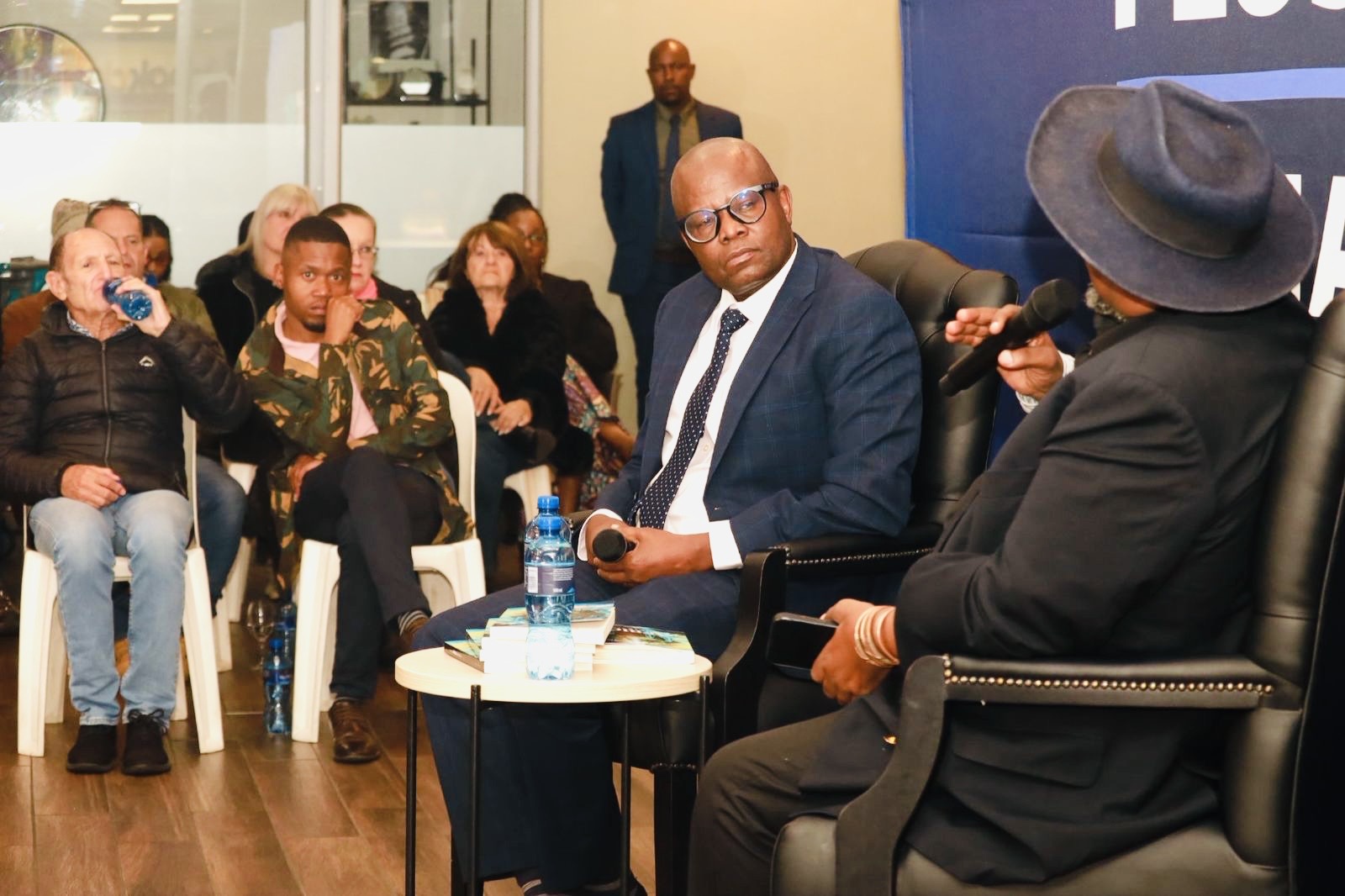
Opening Remarks by Funeka Sobantu:
Good evening, everyone, and thank you for joining us. Welcome to the launch of Dr. Sifiso Falala’s book. I will not attempt to introduce him because he is such a giant and a remarkable individual that I cannot do justice to his achievements. We have Dr. Sifiso Falala, the author, and Mr. Saul Molobi, who will facilitate the conversation and properly introduce him.
All protocols observed. If I fail to acknowledge everyone present, please forgive me; I am still learning. Among us are Dr. Torozo Mashangu, Simon Katua from Pretoria and Kenya, members of Dr. Falala’s family, and our host, Mr. Doron, owner of Bookdealers. Thank you for allowing us to hold this special event in your establishment.
The programme is simple. There is no printed programme because the evening consists of a conversation between Dr. Falala and Mr. Molobi, followed by a question-and-answer session and closing remarks. Please enjoy the evening. We also thank our sponsors and partners for making this gathering possible.
I now invite Mr. Saul Molobi to introduce Dr. Falala.
Saul Molobi’s Introduction
I am not delivering a speech because this is not a night for speeches. I simply want to provide a brief context within which we should situate this conversation.
During the first century, the Roman philosopher Pliny the Elder declared: Ex Africa semper aliquid novi — “Out of Africa always comes something new.”
There is also the construct of “outside-in” versus “inside-out.” For centuries, external stakeholders developed narratives about Africa. The Berlin Conference of 1884-1885 institutionalised the Scramble for Africa. Later, Joseph Conrad’s Heart of Darkness portrayed Africa as a dark continent.
Towards the end of the nineteenth century, however, we saw the emergence of Pan-African thought. At home, Pixley ka Isaka Seme spoke about the regeneration of Africa during his graduation address. His vision became part of the broader Pan-African response to colonialism.
In May 1963, African leaders met in Ethiopia and established the Organization of African Unity. On the eve of its launch, Kwame Nkrumah passionately advocated for African unity.
The unification project later gained renewed momentum through the Abuja Declaration, which sought to create structured mechanisms for continental integration.
Before that, in 1958, Chinua Achebe drew on W.B. Yeats’ famous words:
“Things fall apart; the centre cannot hold; mere anarchy is loosed upon the world.”
Unfortunately, in our enthusiasm for Pan-Africanism, nationalism and even ethno-nationalism, we sometimes lost the ability to practise self-criticism. Here in South Africa, we once celebrated a “festival of ideas,” but over time intellectual dissent diminished.
That is why it is such a privilege to engage Dr. Sifiso Falala tonight. He represents the voice of reason Africa desperately needs.
A few months ago I received a copy of this book. This is the “inside-out” approach I referred to. Africans are now providing critical assessments of Africa instead of relying on foreign intellectuals to diagnose our problems and prescribe solutions.
It is therefore important that we understand who Dr. Falala is.
He is the founder and CEO of Class of 1994 Research, one of South Africa’s leading independent market research firms, established in 1998. He founded Sovereign Africa Ratings, which provides sovereign and sub-sovereign rating services, and serves as President of the Pan African Media Research Organisation.
He has chaired the Southern African Market Research Association and is a member of the European Society for Opinion and Marketing Research.
In 2020, he founded Priority Performance Projects, a company dedicated to advancing development and economic growth in the developing world through stakeholder engagement, project design, financing and monitoring.
He is also the founder of African Genius Awards, which celebrate African excellence and seek to reshape Africa’s global narrative.
Dr. Falala holds a PhD in Management of Technology and Innovation from the Da Vinci Institute, a Master of Science in Population Studies, and a Bachelor of Business Studies with Honours.
His expertise spans market research, technological innovation, African development and performance-driven solutions.
There is another reason I read this profile. These days we are quick to describe everyone as an “organic intellectual.” Dr. Falala does not need that adjective. He is simply an intellectual.
Tonight we are not here to chant slogans. We are here for substance—the kind contained in this book.
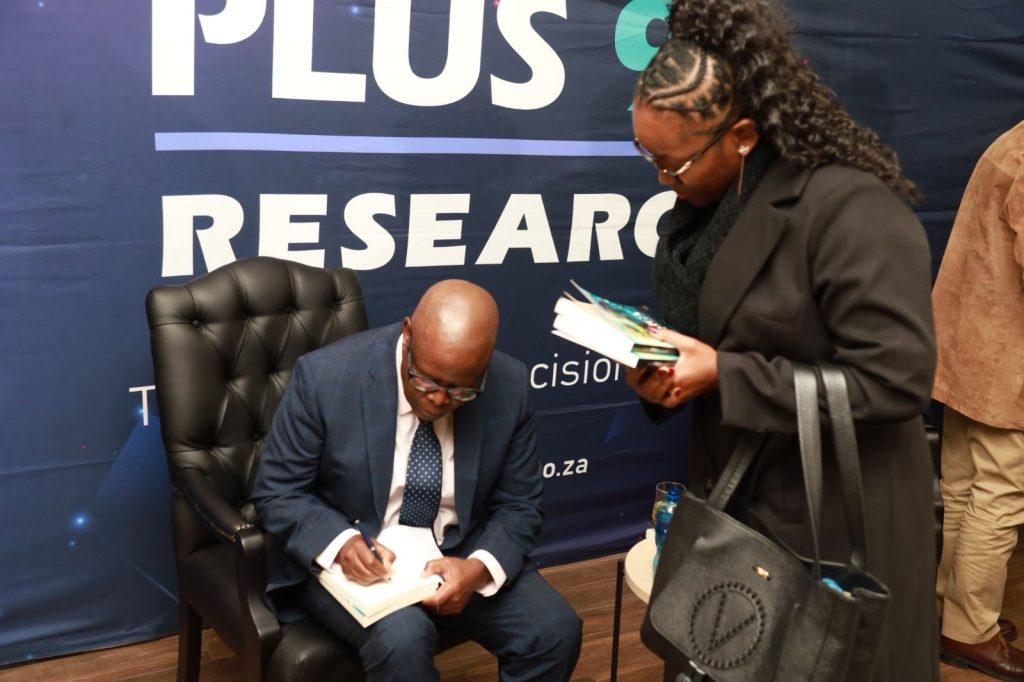
How Africa Defeats Itself?
Saul Molobi:
Your book draws heavily from your lived experiences across the continent. What motivated you to write it, and why such a provocative title?
Dr. Sifiso Falala:
Thank you. Ambassador Molobi has generously described me as humble, though I am still trying to understand the benefits of humility over arrogance.
The obvious question is whether Africa is defeated. It may seem impolite to answer yes, but I believe it is the accurate answer.
Consider that eight out of every ten people living below the poverty line globally are in Africa. Around 400 million Africans live in poverty. Yet Africa is vast. You can fit India, China, Europe and the United States into Africa.
Despite possessing approximately 30 percent of the world’s natural resources — including gold, platinum, diamonds, iron ore, forests and critical minerals used in electric vehicle batteries — Africa’s GDP is only about $3 trillion. If resource endowment translated directly into prosperity, Africa’s GDP should be closer to $33 trillion.
Africa’s economy is smaller than those of the United States, China and Japan. It is smaller than Germany’s despite being a continent.
South Africa itself covers 1.2 million square kilometres. Israel fits into South Africa 55 times, yet Israel’s GDP exceeds South Africa’s.
So yes, Africa is defeated in that sense.
Can we recover? Absolutely. But we cannot recover without confronting the reasons for our predicament. That is why I wrote this book.
I see evidence of defeat every day. Recently Bafana Bafana experienced delays in obtaining visas despite long knowing they would participate in an international tournament. They almost jeopardised qualification because an ineligible player was fielded.
These are not capability problems. They are organisational and leadership failures.
If everyone starts with 100 points, but one team begins on 80 because of administrative failures, uncertainty around accommodation, travel and logistics, then that team is defeating itself before the competition begins.
But isolated examples are not enough to justify a book. This book examines deeper historical patterns, stretching back millions of years to Lucy in Ethiopia and the origins of humanity itself.
The first export from Africa was not gold or diamonds. It was humanity.
Today we face different challenges. We witness corruption, criminal collusion, and public officials who undermine the very institutions they are meant to protect.
You cannot build prosperity when people no longer trust the law.
As a researcher, I seek explanations for observable behaviour. Yet many African realities defy logical explanation. This book explores two concepts: our manifested behaviours, attitudes and beliefs, and the benchmarks and stereotypes through which we evaluate ourselves.
The more I researched, the more difficult it became to avoid one conclusion: many of our actions appear illogical.
That is why I wanted this conversation. Why is nothing being done?
People complain about the weather, traffic, noise and long working hours. Yet few complain about the greatest contradiction of all: the richest continent being the poorest.
This is the elephant in the room.
The book explores the “bystander effect”—the tendency for people to become passive observers of their own predicament. We have become bystanders in Africa’s challenges.
We have also embraced victimhood.
If the roof of this building began collapsing, everyone would run. Yet when economies collapse, industries decline, resources leave the continent and major continental projects stall, we simply carry on.
More than 50 million South Africans have internet access. Tens of millions use WhatsApp daily. We are informed.
Yet what trends online? Humour. Comedy. Gossip. Celebrity news.
The youth spend hours online, but very little attention is paid to agriculture, industrialisation, food security or economic transformation.
Write an article about mining or agriculture and you may receive a handful of views. Post celebrity gossip and it goes viral.
It is as though the continent is under anaesthetic.
That is why I wrote the book. I cannot understand why poverty, inequality and underdevelopment have become normalised.
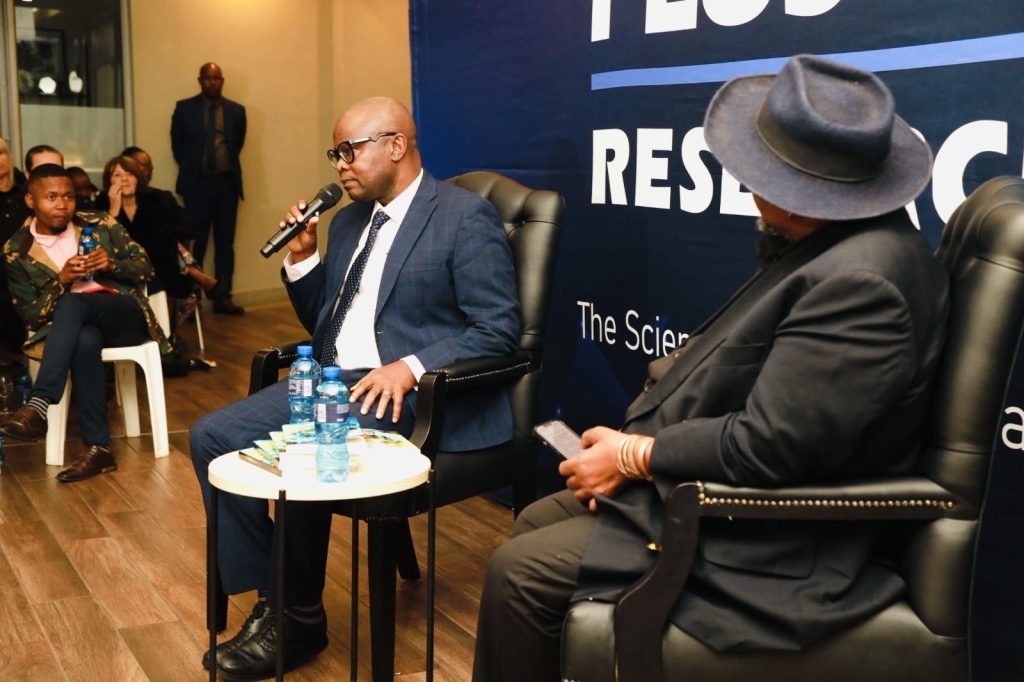
On Victimhood
Saul Molobi:
One of the strongest themes in your book is your rejection of victimhood.
Dr. Sifiso Falala:
The problem with victimhood is that everyone is a victim of something.
Instead of endlessly emphasising our suffering, we should study how others overcame theirs.
Japan endured two atomic bombs and became one of the world’s largest economies.
Israel emerged as a state in 1948 and rapidly built a globally competitive economy.
A Jewish friend once explained the Holocaust to me in three words: “Never again.”
Africa has not said “never again.”
Instead, we often position ourselves to become victims repeatedly.
Victimhood has no expiry date. There is even a theory called the victimhood competition theory, where people compete over who suffered the most.
Some individuals rise to positions of power by showcasing their scars.
That is unhealthy.
Another theory distinguishes between people with agency and those who define themselves solely through victimhood. Declaring yourself the world’s leading victim is fundamentally problematic.
Nobody is coming to rescue us. We must rescue ourselves.
Yes, colonialism was destructive. Yes, slavery was horrific. But at some point we must move from complaint to responsibility.
Rwanda experienced genocide. Today Kigali is often called the Singapore of Africa.
The UAE transformed desert into prosperity.
South Korea was nowhere near its current position fifty years ago.
Everyone has suffered.
We no longer have excuses.
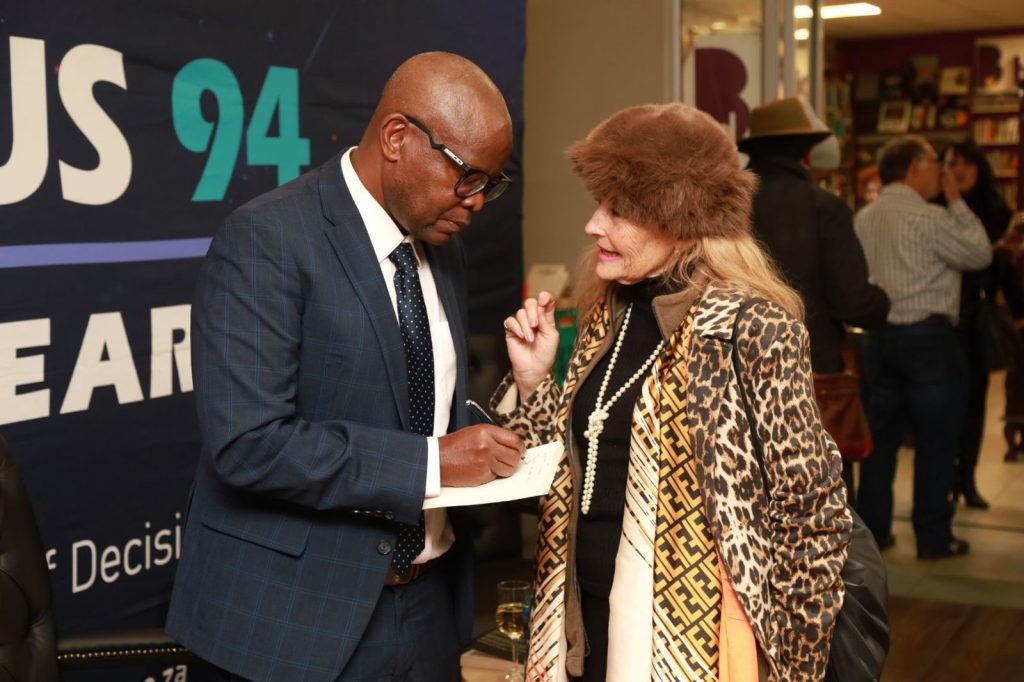
Opportunities for Africa
Saul Molobi:
The book is not all doom and gloom.
Dr Sifiso Falala:
Ethiopia’s investment in renewable energy is impressive. Ethiopian Airlines has become a continental success story.
Ghana is making strides in fintech and technology.
Kenya is emerging as an innovation hub.
The next battle is not between Africans and non-Africans. It is between African winners and African victims.
African winners understand that hard work, competitiveness and excellence matter.
Africa has a young population, vast resources, talent and educational institutions. We can transform these assets into engines of growth.
However, those who seek progress may encounter resistance from those invested in victimhood narratives.
Despite the challenges, I remain optimistic. The continent’s future can be bright if we seize the opportunities before us.