

Saul Molobi: Good evening, dearest reader, and thank you for taking time to read this interview. I am Saul Molobi, Group CEO of Brandhill Africa™, and I have the distinct pleasure of interviewing Sello Lediga, the author of “Dodging the Civil War Bullet: Nelson Mandela and South Africa’s Transition from Apartheid to Democracy.” Sello, congratulations on the successful launch of your book at Constitution Hill. Can you share your thoughts on the event and its significance?
Sello Lediga: Thank you, Saul, and thank you to all who attended the launch of my book. It was a truly remarkable evening. The presence of more than 100 people, some of whom came from as far as Polokwane, speaks to the importance of the subject matter and the legacy of Nelson Mandela. The fact that we had individuals representing the entire political spectrum of South Africa, including Mr. Panyaza Lesufi, was an incredible testament to the book’s appeal and relevance in our society. An honour to have H.E. Baleka Mbete as a keynote speaker – she’s now chairing the non-partisan National Liberation Heritage Institute of South Africa.
Saul Molobi: Absolutely, it was a diverse and influential gathering. I also want to express our gratitude to the sponsors who made this event possible. The support from black women wine brand owners was truly remarkable. Can you tell us more about the sponsors and their contributions to the event?
Sello Lediga: Certainly, Saul. I want to extend my heartfelt thanks to our sponsors, especially these inspiring black women wine brand owners. Their support not only added an extra layer of sophistication to the event but also demonstrated the spirit of entrepreneurship and empowerment that is so essential in South Africa today. Lavo Wines, House of D’licacy, and Luc Mo Wines showcased their exceptional products, and their presence made the evening even more special.

Saul Molobi: That’s wonderful to hear, Sello. It’s worth mentioning the remarkable venue, Constitution Hill, for partnering with Brandhill Africa™ to host this event. Could you elaborate on the significance of this venue in the context of your book and the event?
Sello Lediga: Constitution Hill is a place of deep historical significance. It represents the transition from apartheid to democracy, which is the central theme of my book. The fact that this event took place at Constitution Hill was symbolic in itself. It allowed us to connect with our history, to reflect on the progress we’ve made, and to acknowledge the work that remains. I want to extend my sincere appreciation to Constitution Hill for being our partner in this endeavour.
Saul Molobi: Indeed, Sello, the choice of Constitution Hill as the venue was a brilliant one, and it added a layer of historical context and gravity to the event. Hearing H.E. Baleka Mbete, former deputy president of South Africa, address the audience there was truly memorable. Could you share your thoughts on her speech and its relevance to your book?
Sello Lediga: H.E. Baleka Mbete’s speech was truly inspiring. She brought a wealth of political insight and lived experience to the event. Her words resonated with the core themes of my book, and she reminded us of the sacrifices made during the struggle against apartheid, the role of women in the transition and the incredible journey to democracy led by figures like Nelson Mandela. Her presence and speech at Constitution Hill perfectly captured the essence of the evening and the historical significance of the location.
Saul Molobi: It was a powerful moment indeed. As we move forward, what’s next for “Dodging the Civil War Bullet”? How do you plan to continue the momentum generated by the book launch?
Sello Lediga: The book launch was a significant step in introducing the book to a wider audience, but it’s just the beginning of our journey. I’m excited to engage in a series of discussions and forums around the country to delve deeper into the book’s themes and their relevance in today’s South Africa. We also have plans for international promotion (also participating in a book fair in Botswana) as the story of Nelson Mandela and the transition from apartheid to democracy has a global resonance. I’m eager to see the impact of the book and how it contributes to ongoing discussions about our history and future.
Saul Molobi: Your dedication to spreading the message of reconciliation, unity and the remarkable journey of South Africa’s transition from apartheid to democracy is truly commendable. Given the interest generated by the book launch, do you have any plans for educational outreach or initiatives that can help bring these historical lessons to the younger generation?
Sello Lediga: Absolutely, Saul. It’s crucial that we pass on the lessons of our history, especially to the younger generation. This is what I emphasised in my conversation with Len Kalane at the launch and I’m glad the audience responded positively. I hope you as Brandhill Africa™ will forge discussions with educational institutions to develop programmes and materials that can be integrated into supplementary school curriculums. It’s important that our youth understand the sacrifices and struggles that brought about our democratic society. I also wish you could consider the possibility of a condensed version of the book that’s more accessible to young readers, which I believe could be an effective tool for sparking their interest in South Africa’s history.
Saul Molobi: That’s a fantastic initiative, Sello. The youth are the future and equipping them with the knowledge of their history is key to building a better future. Is there anything you’d like to share with the readers who couldn’t attend the book launch but are eager to get their hands on a copy of “Dodging the Civil War Bullet”?
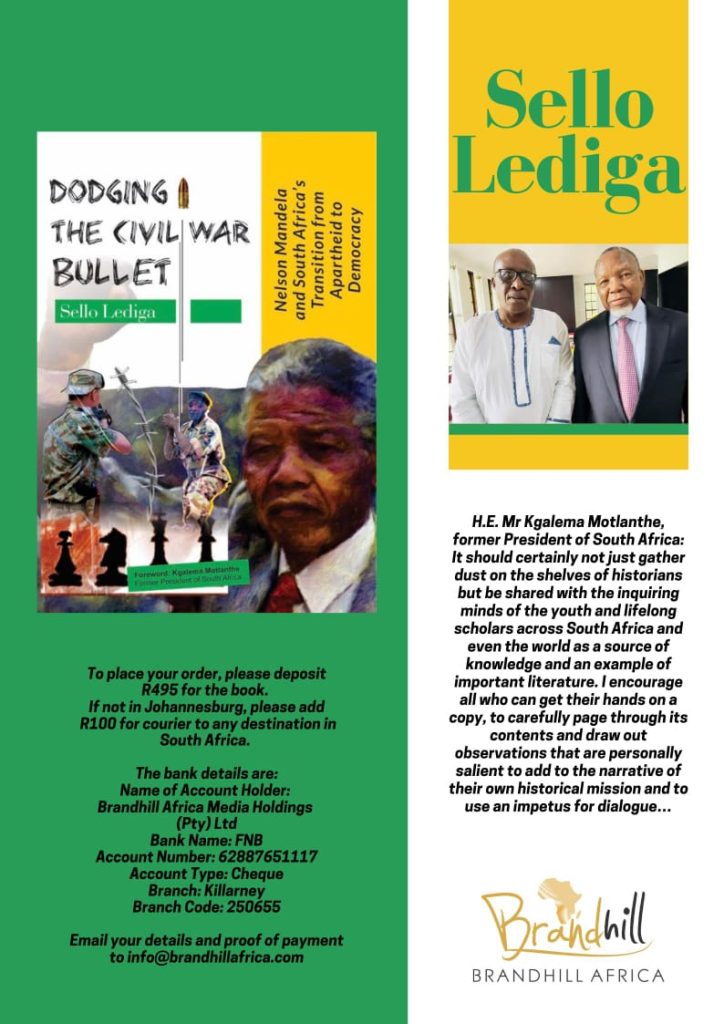
Sello Lediga: Certainly, Saul. To those who couldn’t make it to the launch, I want to express my heartfelt gratitude for your interest in the book. “Dodging the Civil War Bullet” is available at a selection of bookstores across the country, online platforms and directly from Brandhill Africa™ (https://www.brandhillafrica.com). I encourage everyone to explore the pages of the book, learn from our past, and engage in discussions about the future of our beloved South Africa. The story of our transition to democracy is one that needs to be heard by all, and I hope the book can be a valuable resource for understanding our journey.
Saul Molobi: Sello, before we conclude, I’d like to ask you about your personal journey in writing this book. Could you share some of the challenges and memorable moments you experienced while researching and writing “Dodging the Civil War Bullet”?
Sello Lediga: Of course, Saul. Writing this book was a deeply personal and challenging journey. The research involved delving into South Africa’s complex history, and at times, it was emotionally taxing to revisit the struggles and sacrifices of those who fought for freedom. I visited Katlehong which was at one stage a site of fierce battles between the ANC and Inkatha Freedom Party supporters. However, it was also an incredibly rewarding experience. One of the most memorable moments was when I had the opportunity to interview some of the individuals who were directly involved in the anti-apartheid struggle and those who defended the system. Their stories and insights were invaluable, and they helped me to truly understand the courage and determination that drove the movement. By the way, let’s not forget I was an anti-apartheid activist too – I have experience of being detained without trial. The journey of writing this book is eloquently captured in my “Introduction” to it.
Saul Molobi: That sounds like an emotionally charged yet rewarding process, Sello. Your dedication to preserving these stories is admirable. As we wrap up, is there a message or a key takeaway you’d like to leave with the readers of your book, something they should carry forward from the stories and lessons in “Dodging the Civil War Bullet“?
Sello Lediga: The central message I hope readers take away from “Dodging the Civil War Bullet” is that change is possible, even in the face of seemingly insurmountable challenges. South Africa’s journey from apartheid to democracy is a testament to the power of unity, forgiveness, and perseverance. I want readers to be inspired by the past and to use those lessons to contribute to a brighter, more inclusive future. As Nelson Mandela said, “It always seems impossible until it’s done.” We can achieve greatness when we work together, just as we did in the struggle against apartheid.
Saul Molobi: Those are powerful words to conclude our conversation, Sello. Thank you once again for your valuable insights, and I wish you every success with your book and your future endeavours. It’s been a privilege to speak with you today.
***
Saul Molobi’s latest book is “De/constructing brand Africa: A Practitioner’s Perspective”…