
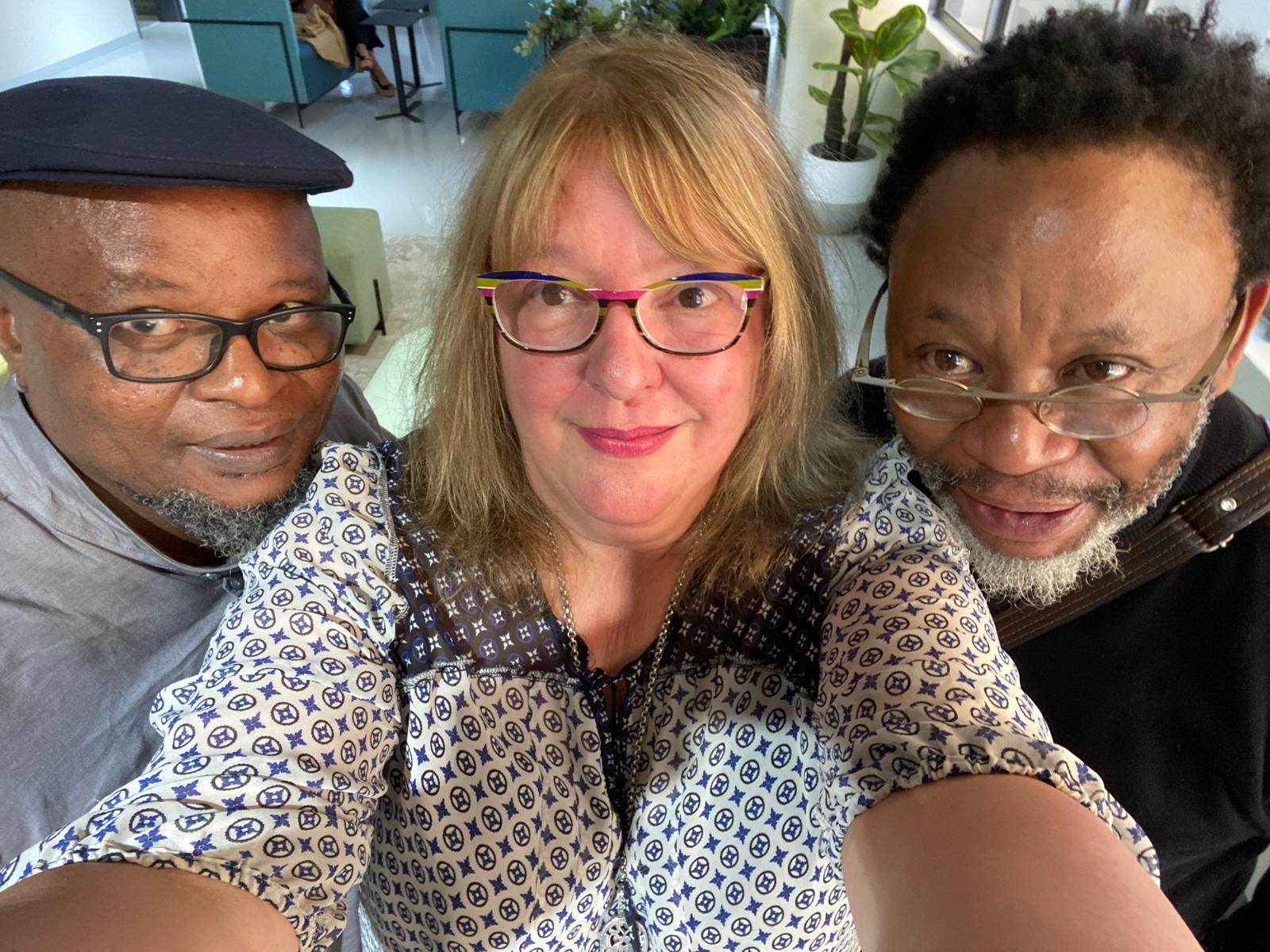
This is the transcript from last week’s Sunday conversation between Saul Molobi, presenter on 101.9 Chai FM’s “Sunset Serenade” on Sundays (17:00 to 20:00); London-based South African jazz musician, Estelle Kokot; and author, Leslie Dikeni, who will soon publish a book, “Music Agency and Power”.
Saul Molobi:
Good evening, dear listener. You’re tuned into 101.9 Chai FM, and this is Sunset Serenade — your companion on this soulful three-hour journey of jazz and poetry. My name is Saul Molobi and tonight promises to be a special one.
As I mentioned earlier, we’re joined in the studio by two distinguished guests. From the UK, we welcome the phenomenal jazz vocalist and pianist Estelle Kokot, whose music has become a familiar presence on this show. I’ve played her songs countless times, and tonight, it’s an honour to finally have her live with us. She was recently in South Africa, performing in Melville to great acclaim.
Joining us too is someone whose name should ring a bell — the esteemed writer, researcher and cultural thinker, Leslie Dikeni. He’s been working on a deeply analytical book exploring the relationship between music, agency, and power. He’ll lead much of our conversation tonight, as this is not just an interview — it’s a dialogue among kindred spirits, bound by our shared love for jazz and storytelling.
Estelle, a warm welcome to Sunset Serenade.
Estelle Kokot:
Hello Saul, hello Leslie — it’s an absolute pleasure to be here. Thank you for having me.
Leslie Dikeni:
Welcome back home, Estelle. I must say, I was at your show in Melville, and it was an unforgettable performance. Some of what we’ll talk about today will certainly draw from that experience.
Saul Molobi:
Leslie, the floor is yours.
Leslie Dikeni:
Thank you, Saul. It’s truly a pleasure to be in conversation with you both. Over the years of working on my book, I’ve had the privilege of interviewing a broad spectrum of artists — some of whom, sadly, are no longer with us. Among them are iconic figures like Brenda Fassie and Lulu Dikana. Just yesterday, I completed an interview with Nicole.
A question that keeps emerging in these conversations — and one I think is timely tonight — is about the authenticity of jazz. And Estelle, whether you define yourself as a jazz artist or not, I think this question resonates with your experience and your artistry.
Let me frame it with some context. In the mid-1980s, particularly around 1985, South Africa was in political turmoil. The country was under a State of Emergency. Amidst the oppression, music persisted — it became a form of both resistance and survival. Pop music, particularly Brenda Fassie’s Weekend Special, was everywhere — commercially successful, culturally significant.
At the same time, jazz musicians like Winston Mankunku were creating deeply political work — songs like Jika, which encouraged people to move to Khayelitsha as part of a broader message of defiance and dignity. That song was banned, and Mankunku had to leave the country, performing it later in exile alongside fellow musicians in London.
So, my question is this: What defines the authenticity of jazz in such a politically charged landscape? Why does pop music seem to receive more institutional recognition and reverence than jazz?
Estelle Kokot:
That’s such an important question, Leslie, and I’d love to share something here. Do you remember the band Rush Hour and our song The Perfect Way? That was me. We were signed to Gallo too, and they created a special label just for us — it was called uMkhonto. It’s a long story, but significant.
Brenda Fassie and I were contemporaries — we even shared stages. I only met her once, at the OK TV Awards. We were both nominated. I remember meeting her at the basin in the ladies’ room — she gave me a big, warm hug and said, “I love your music so much.” I told her, “I love your music just as much.” It was a beautiful moment of mutual recognition — two artists from different worlds but deeply connected.
Victor Ntoni once told me, when we were working together in Pambili, that if Brenda had turned to jazz, she would’ve wiped the floor with everyone. That stayed with me.
Leslie Dikeni:
Exactly. That’s the moment I’m trying to reflect on. In that same era, while Brenda’s Weekend Special was playing on every radio, protest anthems like Jika were being banned. Musicians like Mankunku were forced into exile to share their truths abroad.
That contrast — between what is celebrated and what is silenced — raises big questions about authenticity, politics, and the role of jazz in society.
Estelle Kokot:
It does. And unfortunately, it often comes down to visibility and commercial success. The more records you sell, the more the industry — and society — pays attention. People are drawn to what they perceive as success, and success is mostly measured in money, not in creative or artistic impact.
Take my recent show in Melville — it was a door deal. I had no idea what I’d be paid. But that wasn’t the point. The room was filled with warmth, love, and presence. People came to listen — really listen. That, for me, is everything.
When I talk about authenticity, I’m talking about living in the moment — improvising with what’s in front of you. Even if a note on the piano is off, you make it work. You harmonise with the imperfection. That’s jazz.
Saul Molobi:
And your performance encapsulated the very essence of what Sunset Serenade stands for. We often begin the show with a poem, exploring the intersection between poetry and jazz. So, when I heard you performing Eugene Skeef’s poetry, it moved me deeply. We once dedicated an entire episode of this show to Eugene — like you, he’s one of our great cultural ambassadors abroad.
Estelle Kokot:
That’s a huge honour, Saul. Thank you.
Leslie Dikeni:
You collaborate closely with Eugene, don’t you?
Estelle Kokot:
Yes, we’ve been working together since 2020. It’s a very organic process. He’ll write a poem, and I won’t even read it in advance. I’ll just photograph it, transfer it to my computer, and then improvise — recording a voice note on WhatsApp. There’s a connection between us that defies logic.
Despite our different backgrounds — me from a deep Afrikaans heritage and Eugene from KwaZulu-Natal — our creative energies align powerfully.
Leslie Dikeni:
You performed a powerful piece dedicated to victims of violence. It reminded me of Jennifer Ferguson in the 80s. Her courage, her artistry — that’s what came to mind. Are the two of you connected?
Estelle Kokot:
We’re admirers of each other’s craft, even though we’re in different parts of the world now — she’s in Sweden, I’m in London. But yes, that poem hit me hard. It’s universal. Eugene has that gift — he writes something specific, but it resonates broadly.
Leslie Dikeni:
People often label such music as “protest music.” But I think it’s about context. We’re not protesting — we’re telling the truth of our times.
Estelle Kokot:
Absolutely. Victor Ntoni once said something that changed my life. Backstage at Kippies, I joined in on a political discussion. He pulled me aside and said, “Estelle, forget the politics. Get up on that stage and do what you do — that’s your power.” I was 25, and it’s still the best advice I’ve ever received.
Saul Molobi:
Before we wrap, Estelle, could you share a message with our listeners — especially reflecting on your experience as a South African artist living in the UK?
Estelle Kokot:
Of course. It’s not easy being in the UK — especially for someone like me, who’s constantly absorbing the world. The jazz scene is vibrant, but also cliquey. I often feel like an outsider, even after living there for most of my life.
But I do what I can to be a bridge. Sebastian Scotney from UK Jazz News once called me a cultural ambassador — I’ve embraced that. I’ve brought South African jazz albums to London, introduced people to artists like Herbie Tsoaeli and Kevin Gibson.
To your listeners — thank you for lending us your ears. South African jazz is a force of creativity that the world needs to hear. It’s underexposed and underappreciated globally. Let’s change that.
Saul Molobi:
Leslie, your closing thoughts?
Leslie Dikeni:
Music is a spiritual force. It moves us, cleanses us, makes us think and rethink. Jazz has played a transformative role in this country. Estelle’s presence here reminds us of that. I urge our listeners to keep listening, to stay curious, and to see their own souls reflected in the music.
Estelle Kokot:
One last story — years ago, I turned down a gig at Ronnie Scott’s to perform at the National Arts Festival in Grahamstown. People thought I was mad. But I don’t regret it. The performance was electric — the kind where something unexplainable takes over. I’m just grateful I get to be a vessel for this music.
Saul Molobi:
Time is never on our side, but what an enriching conversation. Dear listener, I’ve already played three of Estelle’s tracks tonight — and I’ve still got two more to go. She’s our Artist of the Week, and we’re giving her the spotlight she deserves.
Estelle, where can people access your music?
Estelle Kokot:
Right now, all my albums are available on Bandcamp. I’ll be uploading some beautifully recorded demo tracks there too — so look out for those.
Saul Molobi:
And your social media handles?
Estelle Kokot:
On Instagram, I’m @Estelle_Kokot. I’ve left X — too much drama and shadow-banning. I’m on Facebook — just search my name. Most of my posts are public. I’ve got nothing to hide.
Saul Molobi:
Thank you, Estelle. Thank you, Leslie. And to all our listeners — thank you for sharing this space with us tonight. This is Sunset Serenade on 101.9 Chai FM. Stay with us.