
By Saul Molobi
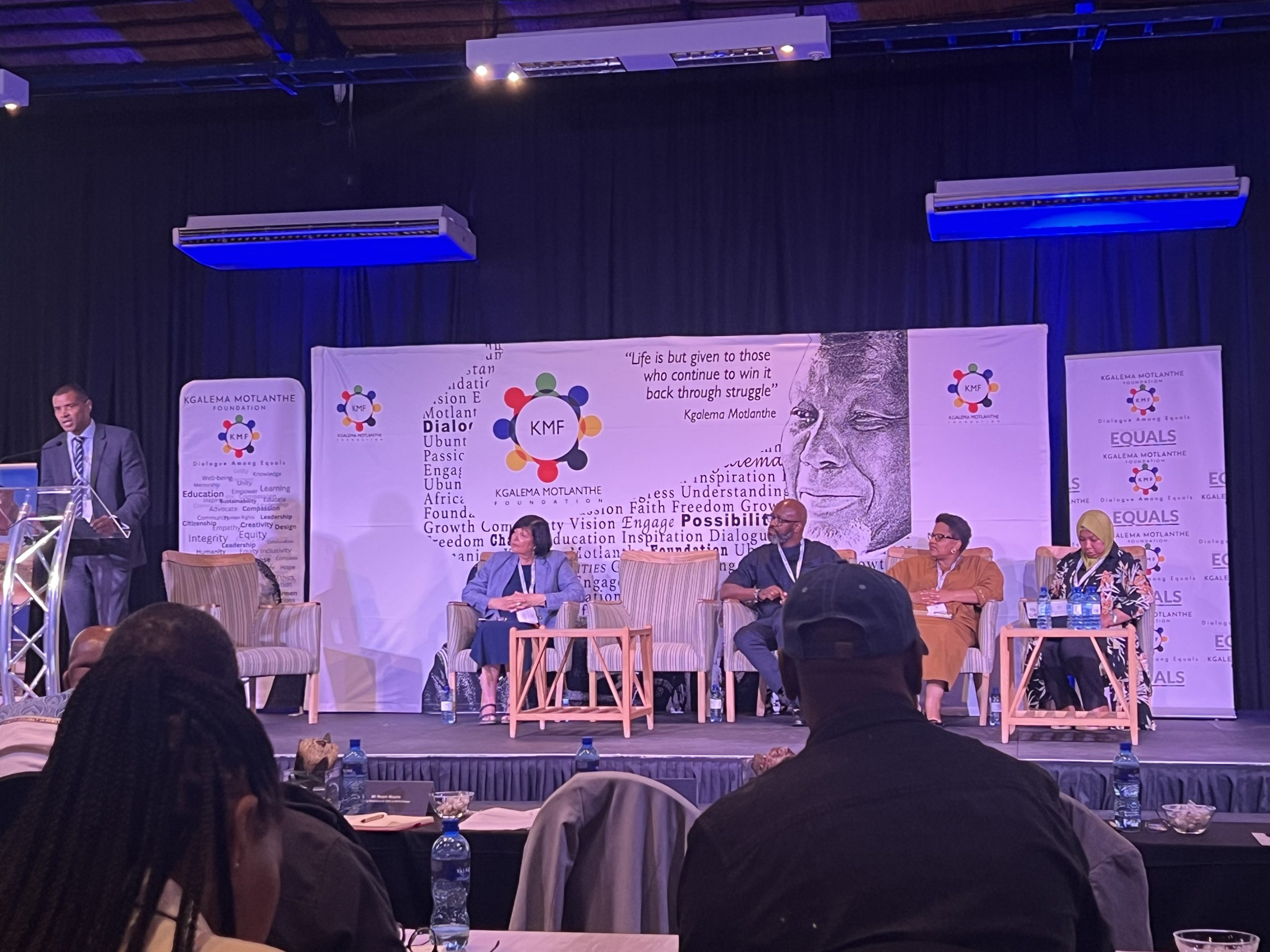
The morning of Day Two at the Drakensberg Growth Summit 2025, hosted by the Kgalema Motlanthe Foundation at the Champagne Sports Resort, opened with a renewed sense of focus and resolve. After a first day defined by deep reflection on South Africa’s political economy and its place in a shifting world, the second day dawned with practical urgency: how do we move from insight to implementation, from rhetoric to reconstruction?
Against the tranquil majesty of the Drakensberg mountains, the morning plenary convened ministers, financiers, business leaders, and labour representatives to confront a single, unifying imperative — to rebuild South Africa’s development architecture through infrastructure, innovation, and inclusion.
It was no longer about who should lead change, but how all sectors could collaborate to deliver it.

Barbara Creecy: Infrastructure as the Script for Renewal
Transport Minister Barbara Creecy provided the day’s most tangible roadmap. With characteristic precision, she outlined six concrete metrics for South Africa’s recovery: by 2029, the nation must move 250 million tons of freight, carry 600 million passengers, and reduce road fatalities by 45%.
Her analysis was candid. The country’s transport arteries — ports, railways, and roads — had been constricted by underinvestment, vandalism, and bureaucratic fragmentation. “The collapse of our freight and logistics network,” she observed, “has become one of the biggest drags on growth.”
Yet she rejected despair. Her tone was pragmatic, calling for public–private cooperation without privatisation — a partnership that restores capacity rather than replaces it. She cited encouraging progress: port efficiency improving, commuter rail lines reopening, and new private freight operators entering the market.
Creecy’s refrain, echoing like an old proverb, lingered in the hall: “The best time to plant a tree was 20 years ago; the second best time is now.”
Jim Hodges: Development Finance as a Catalyst for Change
Jim Hodges, Head of the European Investment Bank (EIB) for Southern Africa, followed with a global perspective rooted in human experience. Recalling his childhood walks to school on a road built with development finance, he reminded delegates that infrastructure is not merely an economic asset but a human enabler.
Tracing the EIB’s evolution from post-war reconstruction to climate-aligned growth, Hodges underscored the role of development finance institutions (DFIs) as “partners in patience.” They invest in what the market often ignores — green energy, inclusive cities, and digital ecosystems.
“DFIs don’t compete with markets,” he said. “We build them.” His words carried a gentle admonition: short-term politics and quarterly capitalism must yield to decadal thinking. “Our success is not measured by how much we lend,” he concluded, “but by how much we mobilise.”

Boitumelo Mosako: DBSA’s Blueprint for Institutional Resilience
Boitumelo Mosako, CEO of the Development Bank of Southern Africa (DBSA), embodied the power of disciplined governance. Despite fiscal austerity and leadership transitions, the DBSA has tripled its retained earnings since 2015 and nearly doubled its balance sheet.
“Strong governance,” she declared, “isn’t a slogan — it’s a source of investor confidence.”
From rebuilding Parliament to financing hospitals, schools, and municipal infrastructure, the DBSA has positioned itself as a technical partner to the state — quietly rebuilding capability where it has eroded. Mosako reaffirmed her pan-African commitment: “Africa’s $155 billion annual infrastructure gap is not a crisis — it’s an opportunity waiting for bold, coordinated leadership.”
Her clarity reflected both moral conviction and managerial competence — a combination too rare in our public institutions.

Ralph Mupita: The Digital Revolution and Africa’s Future
Ralph Mupita, Group President and CEO of MTN, delivered what felt like a manifesto for the continent’s digital awakening. “We are living in years where centuries happen,” he said, invoking the velocity of technological change.
Framing Artificial Intelligence (AI) as the defining force of the era, Mupita warned that Africa risks becoming a digital underclass if it remains passive. While the US and China pour hundreds of billions into AI ecosystems, the entire African continent attracts barely 1% of global investment.
“The AI revolution will not wait for us,” he cautioned. “Without energy, data infrastructure, and skills, we will be spectators in a world written by others.”
Yet his tone was not fatalistic — it was visionary. He set out five imperatives: energy access, digital infrastructure, language inclusion, youth skills development, and public–private partnerships.
“AI should empower our people, not replace them,” Mupita concluded, his words blending corporate foresight with civic responsibility. It was a call for Africa to write its own algorithm for the future.

Rifta Ajams: Workers at the Heart of Human Development
The morning’s final voice, Rifta Ajams, General Secretary of FEDUSA, grounded the high-level discussions in human reality. Her words struck a moral chord that resonated deeply: “Development without dignity is not development.”
She spoke of the emotional and psychological toll of modern work, where the promise of technology has often yielded precarity instead of progress. Behind every spreadsheet and app, she reminded the audience, stands a worker — invisible, exhausted, but indispensable.
Ajams championed the International Labour Organization’s proposed convention on decent work in the platform economy, urging South Africa to modernise its labour laws for the digital century. “We must build a social compact,” she insisted, “where protections follow workers — not jobs.”
Her message was unmistakable: economic reform must never outpace social justice.
From Reflection to Reconstruction
The Day Two morning plenary of the Drakensberg Growth Summit crystallised a national truth: that South Africa’s renewal will depend not on slogans or sentiment, but on execution, empathy, and ethical leadership.
From Creecy’s infrastructural realism to Mupita’s digital foresight, from Mosako’s fiscal discipline to Ajams’s moral labour vision — each voice pointed toward the same horizon: a country that works, because its people work together.
In the calm majesty of the Drakensberg, that idea no longer felt abstract. It felt like a promise taking shape — a shared project of rebuilding, one partnership at a time.