
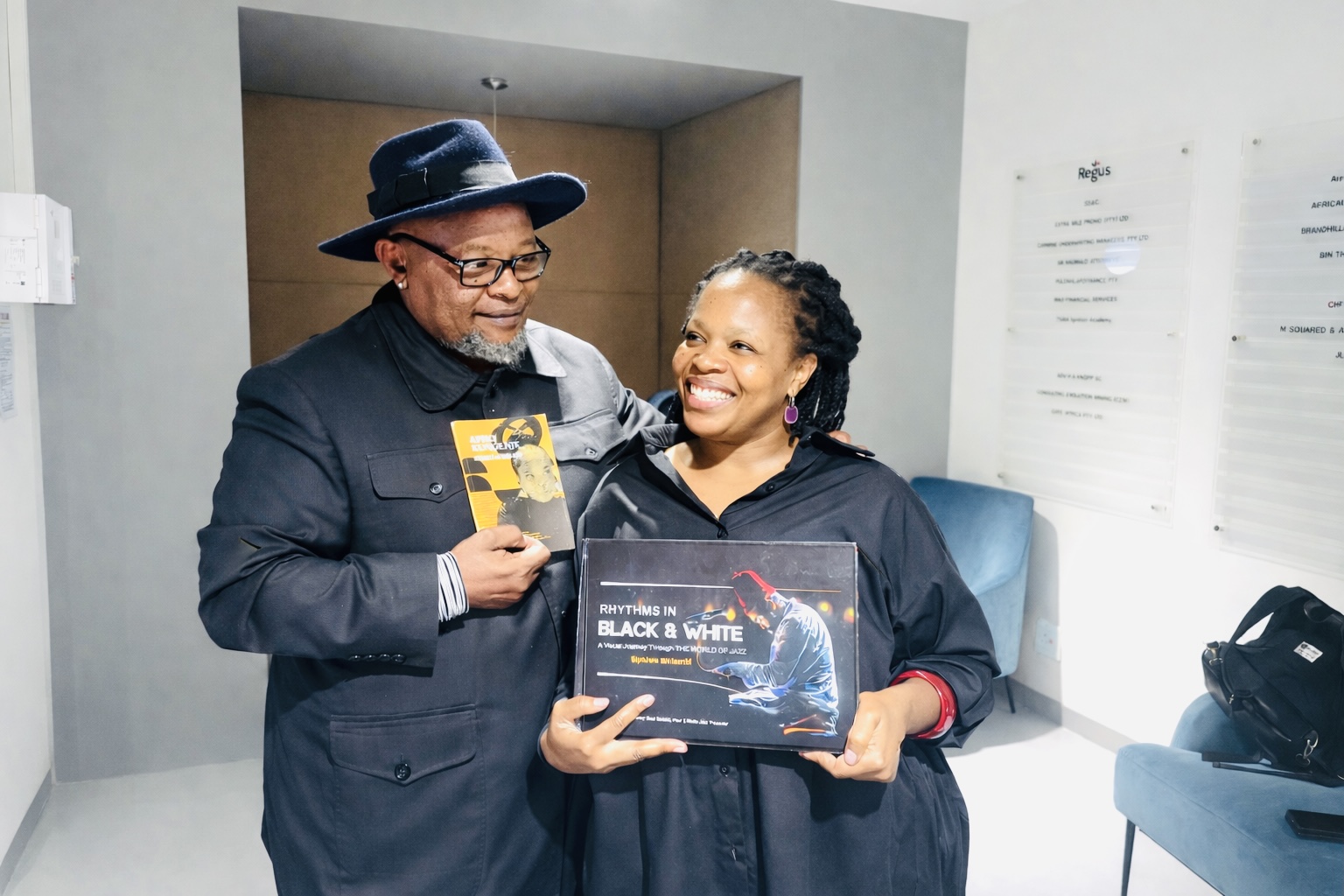
Yesterday’s Saul Molobi’s interview with Ncesh Nonxishi, Sunset Serenade’s Artist of the Week, offers an intimate entry point into the mind of an artist whose music and poetry are deeply attuned to history, identity, and the unfinished project of restoration. In speaking about her journey, her songwriting, and the stories that shape her work, this conversation extends the evening’s theme beyond the music itself, affirming art as a living archive — one that remembers, questions, and ultimately reimagines what dignity sounds like in the present. She will be performing at the Newtown Jazz and Heritage Festival end January…
Saul Molobi
You have tuned into 101.9 Chai FM to listen to “Sunset Serenade”, a three-hour journey of deconstructing jazz music.
My name is Saul Molobi, I’m hosting a very brilliant artist. Her name is Ncesh Nonxishi.
I’m glad she’s here with us, and she’s going to share with us the aesthetics of her music. By the way, she’s also a very brilliant poet and a published author. So we will be talking about her album while also talking about her book that speaks to her musical work.
Hello, my sister, and welcome to Sunset Serenade.
Ncesh Nonxishi
Thank you so much for having me, Saul.
Saul Molobi
Yes, I’m going to do less talking today because I want our listeners to learn as much as possible about your music. It’s better for them to hear it from you as the artist.
Take us through your musical journey.
Ncesh Nonxishi
My musical journey begins in the environment that I grew up in, which is the Eastern Cape. I grew up between two locations: a village called Malcho and a township called Mdantsane. These were my formative years.
During that time, I was hearing music sung at imigidi – traditional ceremonies, and I was hearing music from church. I’m from the Church of God and Saints of Christ, which has a very important history in our country, linked to the Bulhoek Massacre in the early 20th century.
I wasn’t a soloist; I was singing in choirs like most people. But songwriting – because I’m more a songwriter than anything else—began in my late teens and early twenties.
I was a student at Rhodes University, and often I would be sitting in my journalism and politics classes and end up processing what I was learning by writing songs about it. I started attending open-mic sessions and writing songs about Sarah Baartman and about what I was observing in the world.
But I’m not extroverted, so the stage scared me. I moved away from performing and followed my career in journalism and media, working in broadcasting.
As I was about to turn 40, I realised that life is not forever. If I didn’t take charge and live out my purpose—performing the songs I write—I wouldn’t have fulfilled it.
That’s where my debut album “Apho Kungenje” comes from. It’s work written over a 15- to 20-year period, from my second year at varsity to 2024, when the album came out.
Saul Molobi
Translate the title for me. I usually say language isn’t that important when it comes to music, because music itself is a language, but I’m interested in knowing your title.
Ncesh Nonxishi
For me, it comes from a memory of an older sister or cousin—mostly a woman—being asked, “You’re looking so pretty, where are you going?”
To avoid people knowing their business, they would say apobungen, which means “I’m going wherever.”
For me, it represents a thread in my music: writing about things I observe in the world that I wish to change. When I say apobungen, I’m expressing a yearning for a different world—one where terrible things don’t happen.
A lot of my music is political, linked to my background in politics and journalism.
Saul Molobi
And by its nature, it’s political.
Ncesh Nonxishi
Yes, that’s where the title comes from.
Saul Molobi
Choose four songs from your album—the ones I’ll play tonight—and take us through what inspired each song and what you hope they’ll mean to listeners.
Ncesh Nonxishi
That’s a tough job, but I’ll try.
The first song is “Zhizo zizo”. I was on a work trip to Mapungubwe Hills for the first time. I knew about the Golden Rhino, but being there was deeply moving.
I realized how brilliant our people were, and I was enraged by how apartheid tried to hide that history. In the song, I grapple with pride, rage, and the question of what it means that we were once this brilliant, yet the world sees Black people differently today.
Saul Molobi
Mapungubwe was an 11th-century kingdom at the confluence of Botswana, Zimbabwe, and South Africa. When it disintegrated, one group moved into today’s Kruger National Park and another crossed the Limpopo to establish Great Zimbabwe. This speaks to Africa as the cradle of civilization.
Ncesh Nonxishi
The second song is “Ndinethemba uzobuya”. I wrote it because my family, like many others, has been affected by the drug crisis.
It’s a plea for someone to return to themselves. Addiction turns someone you know into someone else. The song means “I hope you will return.” It’s very painful, and many families are still dealing with this.
Saul Molobi
It’s part of my lived experience too.
Ncesh Nonxishi
The third song is “Lodo mhlada bada”, written in Isidobada, a playful language derived from isiXhosa that young girls often speak.
The song reflects a moment of doubt about the impact of music. I felt that sometimes songs feel like futile melodies, but eventually I arrive at the idea that without music, we are orphans. Music is how we heal.
Saul Molobi
I’m fascinated by this language. Someone really needs to research these languages so they don’t disappear.
Ncesh Nonxishi
I agree. Younger generations are losing African languages, and Isidobada depends on understanding isiXhosa. It’s disappearing.
The final song is “Kind Regards”. I wrote it after receiving a rude email from a boss. It’s fun, has a Latin vibe, and is written as an email response.
Saul Molobi
Let’s talk about the book accompanying the album.
Ncesh Nonxishi
The book, Apobungen: Lyrics and Essays, came from my love of CD liner notes. Digital music has erased those archives.
The book contains lyrics with English translations, acknowledgements, and photographs. It’s currently available wherever I appear.
Saul Molobi
We’ve lost that multi-disciplinary experience in the streaming era.
How do listeners find you on social media?
Ncesh Nonxishi
Across all platforms, I’m @NceshNonxishi — spelled N-C-E-S-H N-O-N-X-I-S-H-I.
I’ll be performing at the Newtown Jazz and Heritage Festival, playing music from Apobungen and beyond.
Saul Molobi
Your final message to our listeners?
Ncesh Nonxishi
I released my album and book in my early 40s and was recognized as Best Newcomer at the Mzantsi Jazz Awards.
Life really can begin at 40. If you have a dream, pursue it. I’d appreciate you listening to my music on all platforms.
Saul Molobi
Thank you very much. We close tonight with the fourth song.
Good night.
Ncesh Nonxishi
Good night. Thank you so much.