

By Dr Khulu Mbatha
*** IN THE PHOTO: In 2018, New York, USA, Dr Khulu Mbatha meeting Jesse Jackson after a business seminar ***
In American history, country preachers played a pivotal role as the backbone of rural churches. These individuals were not only spiritual guides but also community leaders, deeply embedded within their communities and offering steadfast support during both joyous and challenging times. Their preaching style was renowned for its simplicity, clarity, and power — rooted in applying faith to the everyday lives of ordinary people, which contributed to their widespread popularity.
Jesse Jackson, celebrated as a legendary country preacher, inherited this rich tradition from his mother, Helen Burns. Burns was an intelligent and musically gifted woman with strong moral values, who, as a young mother, instilled in Jesse a sense of purpose and resilience. She later married Charles Henry Jackson, further shaping Jesse’s upbringing.

*** Roberta Flack at the 53rd Birthday Party of Rev Jackson in October 1994, Washington DC ***
For black families growing up under apartheid, the arts became a source of solace, particularly for the youth following the prohibition of black political organisations. Music, both traditional and modern, held a special place, in part because it was integrated into the education system. Jazz music gained significant popularity, especially in black urban areas. In the late 1960s and early 1970s, a distinctive and compelling voice emerged, introducing a familiar jazz piece — originally recorded in 1967 — that became a rallying cry to mobilise African Americans. The powerful words resonated:
“Here we go
Like said before
There are times when …
There are times when things don’t lay
The way they’re supposed to lay
But regardless, you’re supposed to hold your head up high and walk tall
Walk tall!”

Recorded in October 1969 by Rev Jackson and the Cannonball Adderley Quintet as “Country Preacher” (LP/Vinyl) during a church meeting of the Chicago chapter of the SCLC’s Operation Breadbasket, the track remained at the top of the charts until 1970. This recording marked one of the most significant moments in Jackson’s life.
In another live recording of the same song in 1972 at the renowned Troubadour in Los Angeles, the message was reinforced with the words: ‘No matter how various situations are, no matter how difficult it may be, the storm really doesn’t matter, until the storm really gets you down. My advice to you and the message that Cannonball and the quintet bring to us is that when it’s rough and tough…Walk Tall!’
This message resonated deeply, whether one was alone, with family, friends or strangers. “Walk Tall’’ became a direct call not to give up, and the unique voice of Rev Jesse Jackson provided powerful inspiration. In my small Rockville matchbox (house) in Soweto, I was mesmerized!
While studying theology in Chicago, Jackson was influenced by his mentor, Dr Martin Luther King, at Boston University. After King’s assassination, Jackson, as a committed country preacher, became a transformative figure in the civil rights movement, offering hope and empowerment to African Americans. The recording “Country Preacher” symbolised both the zenith and conclusion of Operation Breadbasket — the economic programme initiated by the Southern Christian Leadership Conference in 1962 in Atlanta to boycott white-owned businesses that refused to employ African Americans or support their enterprises. The initiative ended in Chicago in 1972, after which Jackson went on to establish new, vibrant organisations, including the Rainbow Push Coalition.

*** Dr Khulu Mbatha and Roberta Flack at the 53rd Birthday Party of Rev Jackson in October 1994, Washingto DC ***
A Lasting Legacy and Personal Encounters
Julian “Cannonball” Adderley reflected on the cover of the 1969 recording (which I still have), noting: “When Dr Martin Luther King appointed Reverend Jesse Jackson to the post of National Director of Operation Breadbasket… am sure that he expected profound dynamic leadership. However, the success of Operation Breadbasket in just three short years must have exceeded his wildest dreams. The mother chapter in Chicago is supported by a variety of people from the broad social spectrum of the community – black, white, rich and poor – and has begun to revolutionize economic relationships in the black community. Certainly, a great part of this success is due to the moral validity of the cause, but the leadership of the young Reverend Jackson is probably most responsible… Our memorable visits to these meetings have precipitated the inspirational composition, ‘Country Preacher’, which is dedicated to Reverend Jackson (who often refers to himself that way) and the subsequent development of this album.”
Since the announcement of Rev Jackson’s passing, his profound impact and dedication to justice — both in the United States and internationally — have been widely discussed. I never imagined a personal meeting with this hero. Yes, Icame to appreciate Jackson’s contributions during the years of exile, finally meeting him in 1990. This encounter took place when Nelson Mandela, just two months after his release, attended the official international reception, “Nelson Mandela: An International Tribute for a Free South Africa,” a music concert held on 16 April 1990 at Wembley Stadium, London, broadcast across more than sixty countries.
That occasion remains etched in memory, not only for meeting Rev Jackson, but also for connecting with numerous artists and activists involved in the Anti-Apartheid movement — including Aswad, Daniel Lanois, Denzel Washington, George Duke, Jerry Dammers, Johnny Clegg, Lenny Henry, Little Steven, Manhattan Brothers, Neville Brothers, PattLabelle, Shikisha, Steven Van Zandt (Little Steven), Terence Trent D’Arby, Youssou N’Dour, among others.
Upon returning home, I found Rev Jackson to be a frequent visitor to his “second home,” South Africa. Through ongoing interactions, I learned about Jackson’s close relationship with Rev. C.L. Franklin and his family, especially Aretha Franklin. Jackson often recounted how Rev. C.L. Franklin and Rev. Albert Cleage, Jr., both prominent religious and civil rights leaders, organised the 1963 ‘Detroit Walk to Freedom’ march, which brought together over 125,000 people on Woodward Avenue in Detroit. The march peacefully championed racial equality and justice and featured Dr Martin Luther King, Jr. delivering an early version of his iconic ‘Have a Dream’ speech.
This background and friendship with the Franklin family led to Jackson’s appearances in some of Aretha Franklin’srecordings, including his introduction of Aretha and the Franklin sisters at the New Bethel Baptist Church in Detroit during live recordings in 1987. Aretha Franklin, renowned for her unwavering support of Rev. Martin Luther King from a young age, sometimes performed alongside King on gospel tours organised by her father. Ialso recall Jackson’s moving speech at Aretha’s funeral and celebration of her life in August 2018.
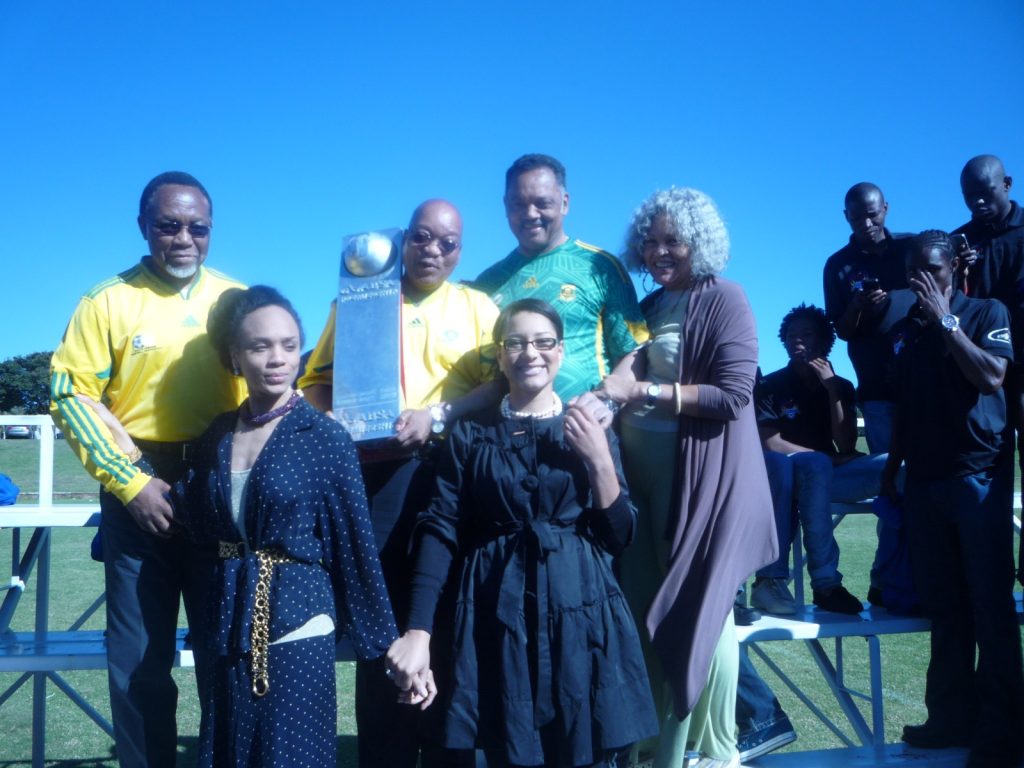
*** Jackson with President Zuma and Deputy President Motlanthe at the Union Buildings during a ‘FIFA Soccer Friday’ in 2010 ***
A Global Figure and Advocate for Justice
President Nelson Mandela gave his first official address to the United Nations in New York in September 1994. Following this, President Clinton hosted Mandela in Washington for his inaugural state visit, with Rev Jackson ever-present in the background. I recall joking with Zindzi Mandela and Ambassador Kingsley Makhubela about granting Jackson South African citizenship, as he was a constant presence at functions honouring Mandela’s visit to the US.
During their time in Washington, Iattended Rev Jackson’s 53rd birthday celebration with Parks Mankahlana (Mandela’s spokesperson), where we met the celebrated artist Roberta Flack, who performed a musical tribute.
Jesse Jackson’s commitment extended even further; he contributed to the campaign for South Africa to host the 2010 FIFA World Cup. In 2013, President Zuma honoured him with South Africa’s National Order of the Companions of O.R. Tambo in Silver, recognising Jackson for dedicating his life to challenging societies and governments to acknowledge the equality of all people and for his outstanding role in the struggle against apartheid.
The last meeting between Rev Jackson and me occurred after a business seminar in 2018 in New York.
Generations to come will remember that Rev. Jesse Jackson stood for them as well.
Hamba kahle Country Preacher, the People’s Reverend!
May His Soul Rest In Peace!