
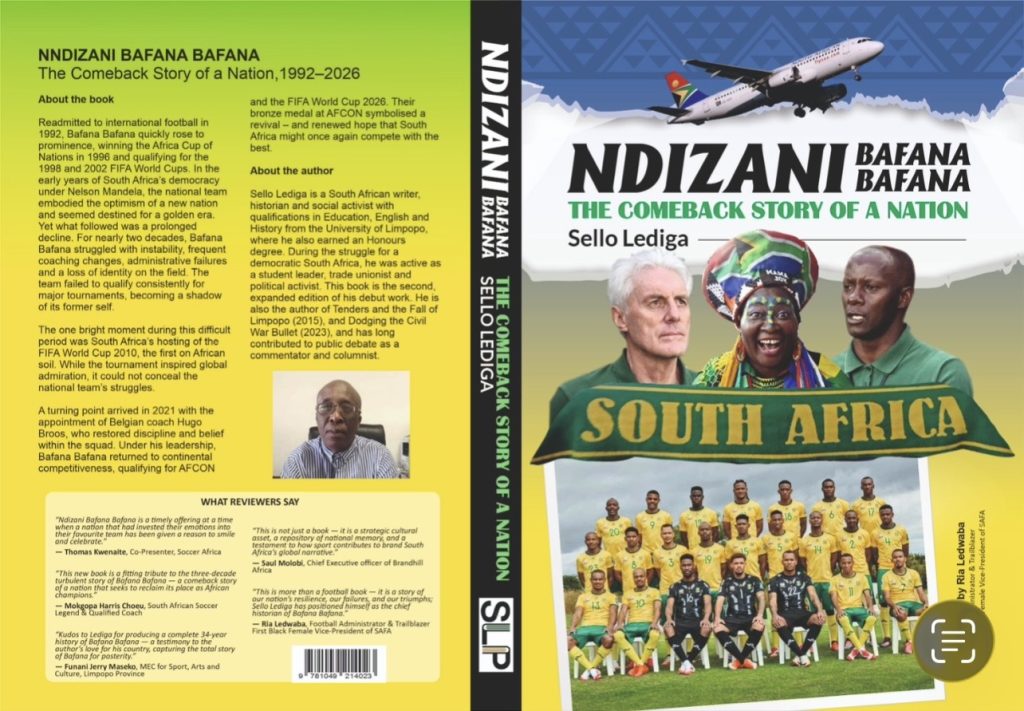
From humble beginnings in 1992, South Africa’s national senior football team, Bafana Bafana, have grown to become a significant player on the African continent in particular and the world in general. Winning the African championship in 1996, Bafana Bafana went on to qualify for the two consecutive World Cup tournaments in 1998 and 2002.
In an historic development, South Africa was appointed by FIFA as the first African country to host the FIFA World Cup in 2010 and executed the mission with distinction according to the world’s soccer federation. Although Bafana Bafana went through a rough spell in performance for two decades since 2002, the national team is back in business and dramatically reached the semi-finals of AFCON 2023 in Côte d’Ivoire.
After the 2023 AFCON excellent performance, Bafana Bafana followed that up by qualifying top-of-the group for both the 2025 Africa Cup of Nations hosted by Morocco and the FIFA 2026 World Cup to be hosted by Mexico, Canada and the USA. It is no coincidence that these two achievements happened under the leadership of the Belgian coach Hugo Broos. If there is any good example of renewal in South Africa, it is in the fortunes of the national team, Bafana Bafana.
As this book hits the market in March 2026, Bafana Bafana had just bombed out of the Group of 16 in Morocco 2025 AFCON tournament. For those who expected the national team to bring the African trophy home there is great disappointment. For those who were open minded and cautiously expected a good performance, it is time for critical reflection as boys prepare for “the greatest sporting spectacle on earth” in June 2026 when the Americas host the FIFA World Cup.
The fact is that AFCON 2025 is history and what counts is how South Africa prepares to accomplish in FIFA World Cup 2026 what it has failed to do in three previous world cup tournaments: to do well in the round robin and qualify for the knockout stage of the FIFA World Cup 2026. Should that happen, it will be a great and historic achievement indeed.
Precisely because the national team was knocked out in the early stages of the AFCON tournament 2025, old debates are resurfacing. The question as to whether South Africa needs a local or foreign coach is back on the table. In the last four years that Hugo Broos has been in charge of the national squad the matter had been off the table. It is only reckless adventurists who propose that Broos be removed as coach and be replaced by a local coach five months before the FIFA World Cup. This doesn’t make sense at all considering the fact that Broos has unequivocally stated that he will be retiring from football after the FIFA World Cup 2026. Simple logic dictates that the Belgian should be allowed to take Bafana Bafana to the world contest that he got them to qualify for.
What the nation should be seized with is who takes over Bafana Bafana after the departure of Hugo Broos later this year. The South African Football Association (SAFA), under the leadership of Danny Jordaan, should be leading the way. It is SAFA that should be initiating and leading a process that will protect the legacy of Broos. There is no doubt that the current Bafana Bafana team is playing good football but generally fails to convert many created chances into goals. Whichever head coach and technical team that replaces Broos and Helman Mkhalele should build on the strong foundation built by the pair and take Bafana Bafana’s standard to the next level. Whether the head coach is local or foreign is immaterial. The important thing is to appoint a capable and competent technical team that will take South Africa to the very top of African and global football.
South Africa has entered a stage where it must begin to define its unique and distinct style of football in the same way the likes of England, Brazil and Spain have done. No doubt this is a monumental task that requires exceptional leadership from SAFA in particular and other football stakeholders in general. A systematic, co-ordinated and transparent process of carrying out this task must be embarked upon. This is a kind of initiative that will take time to produce positive results and therefore require a determined leadership with a clear vision and programme of action.
If South Africa wants to go to the very top of world football, it must become a football-crazy nation that treats football as a religion. Every aspect of national life must have a football element in it. Football must be everywhere and played all the time in rural areas, urban areas, informal settlements, small towns and big cities. All our schools, colleges, universities and all other learning institutions must serve as football academies and produce male and female football stars throughout the country.
Finally, a national football indaba will be a good starting point, especially after the early exit in AFCON 2025. In fact, this is what SAFA and Broos have promised. The government of South Africa, led by the president, business, unions and civil society as a whole must be involved. Business and government in particular must make resources available to ensure that football infrastructure is not just second to none on the African continent but also world class. Football should be supported in the same way that rugby and cricket are currently supported.
Most importantly, those who run football in our country must be visionary, passionate, competent and ethical professionals in order to earn the trust of business and government as the primary providers of resources. The SAFA leadership, in particular, must be beyond reproach and win the confidence of the nation because, as John Maxwell declared in the opening line of this book’s “Foreword”: “Everything rises and falls on leadership”.
****
For more information, please contact Sello Lediga Publishers on email; call +27 72 574 6145; or their website.