
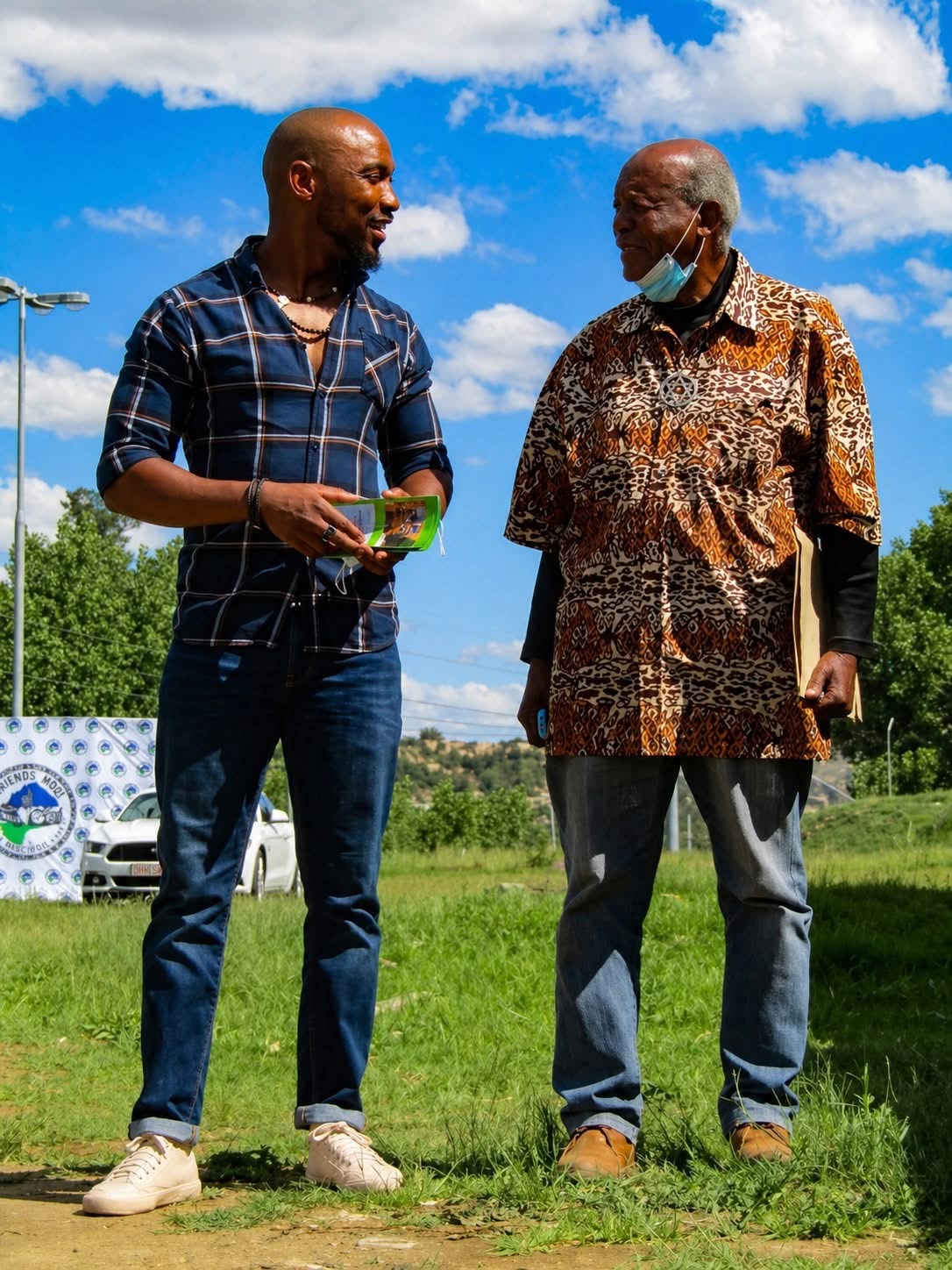
By Leoma Monaheng
(Headline Photo by Motho Oa Bohlokoa)
Some have called Ntate Meshu Mokitimi the Pablo Picasso of Africa – not necessarily for the veracity of his work, but for his conceptualisation of African artistic form, which he has come to popularise. I have met Ntate Meshu and, at times, found myself wondering: is this what it must have felt like to encounter the great artists of history – a Picasso, perhaps a Jackson Pollock, or a Rembrandt? But I soon catch myself. As a writer, philosopher, and Africanist, I have long resisted framing African greatness through Western parallels. I think of how I reject calling Mohlomi the Socrates of Clocolan. There is no one on this Earth like Ntate Meshu. There has never been a man like him. He is Meshu of Lesotho. The world should honour him entirely, in a league of his own.
It may be through our entrenched colonial inheritance that we, as Basotho, sometimes fail to recognise greatness unless it is framed in Western terms. But we should never grow complacent in the presence of what is truly inspiring.
In another chapter of my life, as a Project Coordinator, I had the privilege of hosting one of Lesotho’s most important literary figures, Selemeng Mokorosi – widely regarded as the first Mosotho woman to write and publish a compilation of poems in Sesotho, and among the earliest female African authors on the continent. Ntate Meshu was present at the event. Mme Selemeng, at the time, may have been a year older – perhaps 96 to Ntate Meshu’s 95. I remember them meeting for the first time. I remember her words, almost amused, almost disbelieving: “Oh, you are the Meshu… but you are so young!”
His story begins where many Basotho stories begin – in the fields, among cattle, hands in clay. At twelve, he was already doing more than moulding; he was interpreting. His figures carried proportion, intention – a kind of early authorship. It was at Masite that chance intervened.
A priest noticed. An Anglican sister tested him with something simple – a dove, painted white. That dove did not merely sit in a church window; it opened a door. It told a young boy that images were not distant things printed by machines – they could be summoned, shaped, made real by hand.
From there, his journey did not rise in a straight line. There was encouragement, but also dismissal. Art, however, had already settled within him – something internal, something that did not wait for applause.
South Africa sharpened him. Work, movement, survival – and then Boswell’s Circus, where his ability to sketch animals with striking accuracy found recognition. It was a fitting training ground: movement everywhere, form in motion, instinct under pressure.
Then came Ntsu Mokhehle, and with him, a widening of purpose. Through cartooning in Dukathole News and later publications, Meshu’s work began to speak politically, not just aesthetically. He was no longer only capturing what is seen, but also what is felt, what is contested.
In 1958, he travelled to Ghana to study at Achimota College. There, the intellectual climate shaped by Léopold Sédar Senghor and the philosophy of Négritude helped refine his artistic language. He encountered African sculptural traditions alongside European masters like Michelangelo, Rembrandt, and Vincent van Gogh – not as templates to imitate, but as references to engage and, where necessary, resist.
His life stretched outward across continents – India, Nepal, Israel, Italy, England, France, Nigeria, Brazil, and the United States. He stood among global artists at FESTAC, participated in the São Paulo Biennial, and later travelled through the United States with Operation Crossroads Africa.
It was during this time that he stayed with Miles Davis – an encounter that feels less like coincidence and more like alignment: two artists fluent in improvisation, in bending structure without losing essence.
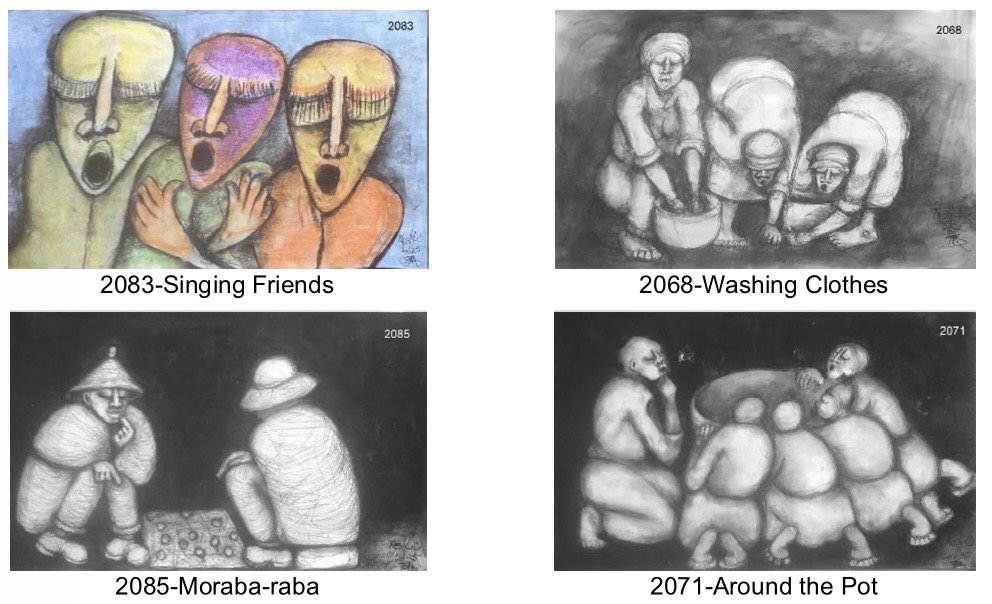
Across all this movement, one thing remained constant: he never left himself behind. His work stayed rooted in Basotho identity, layered with symbolism, distortion, humour, and spirituality. Often described as surreal or expressionist, his art resists easy categorisation. It does not ask to be understood quickly – it asks to be sat with.
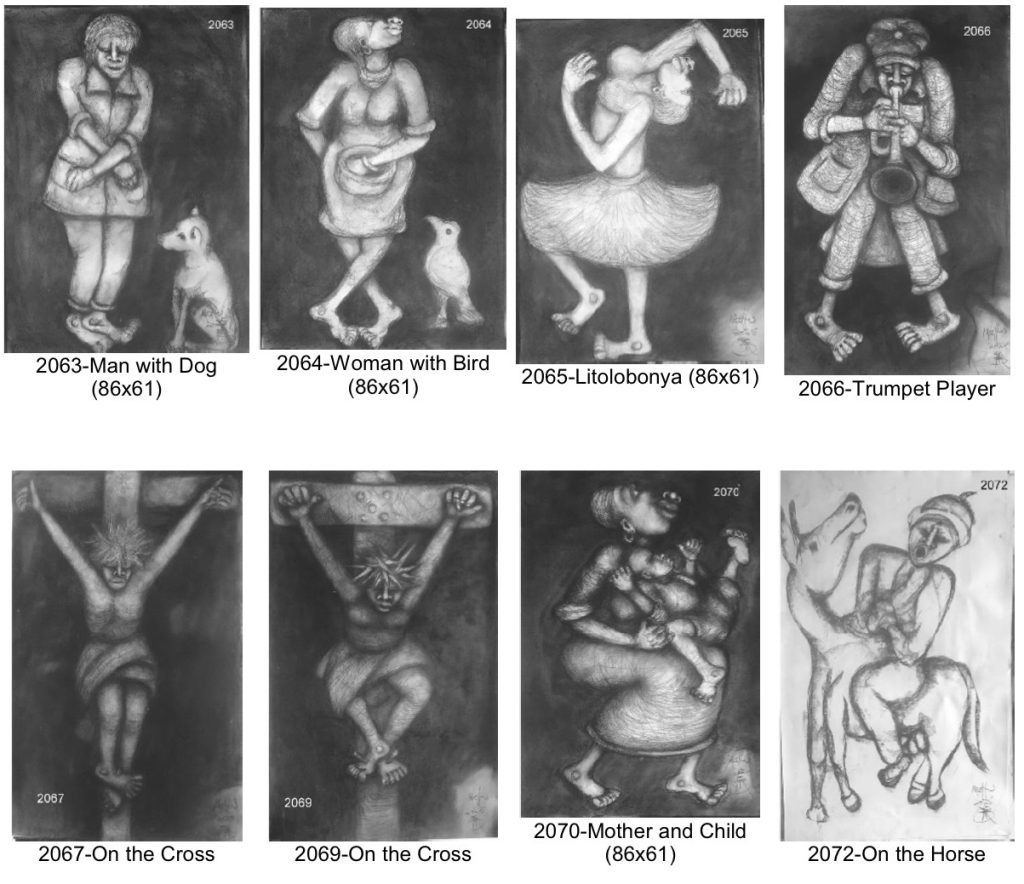
His works have travelled into embassies, museums, and private collections across Europe and America, quietly placing Basotho narratives within global spaces. He has received national recognition, including honours conferred by Letsie III, yet even these feel secondary to the true work of a life lived in creation.
Beyond canvas, he is also an author. His writings reflect on his journey, philosophy, and artistic evolution, offering another layer through which to understand the man behind the work. Those interested in his book, his art, or direct engagement can do so through his official platform:
And then, after all is said – hafter the travels, the exhibitions, the philosophies, the names and places – we arrive here:
Ntate Meshu Mokitimi is 100 years old. He has lived for half the time that our nation of Lesotho has existed. Even so, nothing quite prepares you for a meeting with him. At 100, he remains as excited about tomorrow – about life and artistic creation – as he might have been at 18. One can only envy such zeal for life.
In his lifetime, he has lived with arguably one of the greatest musicians of all time, Miles Davis, and perhaps even contributed to his artistic journey. His works live in museums around the world, most notably in the Smithsonian National Museum of African Art. His art, therefore, is not only representative of Lesotho, but of the African continent as a whole.
Many speak of a man only through his accolades and miss the deeper truth: he is one of the most notable artists in Southern Africa, with a gallery in his name in Maseru, with Bill Clinton among his patrons – and, some say, even Denzel Washington.
To me, Ntate Meshu has always intrigued me for his curious nature. In 2020, I hosted an event commemorating his life alongside that of Moss Nkofo of Sankomota and the great Mosotho novelist Thomas Mokopu Mofolo. What surprised me was not that, in his 90s, he was present – the word “youthful” might well be synonymous with Meshu – but that he would attend another event in his honour in a different district on the same day. I could not fathom the energy. At a third of his age, I felt tired just thinking of it. But not Meshu. The everlasting.
So, in his name, I offer this short biographical account – much of the early detail drawn from his official platform, but expanded through the many fragments of history that follow him like brushstrokes across continents.
To visit Meshu Mokitimi’s official site, click here. http://www.meshu.co.ls/
***
Leoma Monaheng is an African historian, international development practitioner and Fulbright scholar. He is also the recipient of the 2025 African Community Service Award. To follow him on Facebook, click here.