
South Africa is not left out from the impact of the information superhighway phenomenon, which is upon us in the world as the Fourth Industrial Revolution (4IR).
Even though the country has not yet replaced the traditional media platforms such as newspapers, television and radio, the norms of journalism practice have transitioned following the arrival of the social media revolution.
The consumption of news has changed, where a growing number of readers, viewers and listeners rely on social media to get the latest news from across the globe.
However, the reality on the ground is that access to digital technologies is still perceived in part as a luxury.
The majority of South Africans still do not have access to the long list of communication technologies that never existed in 1994. Now or never, South Africans deserve affordable, reliable and inclusive communication services.
The good news is that, it seems as if the government is now moving away from deliberating about Information Communication and Technology without action, writes Nthambeleni Gabara.
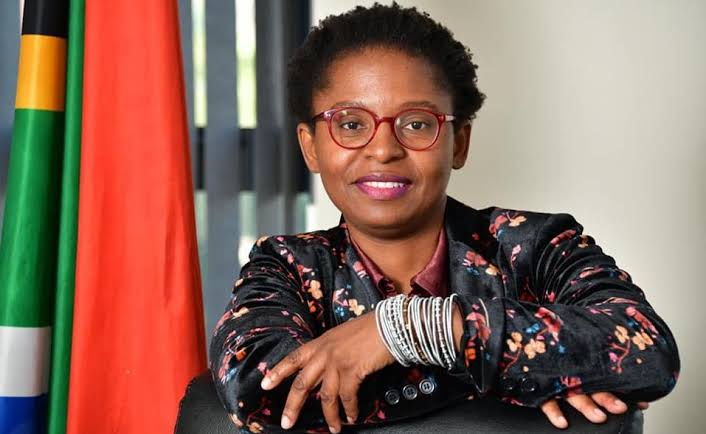
Yes, the desire to leapfrog South Africa grow digitally is alive. Communications and Digital Technologies Minister, Ms Khumbudzo Ntshavheni confirmed this during her opening remarks at the closing of the 7th BRICS Ministers of Communications recently.
“We acknowledge that the economy is moving into a predominately digital economy…as a result, the South African government has approved plans which we are now implementing with the view to fast track the much delayed Broadcast Digital Migration. We have set a target of completion by March 31, 2022 as part of freeing the much-needed spectrum, which should be allocated.
“The allocation of this spectrum is scheduled to be completed, equally, in March next year so that we could use multiple technologies to give internet access to our people as we set a target to connect all Africans,” she said.
The Minister added that they are considering a programme to fast track the connection of all South Africans to ensure that they all have access to internet connection within the next 24 months as part of responding to bridging the digital divide.
According to Ms Ntshavheni, access to high-speed internet connectivity will not only enable services, but will also open opportunities for applications and systems that are developed in the country and elsewhere in the world, promoting collaboration in the Africa Continental Free Trade Area (ACFTA) including in BRICS.
South Africa joined the important bloc of emerging economies-BRICS (Brazil, Russia, India, China and South Africa) in December 2010 in line with the country’s foreign policy to strengthen South-South relations.
To ensure that South Africa does not remain isolated from the rest of the world, Minister Ntshavheni said that urgent solutions with the view to grow the country’s economy and improve the lives of indigenous Africans are needed.
“The new economies are going to be digitally driven and therefore, it cannot be that only systems from other countries dominate, but systems from all our countries should share equal benefit. As BRICS, we have a responsibility to ensure that our respective countries and regions are not dominated by a particular region.
“We have a great opportunity to cooperate with each other to enhance each other’s technological developments and innovations. As we make sure that the free world and equally all society is not that which is dominated by a particular culture, but equally dominated by all cultures of the world and cultures of the BRICS bloc,” she said.
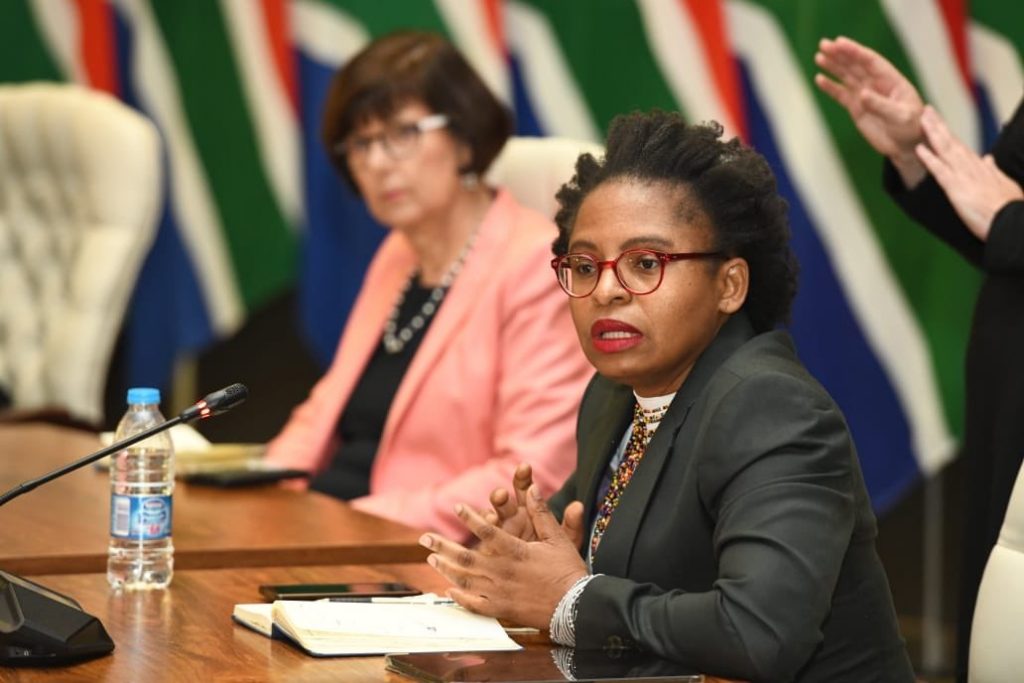
Minister Ntshavheni further said digital divide is one of the government priorities to end the unequal society across the socio-economic spectrum.
She also used the platform to announce that the government adopted the Digital Public Goods (DPGs) platform as a best practice, but also that the services, applications and systems that will be developed within South Africa and the African continent enjoy this benefit as well as be accessible throughout the world.
“I would like to reassure the commitment of South Africa and the African continent in the partnership that we enjoy in BRICS and full cooperation that the economic development of the future as we put our respective countries forward, will be of equal footing, solid partnership and relationship.
“As South Africa, we are committed to this relationship in BRICS and we will see a way on how we add value and how we significantly boost the economies of our countries.
“The innovations and developments from the BRICS bloc including the African continent in order to get a significant play in the new world of the digital economy,” she said.
According to Minister Ntshavheni, the COVID-19 pandemic has demonstrated the magnitude of the digital divide not only in South Africa, but in the developing world too and mainly in the African continent.
She said the digital divide has been evident during this pandemic period between those with access to connectivity and those with zero digital technology accessibility as basic services such as education, health, access to work and the ability to continue to operate one’s business in the event of small businesses.
The social media revolutions, which are part of the new digital transformation phenomenon, are not only addictive, but they also make it easy for people to stay in touch with friends, family and colleagues.
With the revolution in communication technologies public servants too are able to justify their salaries remotely. Before 2030, as a nation, perhaps we will proudly tell the world that indeed, we have successfully harnessed the digital revolution in our country.
****
Nthambeleni Gabara is one of the foremost thought leader on marketing and communications in South Africa’s public service.