
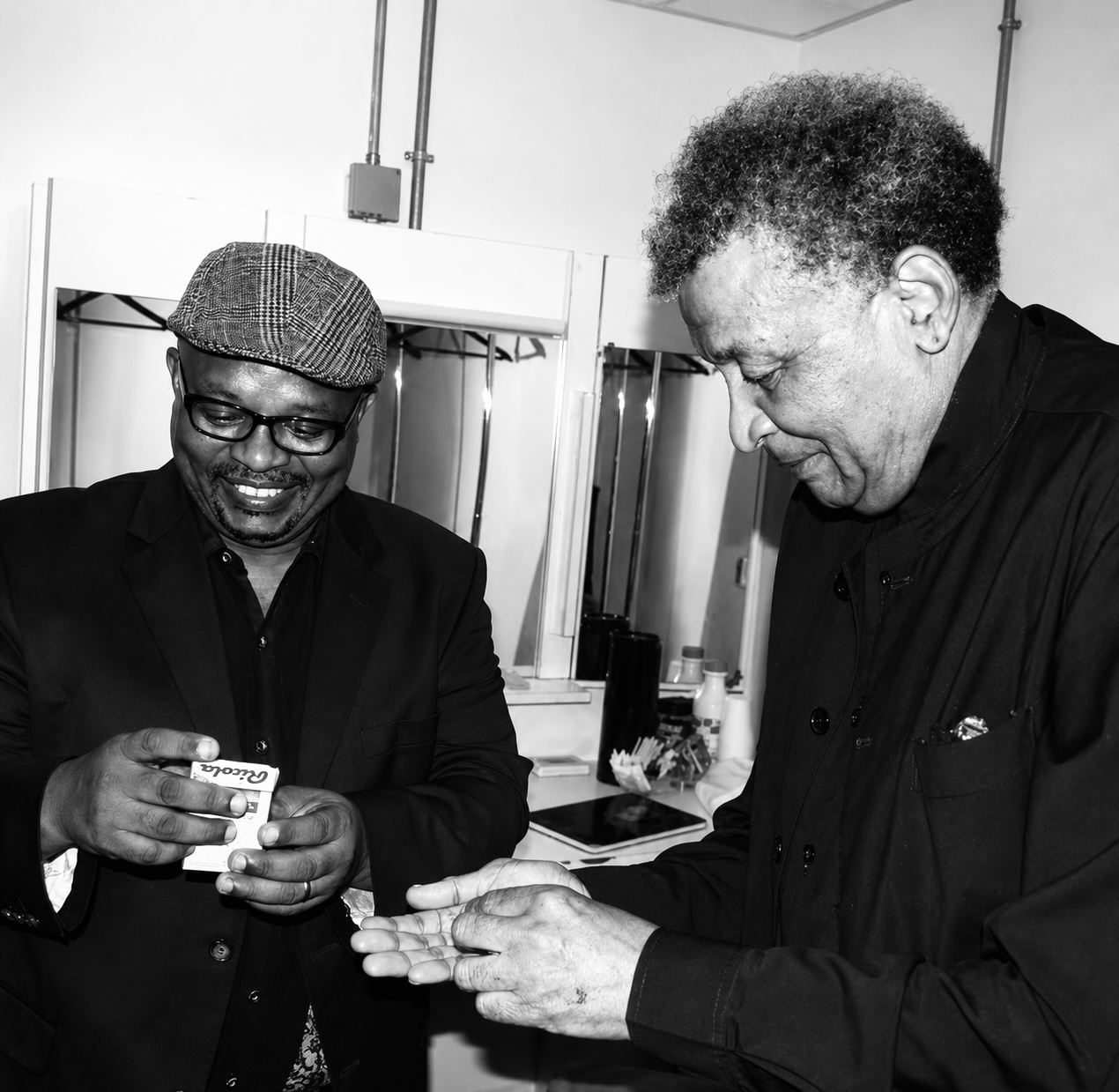
By Saul Molobi
Some artists entertain us. Some inspire us. A rare few become companions on our life’s journey, shaping the way we think, create, dream and understand the world. For me, Abdullah Ibrahim belonged to that rare category.
I grew up listening to him long before I understood the significance of his contribution to South African and global music. His records were played loudly by a neighbour whose sound system spared nobody in the neighbourhood. Whether we liked it or not, Ibrahim’s music became part of our daily existence. His melodies drifted over fences, through windows and into our homes. Looking back, I realise that what felt like an intrusion was, in fact, an early blessing.
Before television became a fixture in our homes, radio dramas captured our imagination. Many of those productions featured music that carried Ibrahim’s unmistakable signature. Long before I knew what jazz was, his music was already helping to shape my understanding of storytelling, emotion and atmosphere.
At university, as a member of the Society for the Appreciation of African Literature, Music and Art (SAALMA), I encountered his work anew. His compositions became more than music; they became an intellectual and cultural compass. We were young Africans seeking meaning in literature, politics, philosophy and art. Ibrahim’s music provided a soundtrack to those explorations. Through his piano, Africa seemed to speak directly to itself.
As a young journalist in Johannesburg, I spent many evenings in the city’s jazz clubs and cultural spaces. Jamesson’s, Kippies, Sof’town, Cotton Pub and Mega Music became classrooms of a different kind. Musicians routinely paid tribute to Abdullah Ibrahim by performing interpretations of his work. Even in his absence, his presence was everywhere. His influence could be heard in every piano phrase, every bass line and every attempt by younger musicians to locate themselves within the rich tradition he helped build.
At the time, my Hillbrow apartment resembled a music library. Vinyl records lined the shelves, and Ibrahim’s collection occupied a place of honour. His music accompanied me through countless writing assignments and deadlines. It stimulated my creativity, sharpened my imagination and taught me the value of silence, restraint and reflection. Like his compositions, good writing often depends as much on what is left unsaid as on what is expressed.
His influence extended beyond me. My artist flatmate, Selemogo Maleho, found in Ibrahim’s music a pathway into what I can only describe as spiritual realism. His paintings became conversations with ancestors, spirits and unseen worlds. Meanwhile, my cousin Setlhong Lebudi had the unenviable responsibility of maintaining order among two creatives whose minds were often somewhere between inspiration and madness.
Then came one of the most significant moments in South African history. The liberation movements were unbanned. Political leaders returned from prison and exile. The country was changing, and so too was the cultural landscape. Abdullah Ibrahim could finally return home and perform before the people who had carried his music in their hearts throughout his years abroad.
I was fortunate to cover one such performance at the Great Hall of the University of the Witwatersrand. It remains one of the most memorable concerts I have ever attended. He walked onto the stage and began with what appeared to be a karate meditation. There was no speech. No introduction. No attempt to explain himself. Then he sat at the piano and allowed his fingers to do the talking.
The article I wrote for Learn & Teach magazine afterwards carried the headline: “His fingers did the talking.”
Even today, I believe those words captured the essence of Abdullah Ibrahim. He never needed grand declarations. His music spoke eloquently enough.
Life later took me to Italy as South Africa’s Consul-General in Milan. Once again, Abdullah Ibrahim’s path crossed mine. Italy was one of his artistic playgrounds, and I had the privilege of hosting him during the Turin International Jazz Festival. What struck me most was not his stature as a global icon but his extraordinary humility. He spent time not only with diplomats and organisers but also with support staff and junior personnel. He treated everyone with the same dignity and respect.
The friendship continued in Milan. Following a freak motorbike accident, I attended one of his performances at the Blue Note on crutches after receiving an invitation from him. During that visit, I watched him reconnect with his old friend Mabel Kester. Together they reminisced about their Cape Town days. He also paid tribute to her late husband, the legendary soprano Joseph Gabriels, whose remarkable talent carried him from apartheid South Africa to international acclaim on Italian and American classical stages.
Those encounters revealed another side of Ibrahim. Beyond the music was a philosopher, a visionary and a custodian of indigenous knowledge. He shared with me his dreams for what he called his Seven Ms creative kingdom in Taung. He spoke passionately about the wisdom he had acquired from local elders and dingakasedupe. He had already acquired land for the project and envisioned it as a contribution to future generations – a place where creativity, culture and indigenous knowledge could flourish together.
Upon my return to South Africa after my diplomatic posting, our conversations continued. Joy of Jazz once again brought him to Johannesburg. He invited me to attend his performance and later join him and his band for dinner at the Park Hyatt in Rosebank. As always, our discussions ranged beyond music. We spoke about life, culture, spirituality, Africa and the future.
Each encounter left me richer. Each conversation taught me something new. Each meeting inspired me to become a better version of myself.
I regret missing what has been described as his farewell performance at the Cape Town International Jazz Festival in 2026. Yet technology has a way of narrowing distances. Through recordings viewed on a cellphone screen, I was able to witness moments of the performance and share in the celebration of an extraordinary life and career.
As South Africans reflect on the immense contribution of Abdullah Ibrahim, I am reminded that artists of his calibre never truly leave us. They transcend physical existence. Their work continues to shape future generations long after they have stepped away from the stage.
Ibrahim’s legacy is not confined to concert halls, recordings or awards. It lives in the imagination of writers, in the courage of artists, in the aspirations of young musicians and in the collective memory of a nation.
He lives among us through his legacy. He lives through us through the values and dreams he inspired. And he lives in us through the music that continues to accompany our journeys.
The man may have left the stage. But the song will never end.