
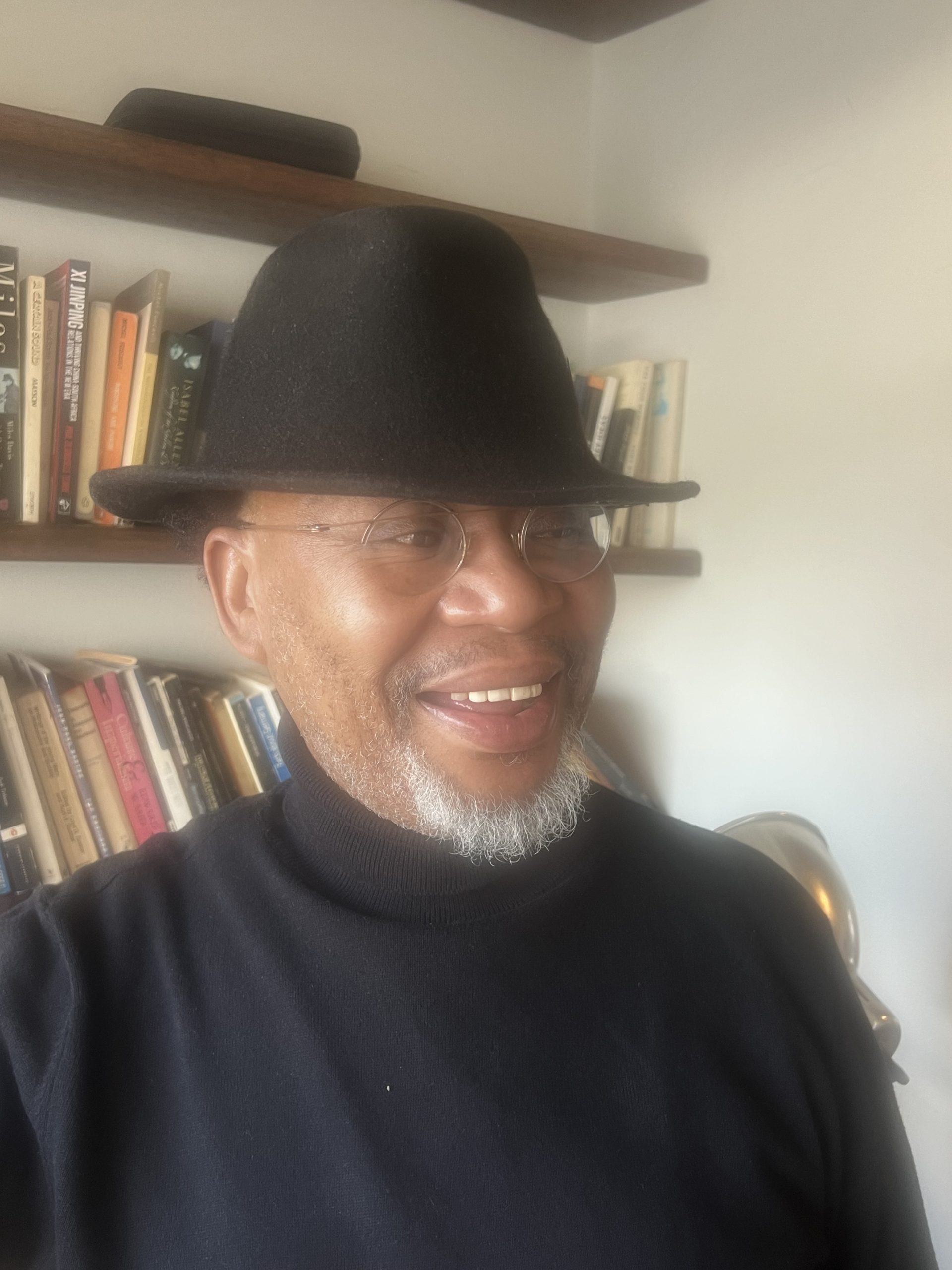
Saul Molobi
Good day Leslie, thank you for joining me. Congratulations on the e-book version of your latest book, “Jazz and I: Music Agency and Power”, having been published this Friday on Amazon and other online platforms.
Leslie Dikeni
Welcome, Saul, and thank you for having me.
Saul Molobi
I guess you’ll do most of the talking. I’m just asking questions, and yes, the space is yours. You should flow because our readers are dying to hear about this book that we’ve been talking about for years.
Leslie Dikeni
Thanks again for having me, and thanks for being a companion over the years during the final stages of writing the book. You have inspired me. You encouraged me, and I’m grateful. You are correct in your insertion when you started by saying that initially the book, as a project, started as “Jazz, Agency and Power”, but as I was doing the research, I then began to discover that it is impossible or unthinkable to study jazz as a musical art form without understanding other genres; since then, the research process itself tilted away from jazz and shifted the theme of the book and the focus of the study away from jazz only. Hence the new title, music agency and power. And indeed, that is what we are referring to. I sought to situate the research process in my personal experiences, not as a jazz performer, but as an autoethnographer and researcher, to examine my own life because I thought they were interwoven. My practical experiences growing up and as a consumer of dress guided the process, and I tried to infuse them into the book. The book’s aim was clear from the start. Still, as any scholar would appreciate, when you begin research with clear objectives, those objectives can change as you encounter the social reality you are studying — hence the changes in theme and, in fact, objectives.
One key objective I set for myself was to understand jazz history. It turned out it wasn’t about understanding jazz history. I had to understand music history. To understand the history of music, one had to start by understanding what music itself is. In other words, I tried to do that. In it, I failed, as you will see in the book, to give a precise definition of what constitutes music, but I tried to open avenues for the reader to ask some of these questions with me. By that I mean, I seek to. Instead of defining what music is, I wanted to understand its origins and then try to explain the theory behind what constitutes music; that was difficult. I have tried, and I cannot say I have fully completed that task, as the reader would likely agree. But I think I tried to contribute as much as I can to a discourse on music that many others have done, but mine was only to contribute to that discourse. I don’t claim to know it all. I am just a contributor within the process. To do that, I had to look at other genres as well to understand jazz; that was the first objective. Okay, the second objective, therefore, then turned out to be to try and understand the producers of Jazz, the producers of music, and within that context, be able to draw contrasting perspectives between different genres of music, and look at the powers that be that exist within this context between jazz and other genres. He also needed to look at the object of music and the subject behind it.
In other words, he looks at the musician himself, who plays the instrument, as well as the persona and what motivates the constructor of music, to understand what motivates them, and then the external forces that shape music itself, and jazz itself. So jazz in the book becomes rather an instructive case. I’m not only looking at jazz; it becomes a key element in understanding music because it introduces me to other dynamics, social dynamics between jazz and other genres. The external forces I’m talking about here are mainly three. First, the role of the state and how it influences or shapes the social outcome of a particular musician or musical artist. Second: the market forces. By market forces, I mean the patrons who own jazz clubs.
Saul Molobi
I remember you visited many jazz clubs, not only in South Africa but also in the U.S. and Europe.
Leslie Dikeni
Exactly, those experiences, my interactions, my social interactions, and my observations with numerous artists and musicians in other clubs in Europe and parts of Africa and Latin America are what led me to pose all these questions, as I said. Those experiences helped me formulate numerous hypothetical questions that led me to write the book.
Saul Molobi
Yeah, I know you are very humble, and you are saying you have made just a contribution, but that doesn’t necessarily mean it is not a top or one of the highest scholarship qualities because it is. As a reader of your book, I’m extremely impressed with your contribution, and yes, it is a masterpiece. I believe it should rank among the highest, if not the highest, contributions to scholarship, not only in South Africa but globally, because readers from any country will easily relate what they’ve learned from the book to their own national spaces. The first part is mainly about you, your journey, and the work you have done as a researcher. And the second part looks at your theoretical framework and methodology. But I also love the book because it isn’t just about theory. It also includes a practical element, evident in the conversations you’ve had with several musicians here at home. Share that with us.
Leslie Dikeni
My starting point in any sociological study I do is that I’m a sociologist, and the book itself offers a window for analysis through sociological theories. So, I look at it from that angle, and I think that is quite true. I will leave it up to the reader to judge. But thank you for the compliment. In my contributions, I sought not to repeat what has been said, but to look at areas where we have not really interrogated music or jazz from a different angle. I did not seek to give a biographical picture of jazz. I did not seek to give a biographical picture of the social actors I worked with, nor did I seek to glorify any underdogs. As I admit in the book, I strongly favoured jazz. Jazz aesthetically, but the research process itself changed me, and that’s what research processes do. And I think, in terms of method, I focus really on ethnographic research, but of course not in the old style of Malinowski’s ethnography. Instead, I use a different, modified form of ethnography. I combine other methods to enhance the research process. I did not use ethnography exclusively, though ethnography is the key method I use in the book. I critique other methods not to downplay them, but to identify the best method for unearthing what I seek to reveal; as I said earlier, one cannot separate theory and praxis. It is unthinkable to think about these two as disconnected. Concepts don’t exist in a vacuum; they emerge through research that informs the author, the researcher, and helps them develop a new language. That’s what I think I’m trying to do in the book.
Saul Molobi
Yeah, I think our readers are dying to hear about some of the musicians you have interviewed. Can you mention a few of them and tell us about your experiences with one or two of them?
Leslie Dikeni
Yeah, I think that these were not interviews that I did. These were conversations because I believe that, in research, interviews are very conventional; look at the power relations between the researcher and the research. These two cannot be disconnected. One must look at the power relations between the researcher and the researched. Hence, I refuse to do interviews because they only give you receipt answers, and you approach the problem as if you are carrying a receipt book. So, I wanted to engage with them in their lives, but the research process itself took many years before I could formalise it into a 10-year project. It took 10 years, and at times I didn’t even know that my earlier experiences with some of these musicians were actually a form of ethnographic research. Only later did I realise they were ethnographic experiences.
Saul Molobi
Yeah, talk about some of them – Feya Faku, talk about McCoy Mrubata, talk about Paul Hanmer, Linda Tshabalala, Siya Makuzeni, yeah, your engagement with them, what experience you gained out of that?
Leslie Dikeni
They taught me how to understand music better, but they weren’t the only ones teaching me. It was almost a pedagogical experience between the musician and me. I engaged with them. I debated with them. For example, I asked questions that contrasted classical music, jazz, and pop music. We also discussed how music knowledge is constructed. One of those key questions I posed was which was aesthetically better. They should know that dichotomy doesn’t exist, but music itself is a social construct, and that the dichotomy I’m creating is wrong. So, I learned a lot from their own experiences, but they also shared with me their own frustrations with the music industry, with the state. They dealt very well and very clearly with the power relations that exist between these, what I call external forces, that impact music, particularly the state, equally the music industry, the captains of industry that I’m talking about, and how they manipulate this cultural phenomenon of music, and how they also resisted these processes sometimes, and at times adapted.
Saul Molobi
What I loved was that you developed a set of variables to evaluate and critique each conversation you had with these musicians. I found it very empowering to read because after each interview, you provide analysis that speaks to the framework you established. For me, it brought the theory into practice because, even though I’m not a trained musician, I could identify which factors to look at when I read those conversations we’ve had with them. There’s one interesting conversation there. It’s with Matshediso Kwela. She’s not a musician. She is a cultural activist, but in your book, she came in as the wife of the late Allen Kwela, and from there you spoke about Allen Kwela’s musical legacy. What’s your take on that? What motivated you to reach out to Allen Kwela’s wife? Even though I do acknowledge that Allen Kwela has since transcended into the celestial world.
Leslie Dikeni
Yeah. I also had my own encounters with Allen Kwela before he passed on. Number one: each interview I had with the social actors I’m interviewing, the musicians, reveals different, specific narratives. With Allen Kwela, it reveals how deeply society misunderstood him. Number two: the social judgments that we sometimes, as consumers of music, would place on such an actor, a social actor. Number three: the state not keeping his memory alive, and I think what was important in that interview is that Mercedes wasn’t looking for a reward, but recognition for his work to be archived. But also, the actor himself. His temper, his anger about society, his nonconformity to what he calls pure musical art, not. And not critiquing other genres of music, as with all other interviews, this point, this thing emerged very strongly. They weren’t saying the other genres are bad; jazz is good. I was the one who was actually wrong, because I believe in jazz. I love it; it’s my form of taste.
Saul Molobi
You’re a jazz snob?
Leslie Dikeni
Yes, I’m a jazz snob in that sense, in a way. But they humbled me and taught me to be humble, to listen to other genres and see how they connect and interconnect. But the issue of power in musical aesthetics emerged as well: jazz, as a particular aesthetic musical art form, wasn’t bringing in enough of an audience, and therefore there was no money, no capital, and the industry’s caterers didn’t want that. They’d rather get a jar of that will bring numbers, and this process will generate more capital. But equally, the state wanted big numbers. The issue of big numbers is a very important one that came out of there. But Allen Kwela and others like Feya, they speak to their art form despite the odds, and that was the most beautiful thing that came out of them. But also, let me say, because sometimes when we do these conversations, when we do the observations in ethnography and so on. When we do the interpretation part of it, we tend to think in a Kantian way. By a Kantian way, I mean the philosophical way of, okay, let me give my analysis. Let me give what I think. Now, I want the leader to understand that my analysis was taxonomic; in other words, there was method, and in method there’s madness.
Saul Molobi
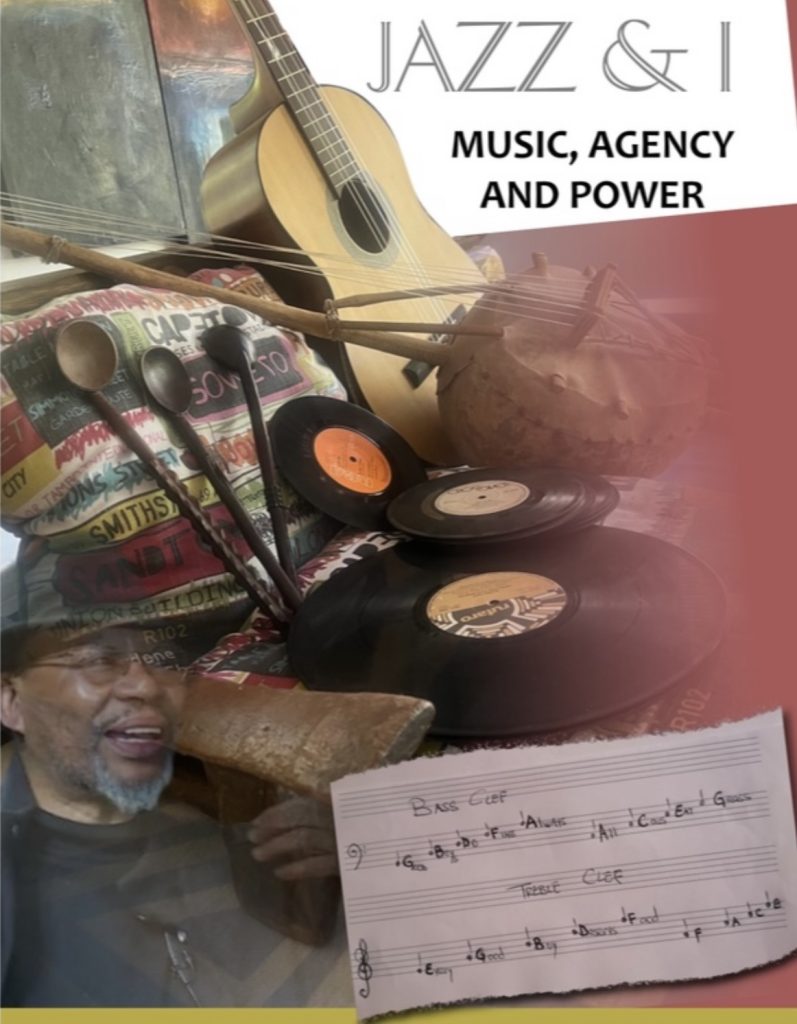
So, it was methodical. I wasn’t giving in to my feelings. Oh yeah, no, I feel this and that, and this is what he said. This is what he means. In a way, it was a scientific study. Yeah, in fact, I was going to say it’s highly scientific, but at the same time, highly accessible to a reader, an ordinary reader like myself. I love that on your book cover, I noticed a score sheet Feya Faku wrote for you. I sense a very special relationship between you and him.
Leslie Dikeni
Oh, that one stretches back to the early 1980s – ’86/’87, and during my encounters with him, and that’s for how long I observed him playing, and we have been friends in a way. So, we’re subjective and objective to each other. That scholarship is when I had to say to him, you know, I can write text, but I cannot write music. How do you explain those ghost sticks? Those ghost sticks. Yeah, yeah. For it was simple. It was a bread-and-butter issue. Yeah, and then he said, “No, it’s simple. Come, I’ll teach you.” That’s how that came to be. He then gave me this, and he tried to teach me that. But I have to be honest. Still, it’s not only him. Every other mission that I’ve spoken to there, in fact, there are two or three. I think McCoy tried, Paul Hanmer tried, and I’m still trying to read this musical thing. This year, Zim Ngqawana also tried to do this to me, and I failed that test miserably. I think they were saying to me: “It’s not about knowledge”. They say I’m lazy, so I guess I am. But for me, it’s complex. But it also shows the idea of knowledge. That knowledge is a social construct. No one has a monopoly on knowledge. That one can learn, should be able to learn, and that different people learn in different ways. So, the idea that knowledge is esoteric- they don’t didn’t see it that way. In fact, in the last conversation I had with Feya, as we finished, he said to me, “Was it difficult?” I said, “Yes, yeah, difficult.” Then he said, “Yeah, you must read your works.” Wow! Now we are scrapped. Wow!
Saul Molobi
But what I also love about the book is that it’s a multimedia platform. We have your text, and we also have QR codes that lead us to platforms where we can access these conversations. So, I can read the conversation narrative in text form, and I can also go into the online audio platforms. Then I listen to the conversation. I think the world is headed in this direction: we are no longer talking about one medium, but multiple mediums for delivering content. What message can you give to our listeners?
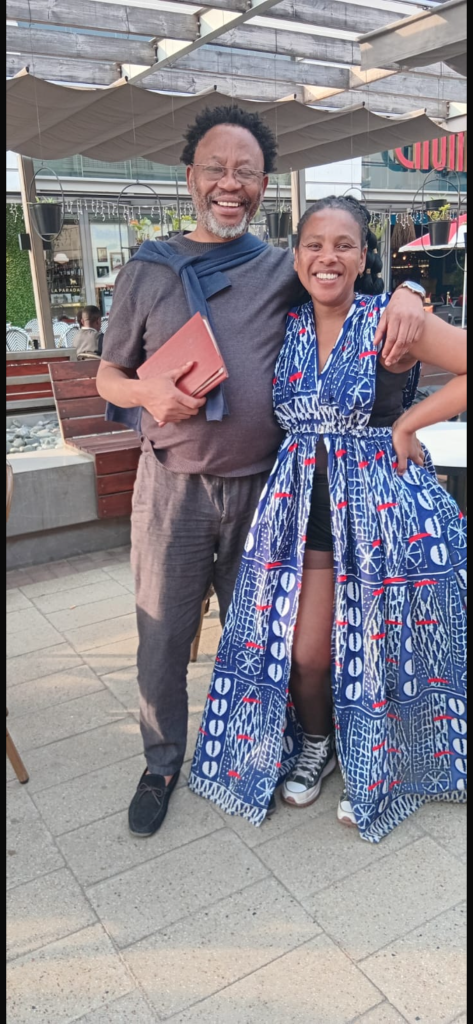
*** Leslie with trombonist Siya Makuzeni ***
Leslie Dikeni
In closing? In closing, the message I would give to the listeners is that, in my own biases, jazz is an important art form that contributes a lot to society. It shapes our lives. It has shaped my life because I weave my own experiences into these conversations, and music has shaped my trajectory. It has contributed immensely, reprimanding me at times and consoling me at others. It taught me a lot about society, so don’t fall into the trap I fell into, and one I’ve just fallen into. Open your eyes, open your mind. Enter these genres with that open-mindedness. That’s what the book has taught me: jazz plays an enormous role in society. But we must keep challenging the powers that seek to shape music for their own interests, whether it be the state, the captains of industry, or external influences from other parts of the world, because I think our musicians improvise, take jazz, and take other genres. They often try to contextualise it and place it in the South African context.
Saul Molobi
Thank you very much, my dear listeners. The book is available on Amazon in Print2Digital. To get in touch with Leslie Dikeni, the author, find him on all social media platforms. You can also find social media handles titled “Jazz and I: Music Agency and Power”, and on Spotify you can catch the conversations he has had with various musicians. Thank you, Leslie, for joining us, and give us one song from one of the musicians you’ve spoken with.
Leslie Dikeni
It’s the album, “Impilo”, by Feya. That was an immense one for me.
Saul Molobi
Great! There’s a song I love from it. I think it was recorded at Nikki’s, probably paying tribute to Nikki’s Oasis Jazz Restaurant. It’s titled “JG at Nikki’s”. Stay blessed…
****
Catch my interview live with Leslie Dikeni this Sunday, 17:00 to 19:00, on 101.9 Chai FM by tuning into 101.9 FM or streaming live from www.chaifm.com