
By Saul Molobi
Intro
There are artists whose music entertains, and then there are those whose sound carries memory, history and meaning across generations. Masauko Chimbere belongs firmly in the latter tradition. Born into exile, shaped by the liberation struggles of Malawi and South Africa, and forged within the cultural intersections of Africa and the diaspora, his music is not merely heard – it is lived.
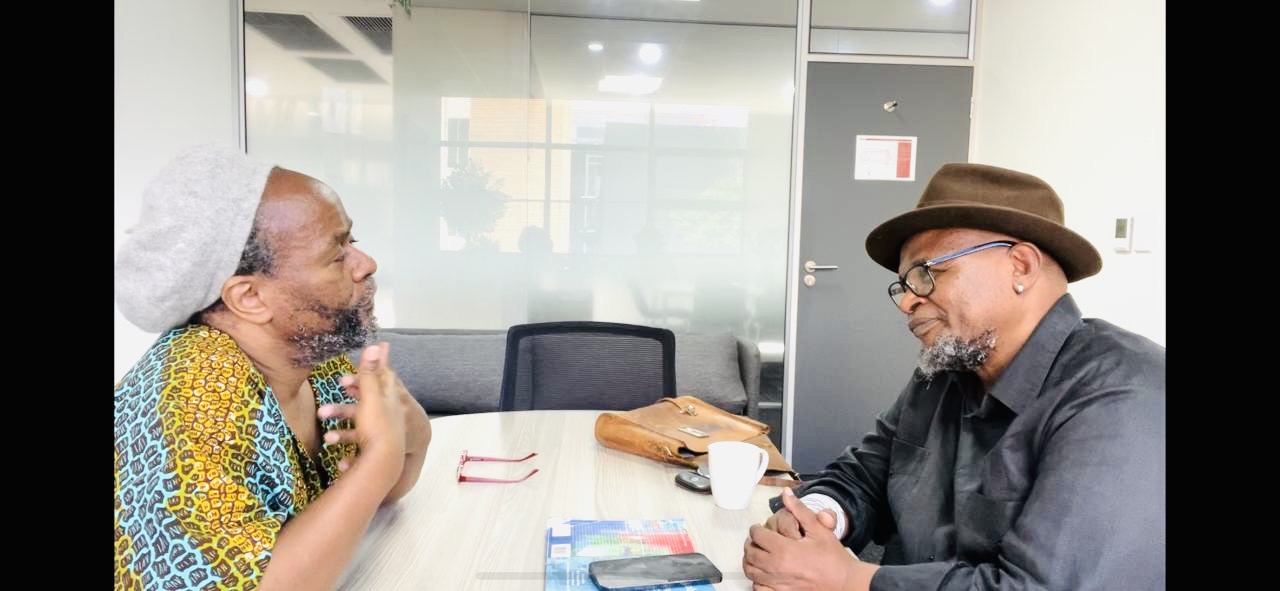
In this deeply reflective conversation with me, we journey beyond melody into memory; beyond rhythm into resistance. From the political legacy of his parents to the quiet, formative encounters with musical giants, Masauko invites us into a world where music becomes an instrument of healing, a language of ancestry, and a vehicle for imagining new futures.
This is not just a conversation about music – it is a meditation on identity, creativity and the enduring power of the human spirit.
Saul Molobi: My brother, welcome to the studio.
Masauko Chimpebere: Thank you, sir. Nice to be here.
Masauko Chimpebere: That is wonderful. Please introduce yourself… it’s always better coming from the horse’s mouth.
Masauko Chimpebere: I am Masauko Chimpebere Jr. I am the son of Henry Masauko Chimbere and Catherine Medi Ajizinga Chimpebere from Malawi. These two people dedicated their lives to the liberation of Malawi, beginning when the country was still Nyasaland. My father was what we might call the spearhead of the movement that broke the Federation of Nyasaland and Southern and Northern Rhodesia.
Our connection to South Africa begins with my father attending Fort Hare University and being shaped by the intellectual culture of Z.K. Matthews, one of his mentors. He was there in the early 1950s, when apartheid was tightening its grip, and witnessing it activated his political consciousness. My father became the first non-South African to join the ANC Youth League.
When it came time to graduate, he wanted to remain in South Africa and fight apartheid. However, Z.K. Matthews advised him to return home and fight the Federation of Nyasaland and the Rhodesias, describing it as an extension of apartheid. He told him that if he began that struggle early, Malawi would be liberated decades before South Africa – and indeed, Malawi gained independence in 1964, while South Africa was liberated in 1994. Matthews’ insight proved exactly right.
Many of you will have heard of Kamuzu Banda, a controversial figure in African history. My father, together with another politician, invited Banda back to Malawi. They were young leaders in their late twenties and recognised that, culturally, people trusted older leadership. On the advice of Kwame Nkrumah and Jomo Kenyatta, they brought Banda in as a unifying figure.
To consolidate unity, they constructed a powerful image of Banda as a prophetic leader. While effective, this strategy eventually backfired. The cultivation of a cult of personality led Banda toward authoritarianism. Having spent decades outside the country, he became suspicious of the younger leaders who had built the movement, fearing they might remove him. He insisted on becoming President for Life.
This led to tensions, culminating in the Malawi Cabinet Crisis. My father eventually led an attempted coup in the mid-1960s, which failed, forcing him into exile. International forces, including intelligence agencies, saw strategic value in keeping both sides in play – maintaining Banda in power while keeping his opposition in reserve.
My father spent time in Los Angeles before returning to Tanzania to continue the struggle. However, after the assassination of Mozambican leader Eduardo Mondlane, my father – who had been warned he would be next – was forced back into exile in the United States. My mother was pregnant with me at the time, and I was born in the US.
So, I am a child conceived in Africa but born in America. That duality is central to who I am as an artist – I see myself as a bridge.
When my family arrived in the United States, we had lost everything. My father, who had been Malawi’s first Minister of Education, had to start from scratch. He pursued further studies at UCLA, eventually becoming a lecturer. But he passed away when I was five years old, leaving my mother to raise seven children in a foreign country.
My mother began on welfare but refused to remain dependent. Despite being told she belonged in that position, she pursued early childhood development and opened a crèche in Pasadena. Within a few years, it attracted families from across communities, including African families.
One of those families was the Semenyas. Their son attended my mother’s crèche, and through them I encountered music more deeply. I was already drawn to music, but seeing Caiphus Semenya – his life, his artistry, his success – was transformative. I asked my mother what he did, and when she said he made a living playing piano, something clicked: I wanted to do the same.
He later gave me my first record player. Around that time, I was also exposed to music from my siblings – Bob Marley, Exodus, Steel Pulse – music infused with themes of liberation and return to Africa. These ideas quietly took root in me.
Through my sister, I also encountered Lebo M, who would come to our house. I used to insist that I was the one who should be taken to the studio. Years later, when we met again professionally, he remembered my boldness.
These early experiences shaped my musical identity. I was exposed to a wide spectrum – reggae, rock, jazz, funk, soul – before I even understood the concept of genre. To me, it was simply music.
Another profound influence was Caiphus Semenya’s son, who would play piano in our home. I would secretly watch him, absorbing what I can only describe as something between Prince and Abdullah Ibrahim. These moments deeply shaped my sound, even if I only understood their impact much later.
Saul Molobi: That explains why you came to South Africa. Tell us about that journey.
Masauko Chimpebere: When I came to South Africa, I was searching for Caiphus Semenya and Letta Mbulu, who were like family. I had already started Blk Sonshine, and they were incredibly supportive. At one point, after hearing me perform, Caiphus said, “Man, you can sing.” That affirmation meant everything.
Lebo M had a similar moment when he saw me perform in Los Angeles. He had no idea who I was, but after the show, he told me I could really sing. I reminded him that I had told him so years earlier.
Eventually, I performed alongside artists like Stevie Wonder and Hugh Masekela at an event for a New South Africa, hosted by Desmond Tutu.
When I arrived in South Africa in the 1990s, the atmosphere was electric. Coming from Los Angeles, which was experiencing racial tensions following the Rodney King incident, South Africa felt like a place of possibility – Mandela, freedom, the Rainbow Nation.
I had been writing politically conscious music influenced by artists like Bob Marley, Curtis Mayfield and Miriam Makeba. However, in the US, the industry often wanted to dilute that message. In South Africa, it was embraced.
I eventually became part of the vibrant Johannesburg music scene, particularly in Yeoville. It was a powerful moment of artistic convergence – musicians, poets, thinkers – all energised by the spirit of change.
I studied informally at Wits under Prof. Darius Brubeck, whose influence was profound. I also met my wife in this environment.
A key turning point came when I met Busi Mhlongo, who taught me the importance of grounding one’s music in cultural identity while drawing inspiration globally. That was another lightbulb moment.
Saul Molobi: Let us focus on your music. What inspires your songs and albums?
Masauko Chimpebere: My first major song with Blk Sonshine was “Building”, with the line: “We grow from seed to tree, me and my people building.” It was inspired by a movement in Los Angeles that emphasised the power of words – what they called “word, sound, power.”
The idea was that language is alchemical – it shapes reality. That belief continues to guide my work. Interestingly, I now find myself working with farmers in Malawi, literally building communities from seed to tree.
I believe music is an alchemy. What you speak can manifest. That’s why I always caution young artists about the power of words. Even scripture reminds us: “Let there be light” – and there was light.
Saul Molobi: The bible’s “Proverbs say “thinketh in his heart, so is he”. And Descartes says “cogito ergusum” (“I think therefore I am”).
Masauko Chimpebere: African philosophy, rooted in “Ubuntu”, emphasises “we exist for each other,” while Western philosophy emphasises “I think, therefore I am.” My music seeks to balance both, but it leans toward the collective – toward “we.”
Saul Molobi: Now, I know you love all your songs, but recommend four.
Masauko Chimpebere: First, Makolo Akale, which honours my ancestors, particularly my father.
Second, Me and My People “Building”, which has become a defining song in my life.
Third, “Soul Smile”, dedicated to my wife, exploring love as a revolutionary force.
Lastly, “Ilala”, a reinterpretation of a traditional Malawian wedding song, infused with ancestral memory and exile narratives.
I didn’t get to mention my hip-hop roots, but they were essential in shaping my understanding of poetry and language.
How can listeners get in touch with you?
You can visit masauko.com, or find me on Instagram, TikTok, YouTube, and Facebook under Masauko. I also have a series with my mother on Malawian history called My and I.
My mother was a huge influence on my life and music. She later returned to Malawi, became a member of parliament, and even changed her name to Ajizinga, meaning “healing.” Interestingly, my name, Masauko, means “suffering,” symbolising a profound balance between suffering and healing in my lineage.
Saul Molobi: Your final message to my listeners and readers?
Masauko Chimpebere: Creativity is the most powerful force in the world today. The life you want must first be imagined and then created.
We are entering an era where systems attempt to take creativity away from individuals and give it to machines. I urge people to reclaim their creativity – read, write, imagine, and create.
That is how I have shaped my own life.
Saul Molobi: How do we access your music?
Masauko Chimpebere: It is available on streaming platforms like Spotify and Apple Music, but I also encourage direct engagement. I have CDs and vinyl available, and I welcome people to connect with me personally. Music should be a human experience.
Saul Molobi: Thank you so much, my brother. This has been wonderful.
Masauko Chimpebere: Thank you.
Outro
What emerges from this conversation is a profound reminder that music is more than sound – it is a force, an alchemy, a way of shaping both self and society. Masauko Chimbere’s journey affirms that creativity is not a luxury, but a responsibility: to remember, to reimagine, and to rebuild.
In an age where the world is increasingly mediated by technology and speed, his call is both urgent and timeless – hold onto your voice, nurture your imagination, and remain grounded in the stories that define you.
As we return to the music, we do so with a deeper appreciation of the worlds it carries within it. For in every note lies a history, and in every song, the possibility of becoming.
***
Catch my radio interview with Masauko Chimpebere this Sunday in “Sunset Serenade”, a jazz show on 101.9 Chai FM, from 17:00 tom19:00