

Jambo Africa Online’s Senior Editorial Correspondent, FRANCOIS FOUCHE, brings us a collage of news tit-bits from around the world that impacts on Africa’s economic development…
Nigeria stays on top
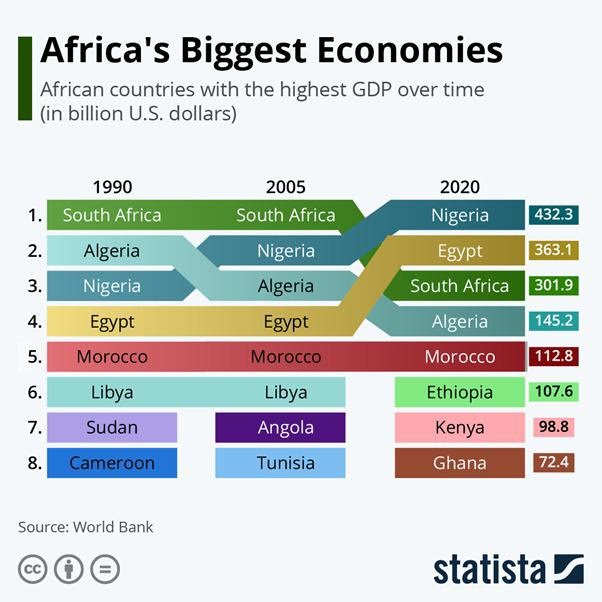
With a total GDP of $432 billion, Nigeria has become the biggest economy on the African continent over the last 30 years. While the 5 highest spots in this ranking have been constant over the last 3 decades, the rest of the top 8 are subject to bigger fluctuations.
Libya, for example, managed to come in 6th in 1990 and 2005, but dropped out of the top 8 and only made the 17th rank in 2020. The Second Libyan Civil War being the rationale. Conflict started in 2014 in the aftermath of the election results.
Kenya, on the other hand, passed a new constitution in 2010 which limited the power held by the country’s president and enabled business and technology centers like Nairobi to grow. The city is now home to the African offices of Google, Coca-Cola, IBM and Cisco.
Nigeria‘s first place is largely attributable to its rapidly expanding financial sector, which grew from 1% of GDP in 2001 to 10% in 2018, and its role as one of the world leaders in petroleum exports.
The growing tech hub of Lagos, the 2nd largest metropolitan area in Africa and among the largest in the world, is also likely to further bolster Nigeria’s growth in the coming years, even though the divide between the part of the population living in slums without access to basic sanitation and its upper class making the city one of the most expensive in the world is likely to grow as well.
This is also reflected in its comparably low GDP per capita of $2,100.
When considering this indicator, Nigeria doesn’t even make the top 10 in Africa.
Of the 54 countries in Africa, only 4 countries made the top 50 of the nations with the largest GDP. The top spots on this list are reserved for the US, China, Japan and Germany, whose residents generate a combined GDP of $45 trillion (50% of global GDP).
*****
Inflation is rising around the world.
In sub-Saharan Africa, one item is driving the trend more than others: food prices. Food accounts for roughly 40% of the region’s consumption basket – a measure of goods and services used to measure consumer price index (CPI) inflation.
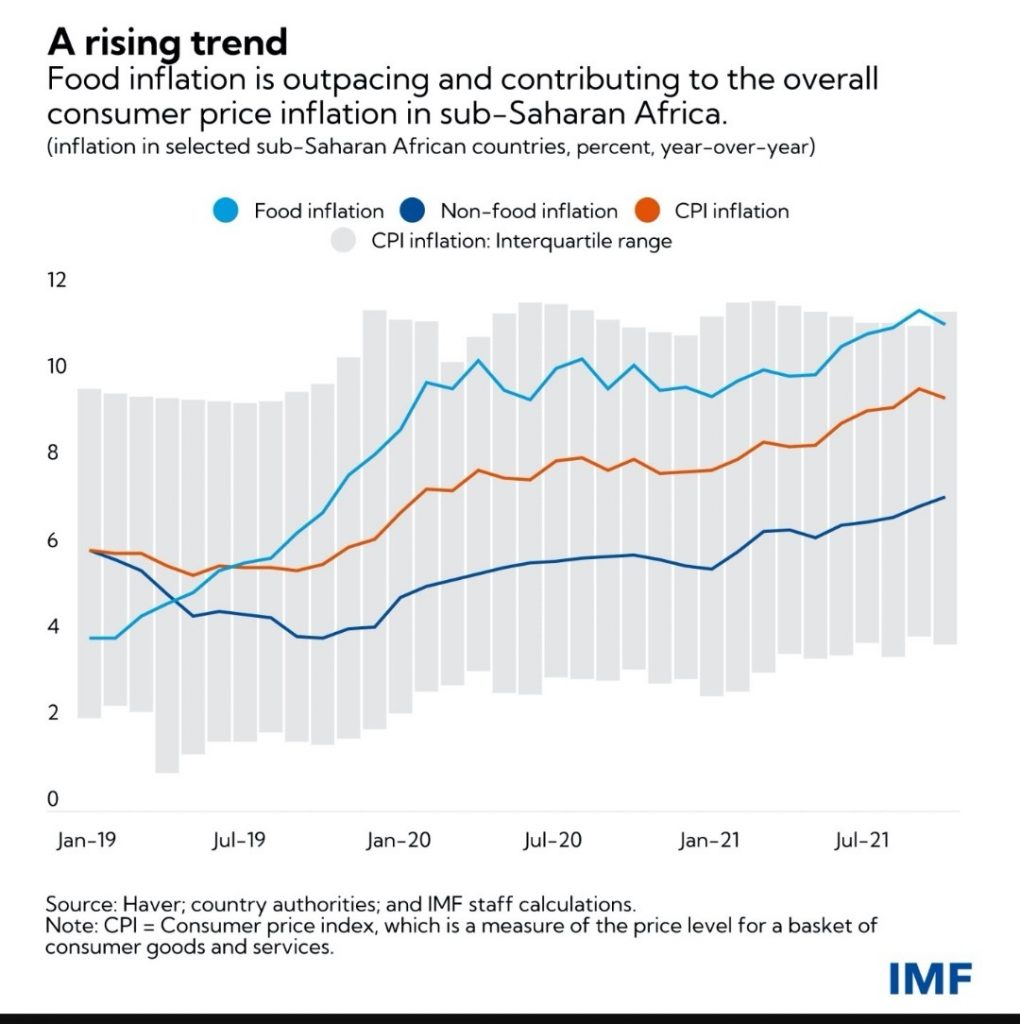
Food inflation increased throughout 2019, on average, across 20 countries in the region where monthly food price data are available. After remaining stable around 9% since the beginning of the pandemic, food inflation started to rise again from April this year to some 11% in October.
The chart below shows how food inflation is outpacing and contributing to the pick-up in overall consumer price inflation in sub-Saharan Africa.
On a global scale, the recent increase in food inflation is attributed to rising oil prices (which raise fertiliser prices and transportation costs), droughts and export restrictions imposed by some major food exporters, and stockpiling in some countries. In addition, pandemic containment measures disrupted production and imports of seeds and fertilisers and caused labour shortages during planting seasons. Importantly, there is diversity across the region—food inflation in Chad is near zero but around 30% in Angola. This suggests that domestic factors such as weather and exchange rates are important contributors to food inflation in sub-Saharan African countries.
The outlook is highly uncertain.
Food inflation and CPI inflation could moderate if commodity prices ease and pandemic-induced global supply chain disruptions resolve. However, high food inflation could persist if inflation expectations become de-anchored or supply chain disruptions continue.
Regionwide, average inflation is expected to edge up in 2021 before easing next year depending on commodity prices and the resolution of supply-demand mismatches.
Higher food inflation would worsen the situation for the countries already facing food insecurity and shortages with a disproportional impact on poor households.
The number of undernourished persons in the region is projected to have increased by 20% in 2020, encompassing 264 million people.
Fighting food insecurity through targeted social assistance and insurance can help populations cope.
Avoiding trade barriers and improving access to finance, seed stocks, insecticide, fertiliser, anti-erosion measures, and irrigation are also important.
This article first appeared here.