
By Saul Molobi
There are music festivals, and then there are cultural institutions. After more than two decades of bringing some of the most compelling voices in jazz to Johannesburg, the Standard Bank Joy of Jazz has firmly established itself in the latter category.
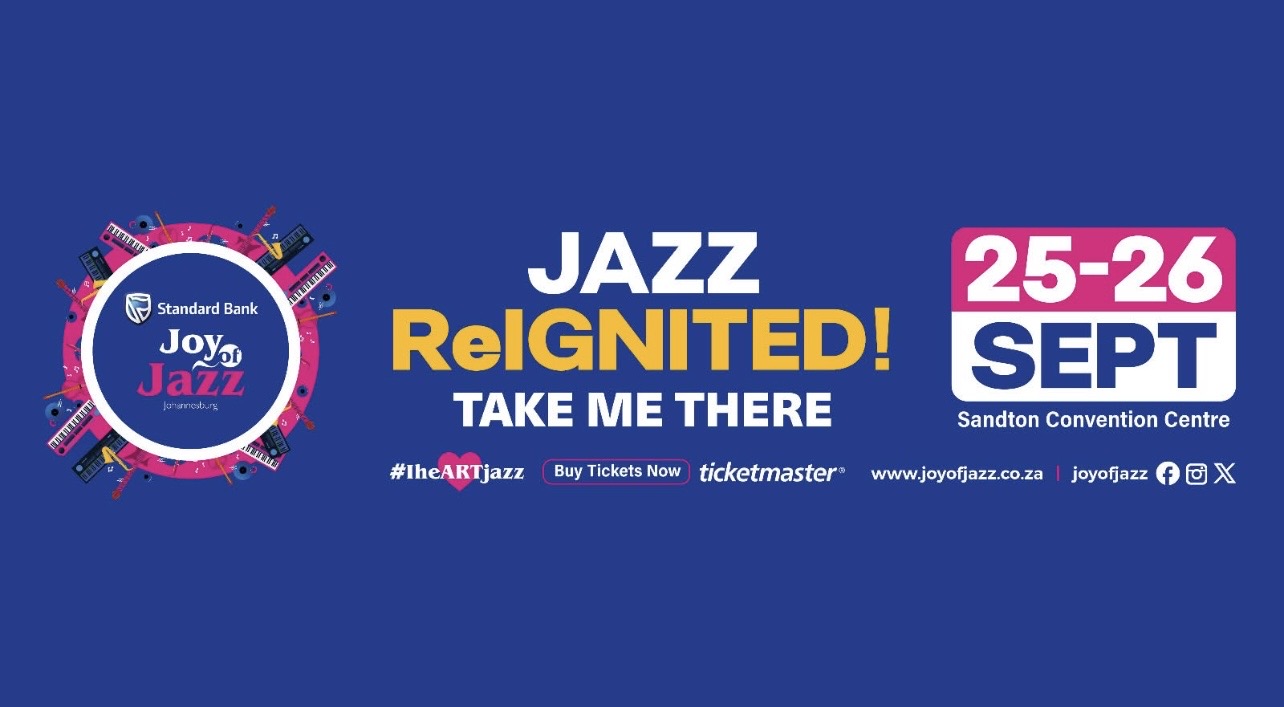
On 25 and 26 September 2026, South Africa’s premier jazz festival returns for its 27th edition, transforming the Sandton Convention Centre into a two-day celebration of jazz, African musical heritage, contemporary creativity and international collaboration. The official festival programme describes the event as a meeting place for international jazz giants, South African luminaries and emerging voices, with four stages offering distinct musical experiences.
But the significance of this year’s festival extends beyond the music.
A festival that has become part of Johannesburg’s cultural DNA
Joy of Jazz has travelled a remarkable distance since its beginnings. What started as a relatively intimate gathering of about 1,800 people in 2000 has grown into a major cultural and economic event attracting more than 25,000 festivalgoers annually. Standard Bank describes it as a cultural and economic force, while the festival itself positions the event as contributing to social cohesion, economic growth and cultural tourism.
That evolution matters.
Jazz has always been more than a musical genre in South Africa. It has been a repository of memory, a language of resistance, a soundtrack to urban life and a vehicle through which generations have negotiated questions of identity, freedom and belonging.
The 2026 edition seems particularly conscious of that history. It arrives in a year marked by two important South African anniversaries: 50 years since the 1976 Soweto Uprising and 70 years since the 1956 Women’s March. These historical milestones give the festival an additional layer of meaning as it looks backwards to honour the musical and social pioneers who shaped the country while simultaneously looking forward to the musicians defining its contemporary sound.
From Masekela to Moeketsi: remembering the masters
One of the most compelling features of the 2026 programme is its emphasis on musical memory.
Thandiswa Mazwai will honour the extraordinary legacy of Hugh Masekela, whose trumpet, compositions and international career helped introduce South African musical consciousness to audiences around the world. Khaya Mahlangu, meanwhile, will pay tribute to another giant, Kippie Moeketsi, whose contribution to South African jazz remains foundational.
These are not simply nostalgic exercises.
The most meaningful tributes in jazz are conversations between generations. They take music that was created in another historical moment and ask contemporary artists to interpret what it means today. In that sense, Mazwai’s engagement with Masekela and Mahlangu’s tribute to Moeketsi become acts of cultural transmission.
The festival also honours the late Busi Mhlongo, with Buhlebendalo Mda and other artists revisiting her formidable musical legacy. Mhlongo’s music, like Masekela’s, carried questions of African identity, freedom and cultural pride.
Africa and the world meet in Sandton
If heritage provides the festival’s historical foundation, international collaboration gives it its global reach.
The 2026 programme brings together artists from Africa, Europe, North America and beyond. Among the international highlights are Beninese global music icon Angélique Kidjo and American saxophonist Kamasi Washington, both appearing at Joy of Jazz for the first time. Other international names include Ibrahim Maalouf, Nubya Garcia, Tank and the Bangas, Floetry, Ola Onabule and Carmen Souza.
The importance of such a gathering lies partly in the way jazz refuses to respect borders.
Its language may be rooted in African-American history, but jazz has travelled, mutated and found new homes across the world. In South Africa it encountered marabi, kwela, mbaqanga, township jazz, traditional African rhythms and the political imagination of generations of musicians.
Joy of Jazz therefore becomes a kind of musical crossroads: New Orleans can meet Johannesburg; Lagos can converse with London; Paris can encounter Soweto; contemporary electronic sounds can sit alongside the acoustic traditions of African jazz.
Four stages, four journeys
The festival’s four-stage structure is designed less as a conventional concert programme than as a series of parallel musical journeys.
The Dinaledi Stage carries some of the festival’s major performances, including Ibrahim Maalouf, McCoy Mrubata, Judith Sephuma and the Kippie Moeketsi tribute led by Khaya Mahlangu. Ola Onabule and Dumza Maswana, who will present the Umngqunqgo Orchestral Experience with a 20-piece orchestra, add further dimensions to the programme.
The Diphala Stage foregrounds women, musical leadership and innovation, featuring artists such as Nubya Garcia, Gabi Motuba and Lorraine Klaasen. Particularly intriguing is 4 Bass Lines, bringing together AusTebza, Rochelle Rautenbach, Chantal Willie-Petersen and Orlanda Da Conceição.
It is a powerful statement about the changing architecture of jazz: women are not merely participating in the genre; they are increasingly shaping its sound, direction and future.
The Conga Stage promises a more rhythm-driven experience, with Tank and the Bangas, Reza Khota, Madala Kunene, Sibusile Xaba, Sydney Mavundla and Tumi Mogorosi’s Thank You For Your Service Quartet. Ndabo Zulu and the Umgidi Ensemble will provide another major highlight.
And then there is the Mbira Stage, where jazz meets neo-soul, poetry and contemporary African expression. Floetry, Nomfusi, Anaïs Rosso, Internet, Manana and Gurulogic are among the artists bringing a distinctly contemporary energy to the festival. Thandiswa Mazwai’s Hugh Masekela tribute will also provide one of the stage’s defining moments.
A platform for the next generation
Perhaps one of the festival’s most important contributions is its refusal to treat jazz as a museum piece.
The presence of Gabi Motuba and Manana, winners of the 2026 Standard Bank Young Artist Awards in Jazz and Music respectively, demonstrates the festival’s investment in the next generation. Their inclusion alongside established international and South African names creates a continuum between tradition and experimentation.
This is critical for the sustainability of jazz.
A festival cannot survive merely by celebrating yesterday’s heroes. It must also create audiences for tomorrow’s artists. It must give young musicians a stage, provide them with professional networks and allow audiences to encounter unfamiliar sounds.
Joy of Jazz has increasingly become that platform.
More than a weekend of music
The festival’s economic footprint is equally significant.
According to Standard Bank, Joy of Jazz has historically generated more than R34.5 million in direct spending, contributed approximately R86 million to the Gauteng economy, and created more than 1,200 temporary and permanent jobs across its value chain. Its Jazzy Joburg Market also supports more than 25 small and medium-sized enterprises annually.
This is an important reminder that cultural festivals should not be measured only by ticket sales.
Behind every concert is an ecosystem: musicians, sound engineers, stage crews, designers, caterers, transport operators, hotels, restaurants, security companies, media organisations, fashion businesses and countless other enterprises.
In this sense, Joy of Jazz is also an economic diplomacy instrument for Johannesburg and South Africa. It brings international visitors into the country, creates opportunities for African artists to engage global audiences and reinforces Johannesburg’s reputation as a sophisticated cultural capital.
Johannesburg gets its jazz weekend
For two September nights, Sandton will become the meeting point of generations.
The city will hear the memory of Masekela and Moeketsi alongside the experimentation of Motuba, Garcia and Washington. It will hear the deep African roots of Madala Kunene and Sibusile Xaba alongside the global sounds of Kidjo and Floetry.
That is perhaps the enduring genius of Joy of Jazz.
It does not ask jazz to stand still.
It allows the music to remember where it came from while continually asking where it can go next.
And that makes the 27th Standard Bank Joy of Jazz more than another entry on Johannesburg’s entertainment calendar. It is a celebration of South Africa’s musical memory, Africa’s creative imagination and jazz’s extraordinary ability to make strangers feel, if only for a moment, that they belong to the same rhythm.
From 25 to 26 September 2026, the invitation is therefore simple: come to Sandton, choose your stage, surrender to the music—and let Johannesburg tell its story through jazz.
Festival details: Doors open at 17:00 on Friday and 16:00 on Saturday, with performances beginning at 18:30. A one-day pass is listed at R1,250 on the official festival site, while a weekend pass is R2,250; Ticketmaster currently lists the Friday general admission day pass at R1,150 including service fees.
_________________
Saul Molobi is a brand architect and a jazz activist, writer, publisher and radio presenter.