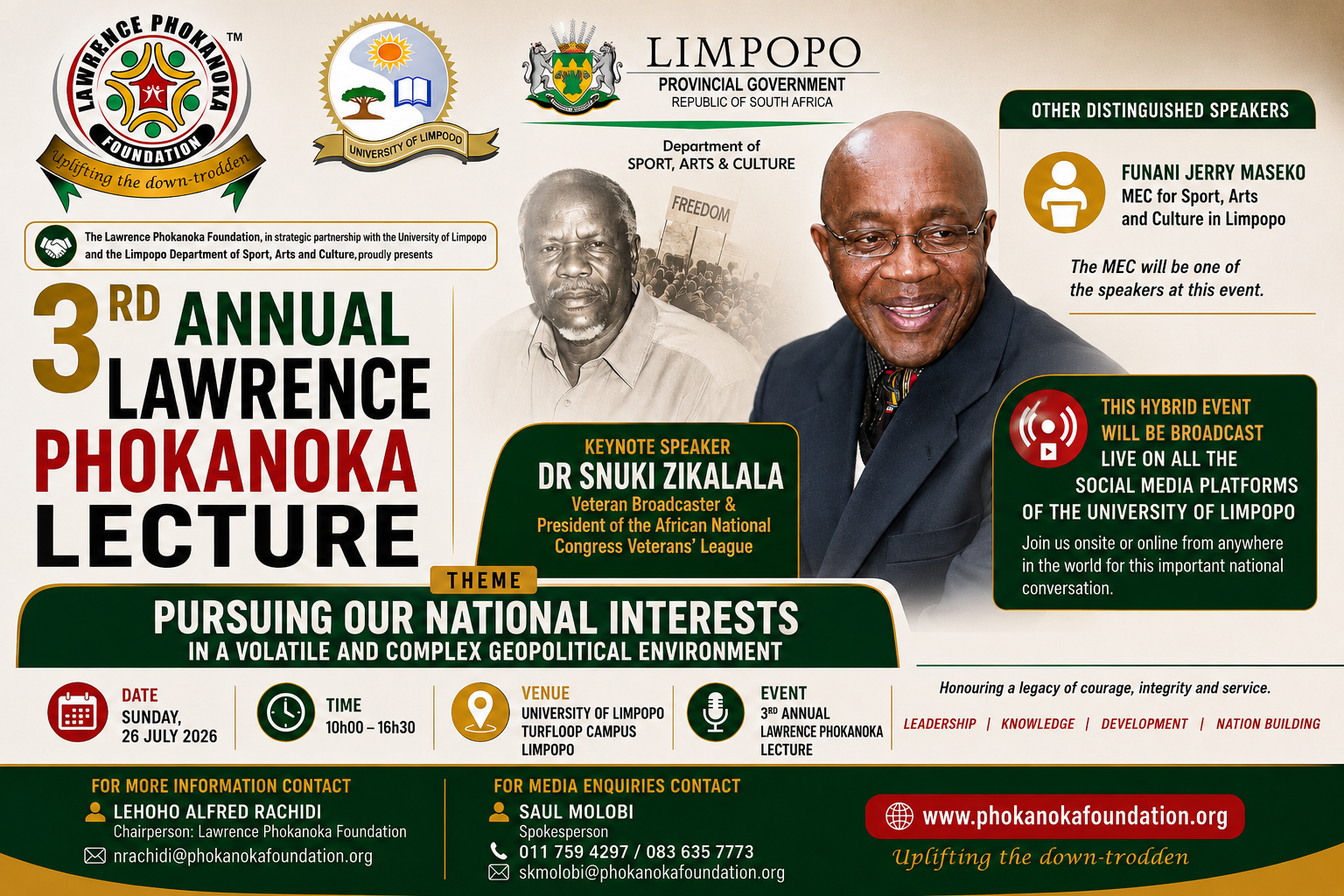
Every generation inherits a name.
A few generations inherit a brand.
A brand is not a logo.
It is not a colour.
It is not a slogan etched upon polished paper.
A true brand is forged where values meet sacrifice,
where purpose outlives personality,
where reputation survives the passage of time.
Such was the brand called Lawrence Phokanoka.
It was conceived long before the marketplace recognised its worth.
Its foundations were laid among the ancient hills of Sekhukhuneland,
where granite taught resilience,
where rivers taught humility,
where African skies reminded every child
that greatness begins with belonging.
There, in Raphahla,
the first chapter of an enduring reputation was written.
Not in ink,
but in character.
Not by privilege,
but by principle.
For every enduring brand begins
long before the world discovers it.
It begins with values.
The first custodians of the Phokanoka brand
were not marketers,
strategists,
or storytellers.
They were his parents.
A father who believed that education
could illuminate even the darkest season.
A mother who transformed ordinary cloth
into garments of dignity.
From one he inherited knowledge.
From the other,
humanity.
Together they fashioned
the earliest identity of a man
who would one day become
larger than himself.
They understood a timeless truth
before a leader builds a nation,
someone must first build the leader.
As the young Lawrence journeyed
from village to village,
from Sekhukhune to Alexandra,
from classroom to classroom,
his address changed,
but his identity did not.
For authentic brands
travel well.
They carry their essence
wherever history takes them.
Then came the defining encounter.
A simple calendar.
The face of an ANC leader.
A message of defiance.
To others,
it was merely printed paper.
To a young observer,
it became the first advertisement
for justice.
Some campaigns sell products.
The greatest campaigns
sell possibilities.
That image never left him.
Neither did the question it planted:
What is the purpose of a life
if it does not serve humanity?
At school,
he learnt that institutions
may educate the mind,
yet it is injustice
that often awakens the conscience.
Student protests became
his first masterclass
in leadership.
Books sharpened his intellect.
Resistance refined his purpose.
Every newspaper he read
expanded the horizon
of his imagination.
Every article strengthened
his moral positioning.
The Lawrence Phokanoka brand
was becoming unmistakable
curious,
principled,
fearless,
and uncompromising
in its pursuit of justice.
Fort Hare
did not create the brand.
It amplified it.
Like fire discovering oxygen,
his convictions found expression
among young Africans
who refused to inherit silence.
He studied science,
yet history assigned him
a different discipline.
The chemistry of solidarity.
The mathematics of equality.
The physics of collective action.
There,
he learnt
that leadership is influence,
not authority.
That credibility
is earned before it is exercised.
That reputation
is accumulated one decision
at a time.
When oppression attempted
to silence his voice,
the brand expanded
beyond borders.
Botswana.
Tanzania.
Moscow.
Each destination
added another layer
to his identity.
He returned
not merely trained,
but transformed.
For global exposure
never diluted
his African purpose.
It strengthened it.
His values travelled.
His integrity travelled.
His commitment travelled.
Authentic brands
never lose themselves
while discovering the world.
Then came Wankie.
History remembers the battle.
Character remembers the choice.
As Political Commissar,
Lawrence Phokanoka understood
that movements succeed
not because of weapons,
but because of belief.
His responsibility
was not simply to prepare comrades for combat,
but to prepare them
to understand
why they fought.
Ideas became
the strongest armour.
Conviction became
the most reliable compass.
His leadership brand
was never built
upon fear.
It was built
upon purpose.
The prison gates
closed behind him.
Many believed
his influence had ended.
Instead,
his reputation deepened.
For adversity
does not destroy
a genuine brand.
It reveals it.
Robben Island
became the ultimate test
of authenticity.
Every day asked the same question:
Will your values survive
when no one is watching?
His answer
was written
not in speeches,
but in endurance.
Character became
his loudest communication.
Consistency became
his strongest message.
The Lawrence Phokanoka brand
required no publicity.
Its credibility
spoke for itself.
Freedom finally arrived.
Many sought prominence.
He sought purpose.
Many pursued office.
He pursued service.
He quietly declined
the temptation
to confuse visibility
with significance.
For he understood
that leadership
is not measured
by how many people know your name,
but by how many lives
are transformed
because you lived.
That decision
became perhaps
his greatest brand statement.
Humility.
Authenticity.
Service above self.
Recognition followed naturally.
The Moses Kotane Award.
The Order of Luthuli.
The admiration of comrades.
The gratitude of a democratic nation.
Yet awards
did not create his reputation.
They merely recognised
what decades of sacrifice
had already established.
For reputation
cannot be manufactured.
It must be earned.
When blindness eventually dimmed
his physical sight,
it could not diminish
his moral vision.
His eyes closed
to the visible world,
yet generations continued
to see
through the example
he had left behind.
The strongest brands
do not depend
upon appearance.
They endure
because their values
continue to inspire
long after their founders
have departed.
Today,
the Lawrence Phokanoka brand
belongs to no political party,
no institution,
no family,
and no generation alone.
It belongs
to every person
who believes
that integrity
is stronger than ambition,
that service
is greater than status,
that ideas
outlive oppression,
and that freedom
must always be accompanied
by responsibility.
His life reminds us
that nations,
like people,
are judged
not by what they proclaim,
but by what they consistently practise.
And so,
while the mountains of Sekhukhune
continue their timeless vigil,
while Robben Island
still whispers the names
of those who transformed suffering into hope,
and while South Africa
continues the unfinished work
of building a just society,
the brand called Lawrence Phokanoka
remains one of the nation’s
most valuable assets
not because it was carefully managed,
but because it was faithfully lived.
For brands fade
when they chase applause.
Legacies endure
when they embody truth.
And truth,
once lived with unwavering courage,
becomes immortal.