
By Saul Molobi
There are moments in a nation’s cultural life when a simple phrase captures more than the mood of an evening – it captures an era.
“We are growing,” said Morakabe Raks Seakhoa, Executive Director of the South African Literary Awards (SALA) and Managing Director of the wRite associates, at the Market Theatre yesterday on Saturday, and it felt less like a casual remark and more like a quiet manifesto. Growing not only in numbers, but in conviction, in institutional memory, and in our stubborn insistence that, in spite of everything, the African word – spoken or printed – still matters.
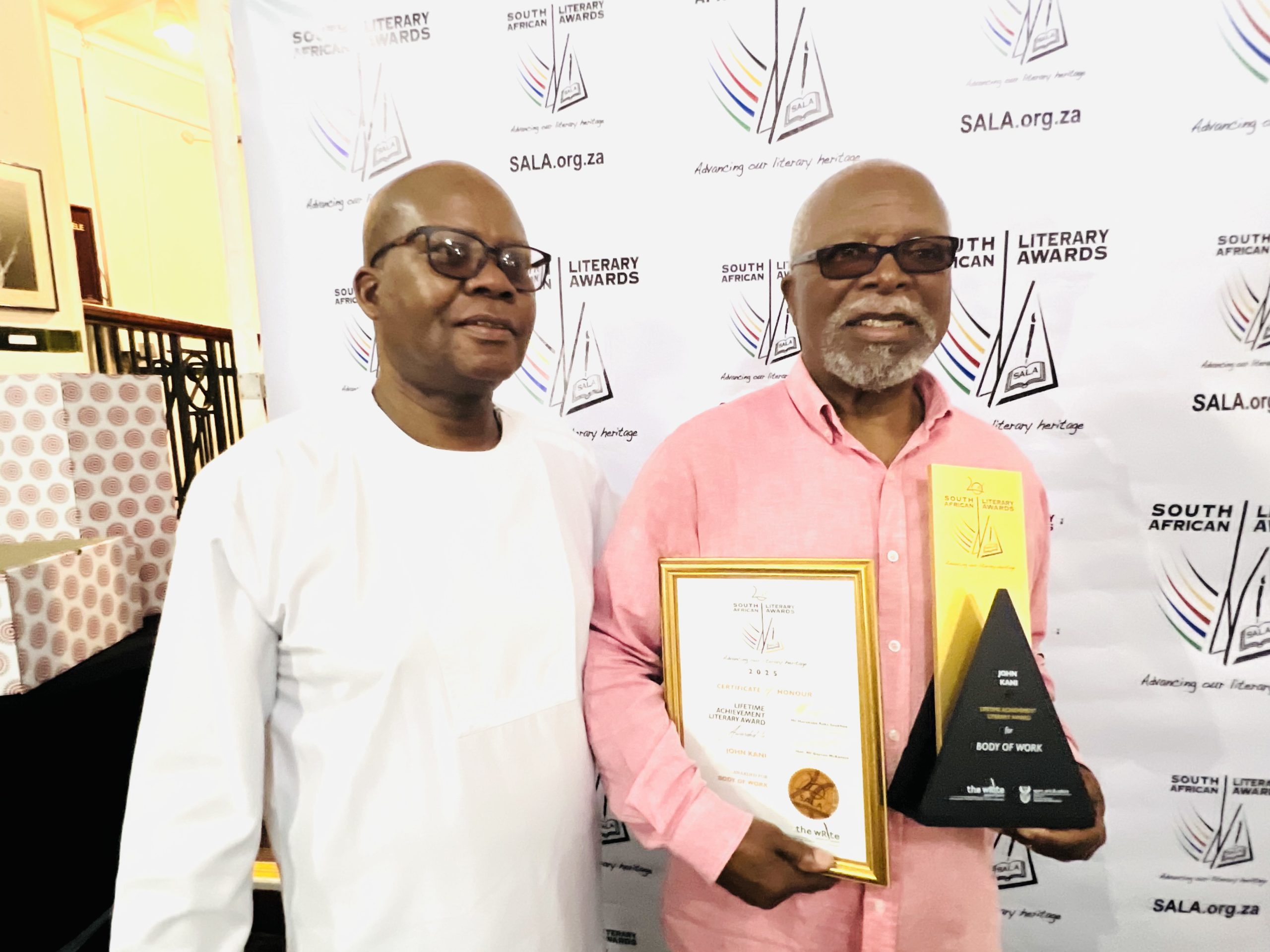
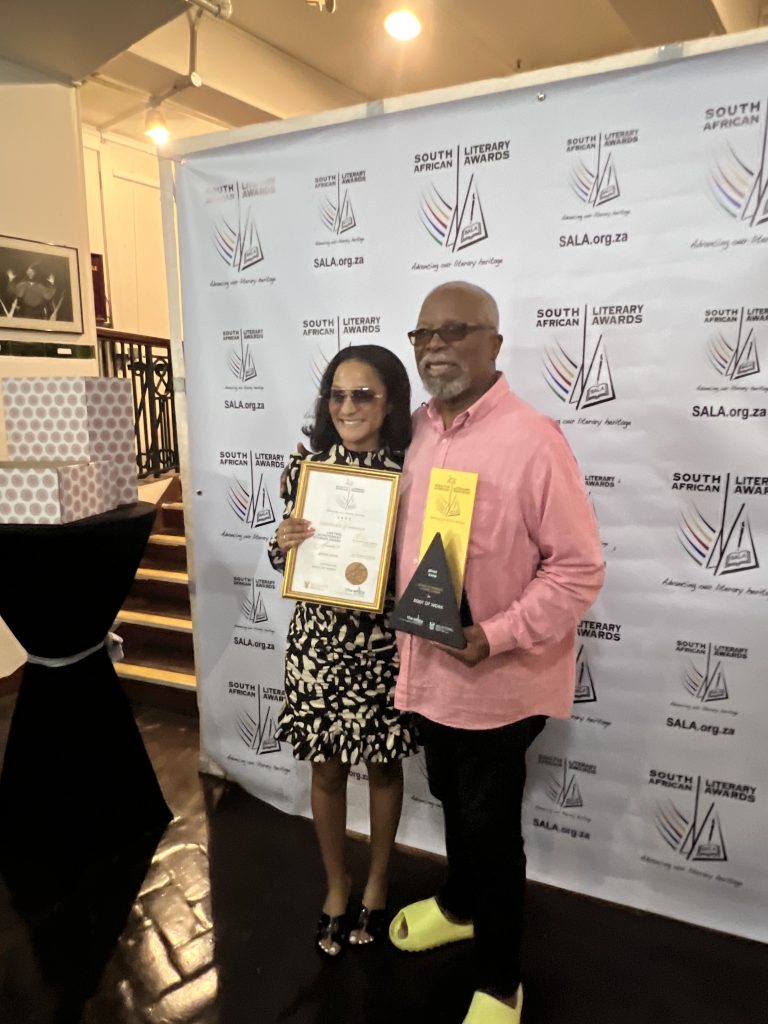
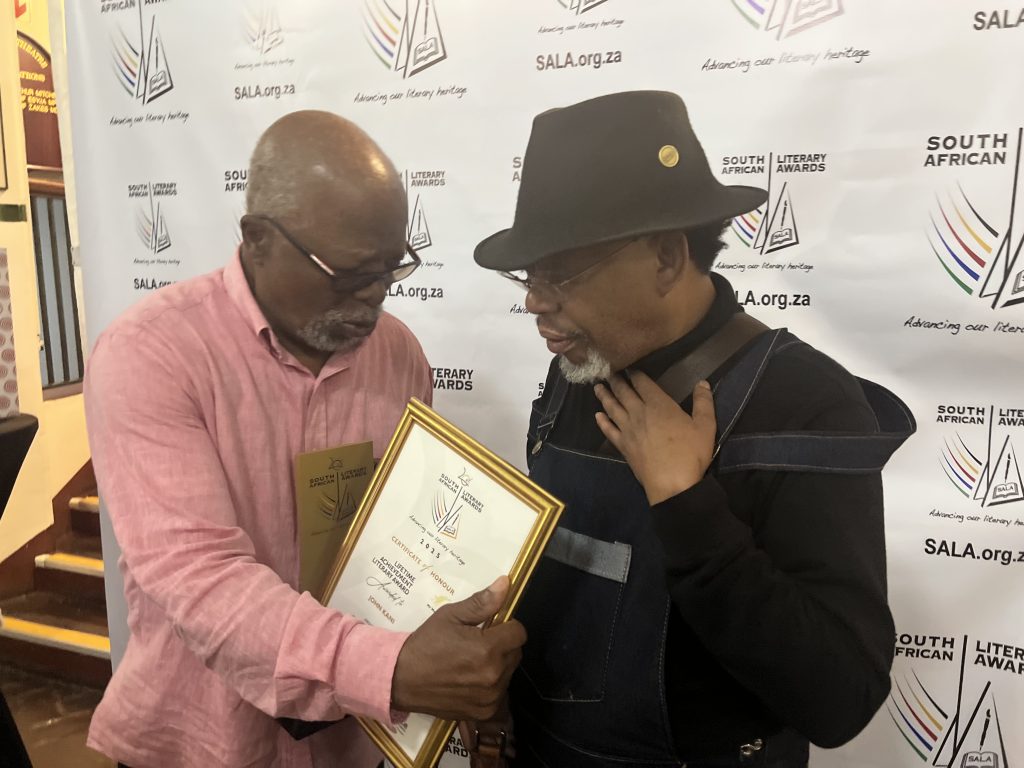
The occasion was the conferral of the 20th South African Literary Awards (SALA) Lifetime Achievement Literary Award on Dr John Kani OIS & OBE. But the evening became much more: a meditation on what it means to build – and sustain – a literary civilisation in a country where books are still too often regarded as a luxury, and artists as people who should have been something else.

The Market Theatre as Living Text
It was fitting that this gathering unfolded in the entrance foyer of the John Kani Theatre at the Market Theatre complex – that legendary crucible of protest theatre and artistic experimentation. Raks opened by acknowledging the institution, and particularly its CEO, with a story that captured the organic way our artistic community often assembles:
“Outside the entrance of the Market Theatre we were warmly welcomed by Sis’ Siwe Hashe, Head of Front of House and Box Office,” Raks told the audience. “She was visibly surprised when she saw the banner, remarking that all she’d been told was that ‘uTat’uJohn Kani was going to receive an award…’ but that ‘’…ngok’Bra Raks this looks like there’s going to be an event…
“She immediately added that, from a protocol point of view, she now had to formally inform the CEO and COO, as well as colleagues in Communications, Security and Operations, because ‘…this is big, even with a formal programme and invited guests…’”
True to her word, she sprang into action and quickly corralled all the relevant colleagues to help set up a proper SALA presentation area opposite the John Kani Theatre – befitting the stature of the honouree and the occasion. Raks noted marvelling that it felt as if “a fully-fledged event management company” had been conjured out of thin air.
That anecdote is more than a charming aside. It reveals how much of our literary and artistic life is still held together by informal networks, human relationships, last-minute miracles, and the unspoken understanding that “we will make a plan.” It is also a reminder that institutions like the Market Theatre are not just buildings – they are living texts, constantly rewritten by those who inhabit them.

A City That Refuses to Bury the Book
If the Market Theatre is one pillar, the partners – Department of Sport, Arts and Culture (DSAC), the Gauteng Department of Sport, Arts, Recreation and Culture and City of Johannesburg’s Library and Information Services – are others. Representing the City, Nobuntu Mpendulo spoke directly to one of the fashionable myths of our time: that the book has no future.
“There are people who say there is no future for the book,” she acknowledged. The phrase is familiar – often uttered with the pseudo-wisdom of those who mistake the rise of screens for the end of reading. But the City’s position, as she articulated, is unambiguous:
As the City of Johannesburg, we insist that there is a future – whether you access it virtually or as a printed book. For us, there will always be a future for the book.
This is not mere rhetoric. She reminded the audience that, even as City departments went through internal changes and the COVID-19 pandemic disrupted everything – including the lives and partnerships of those involved – the relationship between the City, SALA, wRite associates and the honouree did not vanish. He “came back into our space,” she said, and expressed a desire to continue partnering with the City and its libraries.
In a policy environment where arts and culture are often treated as “nice to have,” the symbolism of a metropolitan government saying there is no evidence that the book is dying is profound. It asserts that a city worthy of its name must be a city of readers, writers and libraries – not only malls, highways and billboards.

The Invisible Labour Behind Cultural Infrastructure
Raks took pains to spotlight the people whose names seldom appear in headlines, but without whom events like this would be impossible. He thanked the City of Johannesburg, the Gauteng Provincial SARC, and national DSAC for their support “and Nobuntu Mpendulo for speaking so eloquently and so supportively,” but then moved deliberately into the less glamorous terrain of operations and logistics.
He singled out, among many of his colleagues, the Azale Communications and PR company, headed and represented by Ashley Santos and Elvira Teixeira; wRite associates and SALA administrator, Kanya Mbuzane; SALA website co-ordinator, Mpho Seakhoa; Projects Co-ordinator, Mpho Ramorebodi; Content Development Co-ordinator, Lerato Mohone; and his life partner, Moratwe Mabeo, who he described as a “partner in crime”; and acknowledging that everything visible on the day was the result of her working closely with him “as head of operations and projects.” He also thanked Mxolisi Kani, noting that although he had seen this gentleman many times, they had never truly connected him to Dr Kani until this event – a small but telling admission about how networks of support sometimes take years to crystallise into real collaboration.
Editorially, this matters. We live in a time when the public only sees the red carpets, the stage lights, the final photographs. The intricate ecosystem of cultural production – communications agencies, policy specialists, programme coordinators, venue staff, technicians – remains largely invisible. Raks’s acknowledgements remind us that cultural infrastructure is built by people whose job descriptions may never include the word “artist,” but whose labour is essential to the survival of the arts.

The Trinity and the Township Gallery
Before the group photograph, Raks returned to an idea that had surfaced earlier in the programme: the “trinity” of figures associated with the Federated Union of Black Arts (FUBA) and the broader arts precinct of an earlier era. He mentioned that this year, SALA honoured the third twin members of that trinity, Matsemela Manaka and Maishe Maponya – posthumously.
Manaka “criss-crossed the pages and the stage” and was the first person to establish an art gallery in the township. That detail carries enormous historical weight. To set up a gallery in the township is to insist that art belongs where people live; that aesthetics and intellectual life are not the exclusive terrain of suburbs and gated institutions.
By referencing this trinity, the evening’s narrative stitched the current celebration of Dr John Kani into a longer lineage. It reminded everyone present that the giants we honour today stood on the shoulders of others, many of whom never experienced the institutional recognition that has become possible in the democratic era.
Teaching, Mentoring and the “Child of This Movement”
Both Raks and Nobuntu converged on a central theme: teaching. Not teaching as charity or an afterthought but teaching and mentoring as a political and cultural obligation.
Raks expressed satisfaction that the evening’s conversations had focused on “teaching and mentoring young artists.” Nobuntu echoed this, saying that this is precisely what one expects from “a child of this movement” – a phrase that carries echoes of the struggle, of cultural resistance, and of the responsibility of each generation to lift another.
In that sense, the ceremony was not merely about placing a medal into the hands of a veteran actor and writer. It was about reaffirming a pedagogy of resistance and creativity – one that says the arts are not a hobby but a way of thinking, organising, and imagining a different society.

Calling the Ambassador to the Stage
When Raks introduced me, he did so by weaving together the different strands of my involvement in the cultural and branding space. I was called to the stage not only as part of the SALA collective, but also as the publisher of Jambo Africa Online and as someone who curates a jazz programme on radio under the broader umbrella of Brandhill Africa.
In his words, I am “our ambassador in many respects,” having previously served as South Africa’s Consul-General in Italy. In an understated way, that introduction highlighted a recurring pattern in our cultural landscape: many of our creatives and cultural entrepreneurs have also been diplomats, public servants, organisers and movement intellectuals. The boundary between cultural production and public diplomacy has always been porous; our stories travel, and in travelling, they represent us.
The Discipline of the Arts: A Lesson Carried for Decades
When I took the podium, I did so with a memory from my own days as a dramatic arts student. I recalled returning to this very space, many years ago, with a group of the University of the Witwatersrand’s MA students to attend a lecture by Dr Kani. My takeaway from that session distilled one of the most important professional ethics in the performing arts:
“Even when there are only two people in the audience, you do not cancel the show.
“You perform as if you are playing to a full house…”
This principle speaks to more than professional pride. It embodies a commitment to dignity – both your own and that of the audience. It insists that the value of the work does not depend on numbers alone. That same ethic has carried many of us through half-empty halls, underfunded productions, and under-publicised book launches. It is the discipline of showing up.
“We Honour Dr Kani as a Conscience, a Voice and a Living Legend”
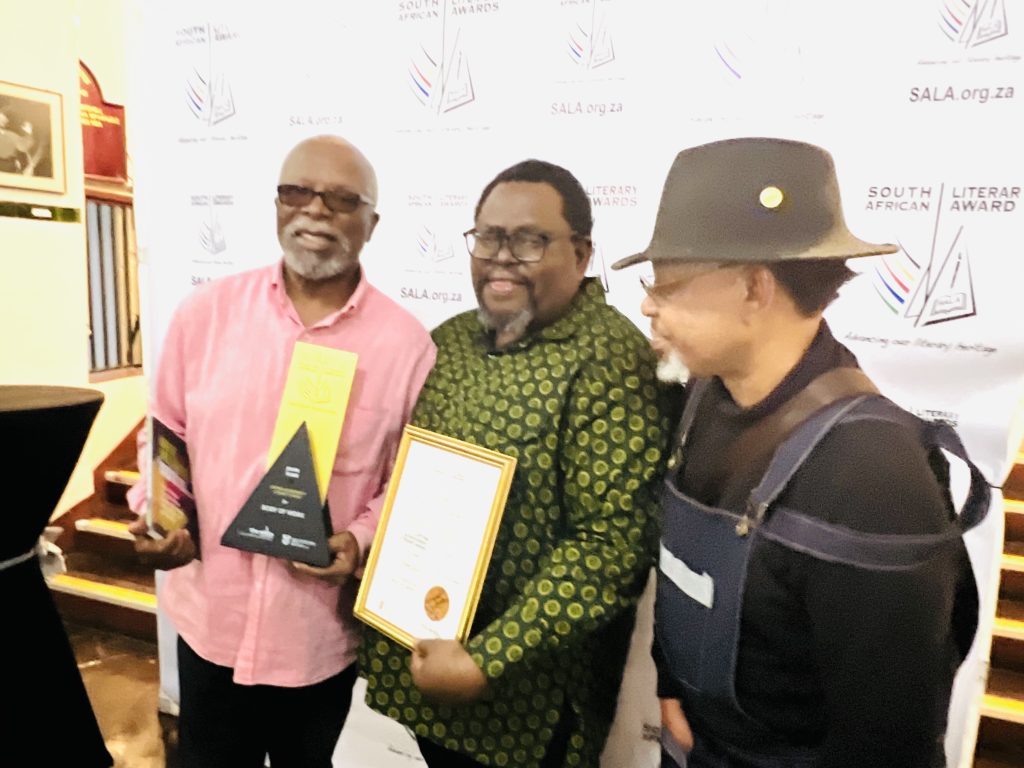
At the heart of the evening stood the formal Citation for Dr John Kani OIS OBE on winning the 20th SALA Lifetime Achievement Literary Award, which I had the honour to read. It captured, with precision and poetic clarity, the meaning of the moment:
“The South African Literary Awards is pleased to finally confer this award upon Dr John Kani.
“Today we do more than honour a career, we honour Dr Kani as a conscience, a voice and a living legend, as a profound archive of our nation’s journey. For decades, through the power of the written and spoken word, you have turned stages, pages and screens into instruments of courage and inspiration. You taught us that language can be a weapon against injustice and a balm for wounded dignity. Your work has carried the pain and poetry of our people, refusing to let the world forget who we are, what we have survived, and how fiercely we insist on our humanity as we chart a new civilisation of human progress.
“On this occasion, it is profoundly fitting that the Lifetime Achievement Literary Award should rest in your hands. You remind us that literature is not only what is bound between covers, but also what is etched into memory through performance, story and moral authority.
As Mongane Serote says ‘this way we salute you’ as a master storyteller, a faithful custodian of our history and a torchbearer for generations of writers and readers still to come.
May this honour reflect back to you a fraction of the light you have poured into our nation’s soul…”
In that citation, several crucial ideas converge:
- Dr Kani is described not simply as an artist, but as “a profound archive of our nation’s journey.”
- His use of language is framed as both weapon and balm – a dual role deeply familiar in societies emerging from violence and trauma.
- Literature is expanded beyond the codex to include performance, memory and moral authority.
- And finally, in invoking Mongane Wally Serote’s phrase, “this way we salute you,” the citation places Kani within a lineage of poet-intellectuals whose work has shaped our collective consciousness.
The citation is, in itself, a miniature essay on what it means to be a literary figure in a country like ours.
“What Are You Reading?” – A Question We Fail Too Often
In his acceptance speech, Dr Kani recalled Raks’ historical journey of artistic involvement and promotion of the written word and its practitioners, through organising writers’ workshops, readings, conferences, international writer-exchange programmes.
“We come from far with you Raks and I am so delighted and honoured that, through your consistency in the literary and cultural industry, you have helped build such institutions as SALA, the wRite associates and others” Dr Kani said
Dr Kani’s response was also as humorous as it was searing. He shared that when he first posted about the Award on social media, more than 37,000 people congratulated him. It is a reminder that, for all our laments about digital distractions, online spaces can amplify the recognition of cultural workers.
But he quickly moved into more uncomfortable territory. In one of his plays, a young man asks what a book is, and the reply is delightfully tactile:
“A book is that thing with pages that you read one by one, then you lick your finger and turn the page to get to the next one. It is not something you Google and scroll.”
From there he launched into a critique that many of us in the literary community know all too well. When South Africans travel abroad, they are often asked a simple question: “What are you reading?” The question exposes a painful reality: we are not, as a nation, reading as we should. We evade the truth with clever responses about “working on” this or that text, when in fact we are reading scripts for survival, not books for nourishment.
In 1982, as he recounted, he and others tried to change this by forming a reading centre, inviting authors to read their books to communities. When authors could not come, they hired unemployed actors, paid them, and still kept the author’s presence central. It was an experiment in marrying reading and performance – an affirmation that the written word and the spoken word are siblings, not rivals.
Writing for Libraries, Not Livelihoods
One of the most stinging parts of Dr Kani’s reflection was his diagnosis of how African writers are forced to think about their own work:
- They write “for the library” – for the one copy that sits on a shelf.
- They write for the ten complimentary copies given by the publisher, which end up as gifts to friends.
- They pray that the Department of Education will prescribe their book for schools, because that is often the only route to meaningful sales.
This is not a sustainable ecosystem. It is a survival strategy. It denies writers the possibility of writing for a real book-buying public, where a title can sell hundreds of thousands of copies at bookstores and allow its author to “make a good living.”
Yet, paradoxically, he emphasised that many of them are not writing out of greed. They are writing because they see a generation under siege from “corrupt and dangerous western values.” They write to save young people, to counter the destructive content that saturates their everyday lives. The stakes are civilisational, not merely commercial.
The Politics of Language and the Imperative to Read in Our Own Tongues
Dr Kani insisted on the importance of reading and speaking in our own languages. “We speak such good English,” he observed, “that we forget the first language we ever spoke.” In his case, that language is isiXhosa.
This is not a nostalgic call to abandon English; it is a call to rebalance the linguistic ecosystem. To write and read in isiXhosa, isiZulu, Sesotho, Setswana, Xitsonga, Tshivenda and others is to assert that our languages are not mere vehicles for “traditional” content, but capable of carrying complex, modern, global ideas.
He argued for a systemic solution: a dedicated public fund to subsidise publishers who produce books in indigenous African languages, freeing them from the tyranny of asking, “Will this sell?” as the first and only question. If we remove the fear of financial failure, and we actively encourage reading in our own languages, we can begin to rebuild a genuine reading culture anchored in African tongues.

The Academy as Sanctuary and Workshop
He spoke with pride of the John Kani Performing Arts Academy at 44 Main, where Professor Zakes Mda and others hold space for writers, actors and directors. The image is powerful: a writing desk, a website inviting you in, sessions with Professor Mda and others. There, young writers are engaged, not as passive recipients, but as creators finding their voices.
The Academy’s work extends into acting, directing and financial management for artists. The latter is crucial. As he pointed out, actors and filmmakers are often seen on stage and screen and then, in the next moment, seen asking the public to “please donate.” The tragic truth is that many of them were never properly paid to begin with. The remuneration system for the arts remains anchored in subsistence, not sustainability.
From Sector to Industry
Perhaps the most important political point he made was about the status of the arts within the national economy. We cannot remain a “sector,” he argued, treated as a decorative fringe or, worse, as a sideshow for mega-events like the G20, where someone calls and says, “We have written a poem; please read it and close the event.”
We must become an industry – with strategies, value chains, upstream and downstream opportunities, and the kind of policy attention that usually goes to mining, manufacturing or finance. That is why he spoke of the need to present government with a coherent five-year plan for arts and culture, and to insist that this is not entertainment but nation-building.
Dignity, Choice and the Refusal to Apologise for Being an Artist
There was humour, of course – stories about an OBE he did not fetch because the British Empire is “low budget,” and how he joked that a president could at least have given him a lift on the plane to the same event.
But beneath the laughter lay a serious message: we must stop treating artistic careers as deviations from the “proper” professions.
“I am a writer.”
“I am an actor.”
“I am a director.”
“I am an artist, a painter, a sculptor.”
These statements should not sound like apologies for not being doctors or lawyers. They should be declarations of a legitimate, respected vocation.
“We did not make a mistake,” he said, “by choosing this path.” That sentence, more than any other, captured the emotional spine of the evening.
We must also insist on better material conditions: that we make enough money to support libraries, to support the next generation, and to build foundations that encourage and promote reading, writing and creativity. We cannot accept crumbs in the form of small royalties that keep us permanently on the hunger line.
“It will only change when we change it,” he insisted. When we stand up and demand. When we present to government a proper plan and say, “This is the strategy for the next five years. This is for arts and culture. This is our role. Buy into this.”
A Vote of Thanks to a Generation
Representing the SALA Advisory Board, Moemise Motsepe’s vote of thanks tied all these threads back into history. He recalled the days of the Federated Union of Black Arts, where music, poetry, dance and visual arts were taught in a precinct infused with the energies of resistance. He spoke of the “trinity” of figures – including Raks and Kani – who inspired an entire generation.
He framed the moment as part of a larger civilisational project: the crafting of a way of life that says, “We are better than where we come from, and we can be even greater.” He described Kani and Raks as “vital elements of the DNA that shapes our collective identity,” insisting that their legacy belongs not only to South Africa, but to the African continent and to the world.
“May your name live forever, golden and remembered,” he concluded. In that blessing, there is both gratitude and a challenge: to build institutions, archives, curricula and cultural industries robust enough to carry those names into the future.
We Are Growing – But How?
So, when Raks says, “We are growing,” what does it mean?
It means:
- We are growing our institutions – theatres, academies, awards, journals, libraries.
- We are growing our alliances – between cities and creatives, between policy thinkers and practitioners, between generations.
- We are growing our courage – to demand better funding, better policy, and better material conditions for the arts.
- We are growing our languages – refusing to let English be the sole custodian of sophistication while our mother tongues are relegated to the margins.
- We are growing our responsibility – to mentor, to teach, to ensure that young writers, actors and readers do not emerge into a cultural desert.
Most importantly, we are growing our refusal to disappear. In a world where algorithms and attention spans seem to conspire against deep reading and serious art, this evening at the Market Theatre was a collective statement: we are still here, we are still writing, still performing, still dreaming, and still insisting that the African story is not a footnote but a chapter in the book of human civilisation.
We are growing.
The question is not whether we will grow.
The question is whether our societies, our governments, our markets and our communities will grow with us.
Click on this link to watch the award conferral video here