
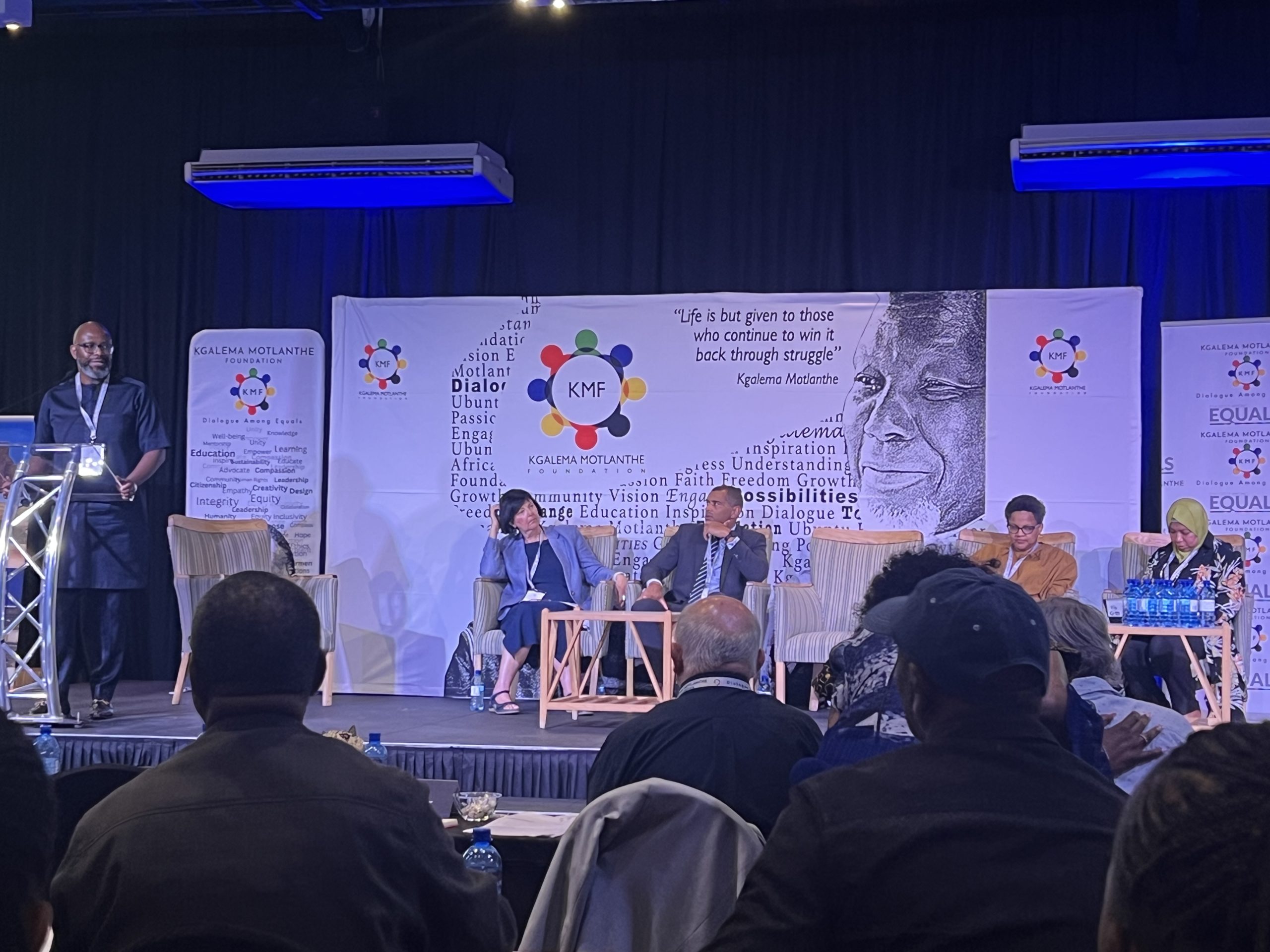
By Saul Molobi, Champagne Sports Resort, Drakensberg
The first plenary of the 2025 Drakensberg Growth Summit, hosted by the Kgalema Motlanthe Foundation, closed with an unflinching conversation on South Africa’s national soul: the need to rebuild self-respect, consequence, and productivity as the cornerstones of renewal.
Chaired by broadcaster JJ Tabane, the session brought together a formidable panel — Reserve Bank Governor Lesetja Kganyago, Justice Edwin Cameron, Dr Amina J. Mohammed (UN Deputy Secretary-General), Former President Kgalema Motlanthe, Dr Mcebisi Jonas, and Absa’s Faisel Mkhize — to debate what one “big idea” could define South Africa’s national interest.
The discussion, both candid and sobering, sought to move beyond rhetoric to real action. What emerged was a tapestry of urgency — a consensus that South Africa’s crisis is not one of ideas, but of integrity, will, and follow-through.
From Political Paralysis to Moral Awakening
Opening the dialogue, Tabane asked the panel to distil the nation’s core interest into one defining value. Former Deputy Finance Minister Mcebisi Jonas replied simply: respect.
“We have a problem of exclusion,” Jonas said. “Too many people remain outside political and economic participation. We must rebuild confidence by strengthening institutions — because when people’s names are implicated and there are no consequences, faith in democracy erodes.”
He added that public servants must rediscover their accountability: “Ask a director-general who they serve — too often, the answer isn’t ‘the public.’ That’s where the decay begins.”
Justice Edwin Cameron: ‘We Have Lost Self-Respect’
Retired Constitutional Court Justice Edwin Cameron extended the argument beyond governance to the realm of national identity.
“I don’t think the rule of law is a myth,” he said, “but it’s tatty around the edges.”
He lamented government’s failure to create a constitutionally mandated independent anti-corruption agency, calling it “a sign of the tattiness.”
But for Cameron, the real crisis lies within the nation’s psyche. “We lack self-respect — black and white, male and female, straight and gay. What do we think we’re worth as a country? Do we think we’re worth failed institutions and criminal syndicates?”
He insisted that the revival of self-respect would compel citizens to demand higher standards from those in power. “If we believed we were worth better, we’d insist on better.”
Lesetja Kganyago: ‘We Must Be Job Creators, Not Job Seekers’
Reserve Bank Governor Lesetja Kganyago took the discussion to economics, arguing that national renewal depends on institutional integrity and productive activity.
“Institutions matter,” he said. “You can destroy an institution without dismantling it — just fill it with pliable people.”
He warned against cosmetic reforms, stressing that without merit-based appointments and consequences for corruption, no economic model can succeed.
On unemployment, Kganyago called for a mindset shift: “Do we want to be a nation of job seekers or job creators? Jobs don’t come from bureaucracy; they come from economic activity. We must create an environment where entrepreneurs can thrive. If you ask bureaucrats to create jobs, you’ll get more director positions, not employment.”
Faisel Mkhize: ‘Banks Must Change or Become Irrelevant’
Responding to questions about the financial sector’s role in enabling small business growth, Absa’s Group Executive for Business Banking, Faisel Mkhize, acknowledged that traditional banking models had failed to include the majority.
“The old systems aren’t working,” he said. “We must find alternative ways to assess risk, understand communities, and support entrepreneurship. If we don’t change, we’ll become irrelevant.”
Mkhize reaffirmed his institution’s commitment to transformation, noting that meaningful progress required “partnership, patience, and policy innovation.”
Kgalema Motlanthe: ‘We Must Identify Catalytic Areas for Growth’
Former President Kgalema Motlanthe brought historical perspective and gravitas to the discussion, insisting that the path forward required decisive investment in catalytic sectors — not endless debate.
“There is no single miracle solution,” he said. “We must focus on education to build skills, and on land reform to resolve the national question. Land must be productive and serve as a commercial instrument, not a political token.”
Motlanthe cited Vietnam as a model: “After decades of war, they gave every household a rice paddy and a buffalo. Today they are the world’s third-largest rice exporter. They don’t see themselves as victims. We too must overcome the psychology of victimhood.”
On national dialogue, Motlanthe cautioned against sprawling agendas. “Identify three or four priorities — cost of living, crime, logistics, and youth enterprise. Focus on what affects people daily. An open-ended dialogue achieves nothing.”
Amina Mohammed: ‘Leadership Must Fear Disgrace’
The most impassioned moment came from Dr Amina J. Mohammed, the UN’s Deputy Secretary-General, who challenged South Africans to rekindle their activist spirit.
“Leaders must feel disgrace,” she said. “They must fear the people, because the people are the ones they serve. When there’s no fear or shame, impunity thrives.”
Mohammed pointed to Africa’s growing instability, where coups in West Africa have gained public support. “It’s frightening when unconstitutional change becomes popular because democracy has failed to deliver. That’s the real danger.”
She urged citizens to act: “People must stand up, hold leaders to account, and use every tool available — peaceful mobilization, digital activism, lawful pressure. You can’t start a fire with ash; find the live sparks and build from there.”
The UN and Global Governance
Asked about reforming the UN Security Council, Mohammed admitted progress was slow but not impossible.
“The reality isn’t good, but the hope is in the Charter,” she said. “The UN was built on power realities, and power doesn’t yield easily. But small reforms matter — like requiring states to explain vetoes before the General Assembly. We need a rebirth of the UN that reflects today’s world.”
She expressed hope that the next Secretary-General — due to be elected next year — would finally be a woman. “After 80 years, if you haven’t had a woman Secretary-General, you haven’t made it,” she said to applause.
The Final Word: A Call for Courage and Focus
In closing, Mcebisi Jonas returned to the microphone, offering a pragmatic challenge:
“We need to bring together those committed to defending democracy and building inclusive growth before the next election. If the Government of National Unity collapses, we face real danger. The dialogue must be focused, not endless.”
The session ended with spontaneous applause — not for any one speaker, but for a shared realization: South Africa’s crisis can only be resolved through self-respect, consequence, and courage.
As Justice Cameron summed it up earlier in the day: “Self-respect combined with action — that’s what we have to recover.”
And as the mist rolled down the Drakensberg slopes, the message lingered: the time for reflection is over. The nation must act — and act with integrity.