
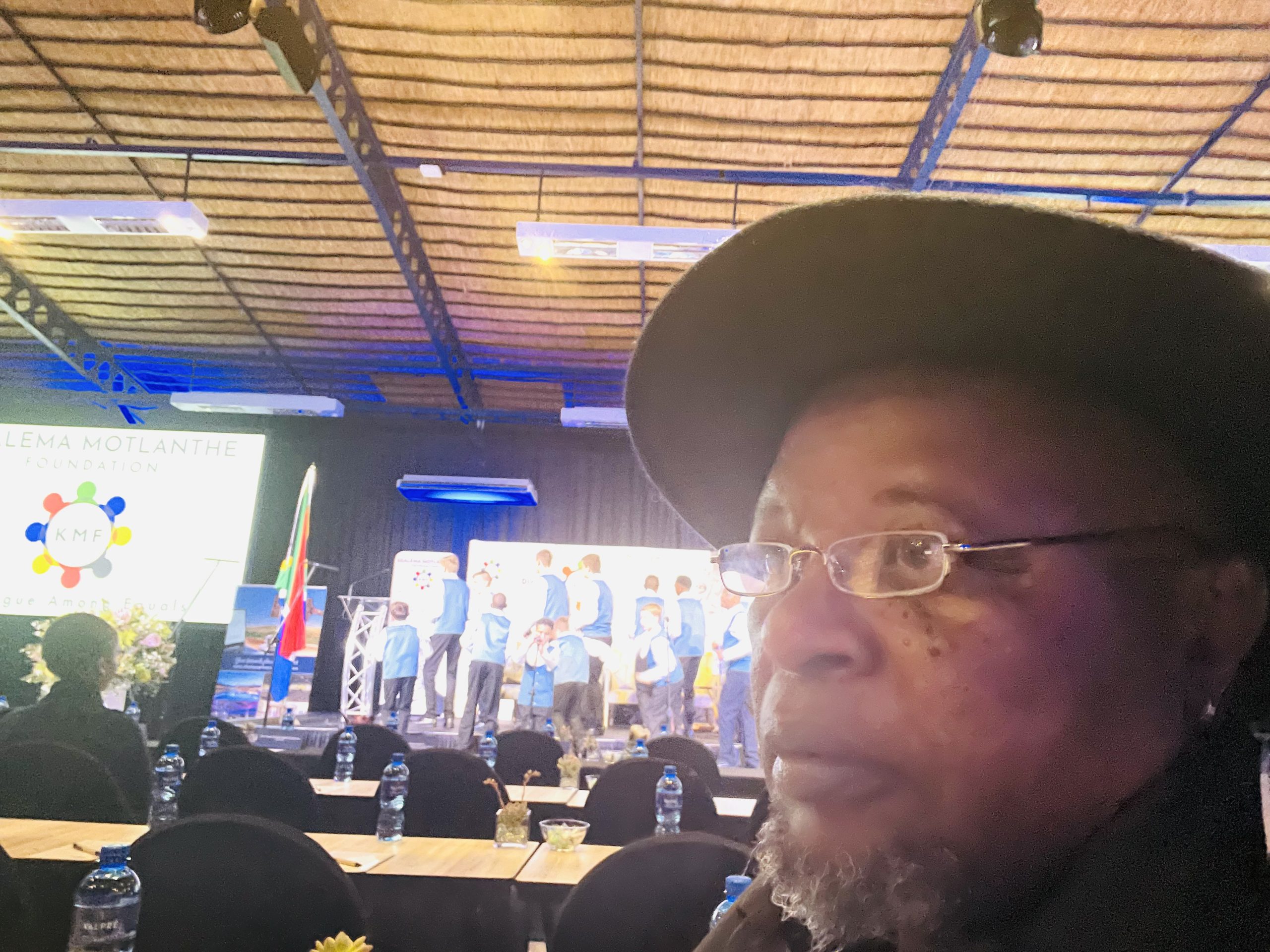
It is a privilege for me to attend the annual Drakensberg Growth Summit, hosted by the Kgalema Motlanthe Foundation (KMF) at the Champagne Sports Resort from Friday to Sunday this weekend. Set against the majestic backdrop of the Drakensberg mountains, this gathering is more than a conference — it is a moral compass for the nation; a space where ideas meet integrity, and reflection transforms into resolve.
Day One began with Gugu Motlanthe, Executive Trustee of the Foundation, reminding us of the collaborative ecosystem that sustains this dialogue. She expressed heartfelt gratitude to the principal sponsor, Absa, represented by Mr. Faisal Mkhize, Chief Executive of Business Banking; to MTN Group, represented by Group President and CEO, Mr. Ralph Mupita; and to diplomatic and institutional partners — the Embassy of the People’s Republic of China, European Investment Bank, Power China International Group, and Huawei Technologies SA. She further acknowledged the in-kind support from Champagne Sports Resort and the Mackay family, the European Union Delegation of Southern Africa, the United Nations Resident Coordinator’s Office, and the African Oral History project.

Her acknowledgements went further — honouring the distinguished guests in attendance: from former ministers like Trevor Manuel, to Mcebisi Jonas, Dr. Lisa Osnati Manu, John Jeffrey, and Finley Makulani, to academic leaders such as Professors Nick Bernadel, Vedi, Amanda Makaria, Busani Nawepi, and Musa Mashabane, as well as former Statistician-General Dr. Pali Lehohla, and Advocate Mojanku Gumbi.
Opening the proceedings, Executive Trustee Gugu Motlanthe reminded delegates that we meet amid overlapping global crises — crises demanding not rhetoric but resolve. “The world is experiencing great changes unseen in centuries,” she observed, quoting Xi Jinping, and in that observation lay a profound truth: the global order is shifting beneath our feet.
Her words framed the weekend’s dialogue within a sobering context — geopolitical realignments, protectionist economics, digital disruption, and widening inequality — all converging to test South Africa’s resilience. Yet, amid this turbulence, she called for a reassertion of African agency, rejecting “blackmail into alliances that do not serve our national interest.”
Motlanthe’s speech was as much a reflection on conscience as it was a meditation on leadership. She cited the 92-year-old activist Audrey Coleman, whose moral clarity on Palestine reminds us that conscience itself has become a radical act.
Her emphasis on youth — “one in every five people on Earth today” — was a rallying cry. Harnessing Africa’s demographic power, she said, was not optional but existential. “Our people are not waiting for handouts; they are waiting for a chance.”
This tapestry of government, academia, business, and civil society embodied the very spirit of partnership that defines the Foundation’s mission — building bridges across sectors, generations, and ideologies in pursuit of South Africa’s common good.

The programme that followed unfolded like a living dialogue between conscience and capacity.
In his reflections, Mr. Faisal Mkhize, Chief Executive of Business Banking at Absa Group Limited, echoed the spirit of collaboration that defines the Drakensberg Growth Summit. Expressing gratitude for the opportunity to share the platform with leaders from government, business, and academia, he affirmed Absa’s pride in its partnership with the Kgalema Motlanthe Foundation, describing it as “a partnership of purpose.” He spoke of how the Summit had, over the years, become a space for learning and synergy — a platform where stakeholders do not tell one another what to do, but rather learn from one another’s innovations and struggles. He underscored the importance of partnerships between government, NGOs, and business, noting that some of South Africa’s most meaningful progress has emerged from such cooperation. Mkhize observed that, while the global environment remains turbulent, Africa has a “golden opportunity” to strengthen intra-continental trade and make tangible progress through the full implementation of agreements like the AfCFTA. He cautioned that business cannot stand by issuing criticism from the sidelines — it must participate, influence, and act deliberately to shape a better future. Reflecting on Absa’s initiatives, he highlighted the bank’s collaboration with institutions such as UNISA to support research and policy development for small business growth, as well as social interventions like providing bicycles to rural schoolchildren near Musina to improve access to education. These, he said, are “small steps that make a big difference” — a reflection of how partnerships can move beyond rhetoric to change lives. His remarks framed the weekend’s dialogue not as a ceremonial exercise, but as a catalyst for shared action, rooted in humility, accountability, and hope.
Justice Edwin Cameron opened the intellectual proceedings with a stirring reflection on leadership and moral duty. His voice — part philosopher, part jurist — cut through the comfort zones of complacency. He reminded us that the decay of institutions is not inevitable but chosen. “Nothing is irremediable,” he asserted, urging South Africans to restore public trust by reasserting ethical leadership, rebuilding the rule of law, and reclaiming the moral centre of public service. His was a sermon of reason and responsibility — an insistence that decency and courage are not luxuries, but obligations.
Then came President Kgalema Motlanthe, whose keynote carried both gravitas and gentleness — the authority of experience tempered by humility. He spoke not from the vantage of power, but from the conviction of purpose. He reminded the summit that leadership, to be authentic, must be people-centred and globally conscious. Drawing from Africa’s position in a fractured geopolitical order, he warned against nationalism that forgets humanity and governance that neglects the vulnerable.
Motlanthe defined the national interest not as self-preservation, but as the shared pursuit of justice, equity, and dignity — within and beyond borders. “We are being tested,” he said, “morally, politically, and economically. The question is whether we will rise to the challenge or retreat into cynicism.”

When Dr. Amina J. Mohammed, Deputy Secretary-General of the United Nations, took the podium, the room shifted. Her speech transcended policy; it was a humanistic manifesto for a new era of global accountability. She spoke of youth and gender inclusion not as development clichés, but as moral imperatives. In a world redefined by artificial intelligence, shifting demographics, and widening inequality, she argued, Africa cannot afford to remain an observer. “The truth is,” she said, “AI does not care about jobs or workers. The lesson for Africa is clear — invest in digital skills, support our youth and entrepreneurs, and design protections for those most at risk.”
Her tone was pragmatic yet prophetic — a reminder that multilateralism must be reborn through African agency, not dependency.

Governor Lesetja Kganyago followed with an address that blended economic clarity with moral insight. His message was precise: macroeconomic stability is not a technocratic exercise — it is a social compact. By explaining the interplay between exchange rates, inflation, and national credibility, he showed that fiscal integrity is itself an act of nation-building. “A strong currency begins with strong institutions,” he noted, echoing the day’s recurring theme that leadership and accountability are the twin engines of sustainable growth.

Another milestone presentation came from Mr. Mcebisi Jonas, former Deputy Minister of Finance and now Chairman of MTN Group. If Cameron’s tone was judicial and Motlanthe’s was reflective, Jonas’s was diagnostic — a sober assessment of our political economy. He described a country “running without a script,” where leadership has lost the discipline of long-term vision.
He warned that South Africa’s crisis is not one of talent or ideas, but of leadership and organisation. “Leadership is everything,” he said. “Organisation is the scaffolding of society. Without it, bold visions remain empty words.” His call to action was direct: transformation must move from rhetoric to reality, bringing women, youth, and rural communities into the mainstream of development.
Former President Motlanthe, in his final remarks, wove the threads of the day into a single tapestry of insight. He spoke softly, but his words landed with force: “We must recommit ourselves to the values of our Constitution — dignity, equality, justice, and solidarity. These values are not abstractions; they are the foundation of our humanity.”

As dusk settled over the Drakensberg, the summit hall felt charged with a renewed sense of possibility. Day One ended not in applause, but in reflection — as though the mountains themselves were listening.
The Drakensberg Growth Summit continues to stand as one of the few spaces in South Africa where substance outweighs spectacle, and where ideas are not mere performance, but propositions for action. This year’s first day reaffirmed that leadership, at its truest, is an act of service — a dialogue between what is and what must be.
And as I left the hall that late into the night, I could not escape the quiet conviction that the future we seek will not be scripted in policy documents alone, but written — day by day — in acts of accountability, courage, and conscience.
Tujenge Afrika Pamoja! Let’s Build Africa Together!
Enjoy your weekend.
Saul Molobi (FCIM)
PUBLISHER: JAMBO AFRICA ONLINE
and
Group Chief Executive Officer and Chairman
Brandhill Africa™
Tel: +27 11 759 4297
Mobile: +27 83 635 7773
Physical Address: 1st Floor, Cradock Square Offices; 169 Oxford Road; Rosebank; JOHANNESBURG; 2196.
eMail: saul.molobi@brandhillafrica.com
Website: www.brandhillafrica.com
Social Media: Twitter / Instagram / LinkedIn / Facebook / YouTube / Jambo Africa Online / WhatsApp Group / 101.9 Chai FM