
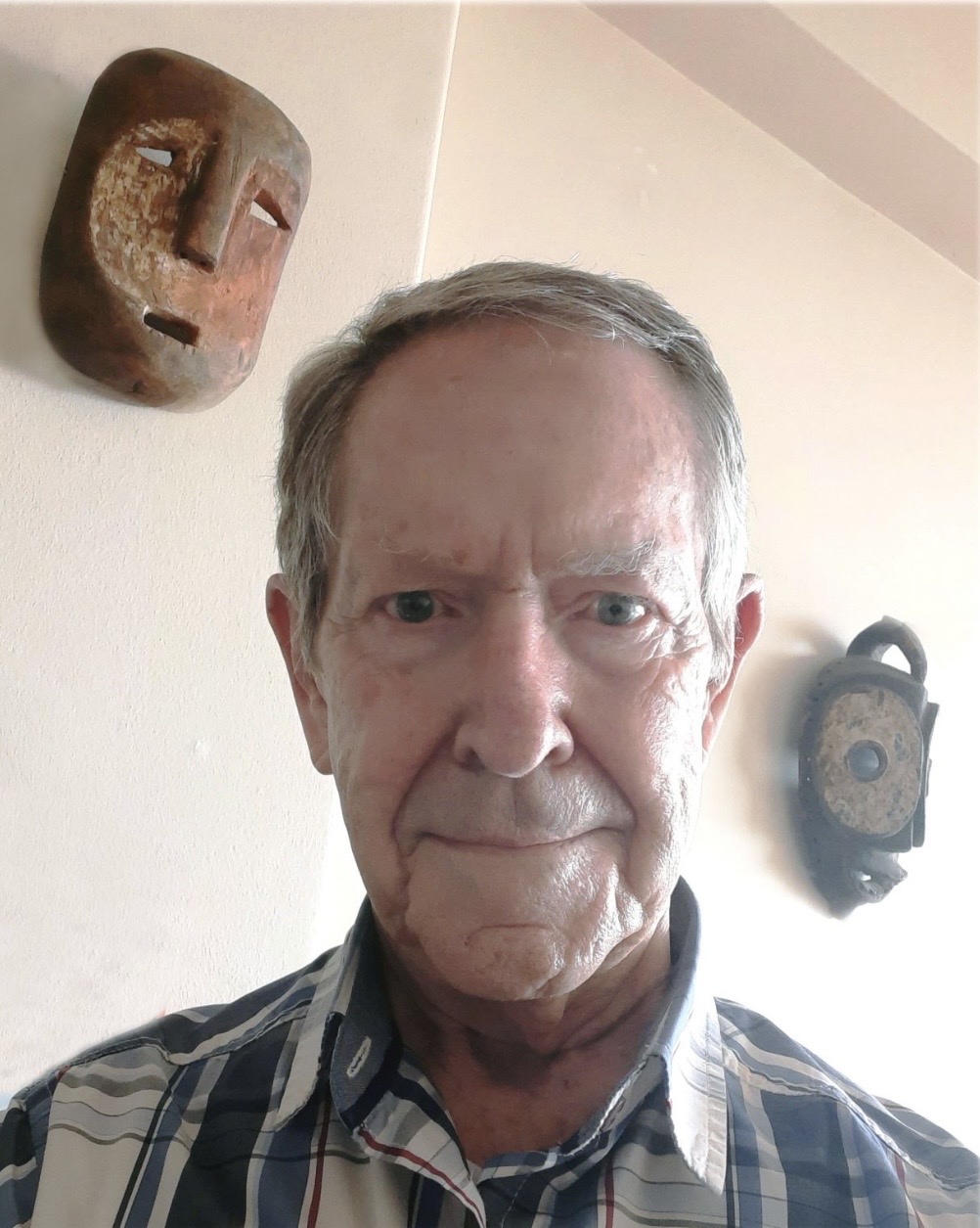
By Saul Molobi
“A great thinker has ceased to think…”
These were the solemn words with which Friedrich Engels marked the passing of Karl Marx – words that carried not only the weight of loss, but the magnitude of an intellectual silence that follows when a profound mind departs from the world.
I first met unce Frank Horley in 1994 when I joined Heinemann Publishers as a Publisher, while he served as Marketing Manager. Coming from an anti-apartheid publishing background – as an activist who had spent 13 months in detention – I was somewhat apprehensive about the kind of people I would encounter in this new environment. Yet I also knew that joining Heinemann, instead of entering the public service, was a profound opportunity. After all, my own political awakening had been shaped in no small measure by the Heinemann African Writers Series (AWS), which published towering figures such as Chinua Achebe and Ngũgĩ wa Thiong’o, alongside many of the continent’s literary and struggle heroes.
Heinemann’s history deepened my respect for the institution – it had disinvested from South Africa in support of the global anti-apartheid movement and had even published the then-banned Long Walk to Freedom, a collection of speeches by Nelson Mandela. My apprehension, however, stemmed from the company’s re-entry strategy through the acquisition of South African publishing houses. I wondered what this transition would mean in human terms – who we would become in the process.
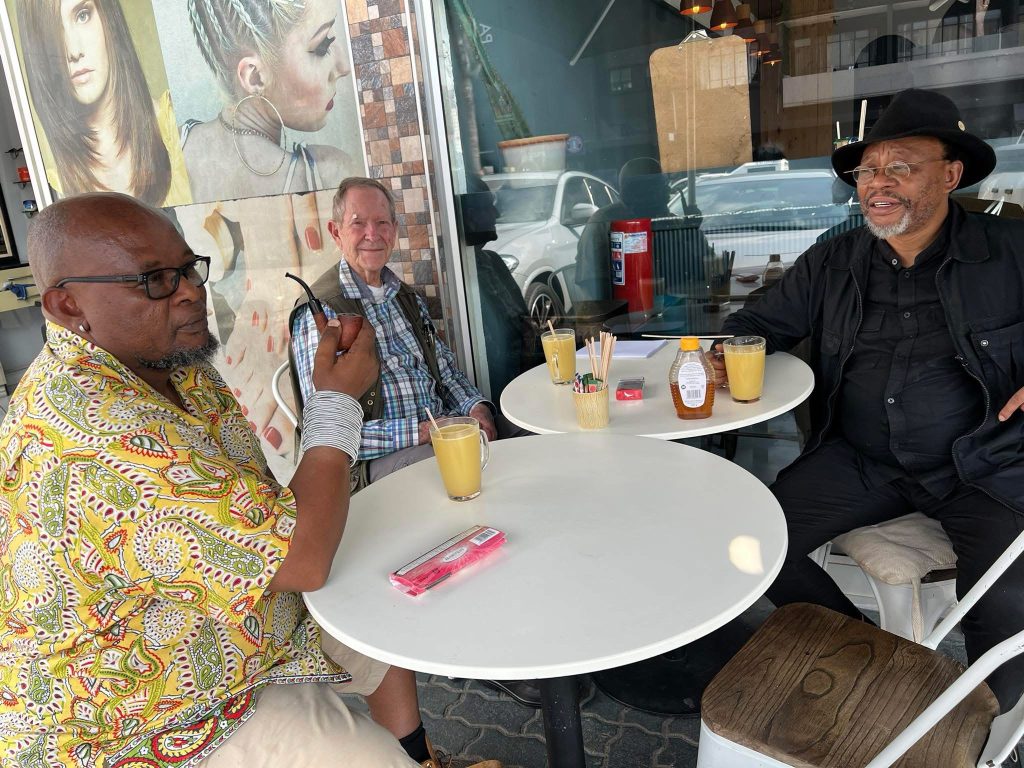
*** Saul, uncle and Leslie Dikeni, one of our crazy friend and fellow scribe ***
That anxiety quickly dissolved. The Managing Director, Kevin Kroeger, invited me to his office after hearing from Judy Norton that Learn & Teach Publications was closing down. At the time, I was Editor-in-Chief of Learn & Teach Publishers and Executive Director of the Independent Magazine Group – a shared services centre for publications such as Learn & Teach, SPEAK, and SA Labour Bulletin. From my very first interactions, I found the Heinemann staff to be warm and welcoming.
But the true turning point – indeed, the cherry on top – was meeting uncle Frank.
We became more than colleagues. He called me his nephew, and I, in turn, called him my uncle. A year later, Dustin Ramahanedza joined Heinemann, and uncle Frank gained a second nephew. Their bond was equally genuine – so much so that uncle Frank would give Dustin lifts to and from work. Yet even in these simple routines, one encountered his discipline: time management was non-negotiable. If he arrived and Dustin was not ready, he would not take kindly to waiting. It was a quiet but firm lesson in respect and accountability.
This quality served us well when we worked closely together to promote the Mamela Africa Series – an African-language counterpart to the AWS. I often drove him to corporate offices as we solicited sponsorships to purchase books for donation to train commuters travelling between Pretoria and Johannesburg. Although later I was, in formal terms, senior to him as Publishing Director, we related as equals – partners in a shared mission to cultivate a culture of reading and book ownership among our people.
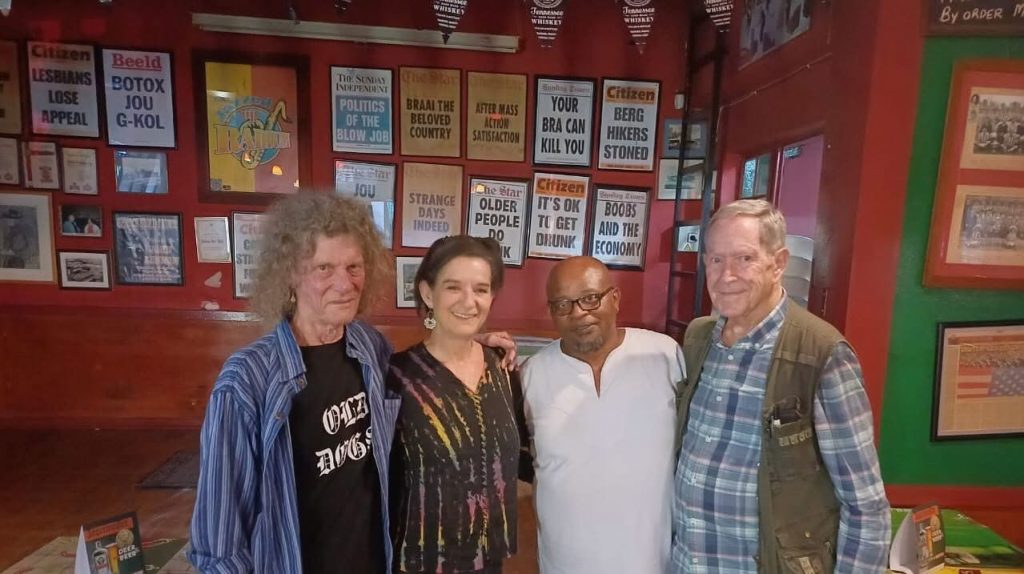
*** Saul, uncle Frank with Amanda Risi and Bill Knight at uncle’s most favourite eatery, The Radium Beerhall, a city heritage site where uncle harboured fond memories of his 60th birthday and the burial service of his bosom artist friend, Fred Schimmel ***
Uncle Frank later afforded me the honour of writing the foreword to his book, African Alphabet, published in 1999. I felt deeply privileged – such a gesture, I believed, was reserved for those of considerable stature. In his quiet way, he made one feel seen, trusted and affirmed.
He was the most genuine, honest, humble, and dependable person I have known – true to his name, Frank in every sense. He was never pretentious. If he genuinely liked you, he threw his whole being into the relationship – fully present, fully invested. Equally, if he discerned traits in you that were unbecoming, he would quietly distance himself. Yet, should you find yourselves in the same space, he would never behave awkwardly or with disrespect. His integrity was consistent, his humanity unwavering.
He never sought favour or advantage from his friendships. He moved seamlessly between worlds, befriending both ordinary people with no material means and multimillionaires of profound influence – treating each with equal dignity and respect. To me, he embodied the very essence of pan-Africanism.
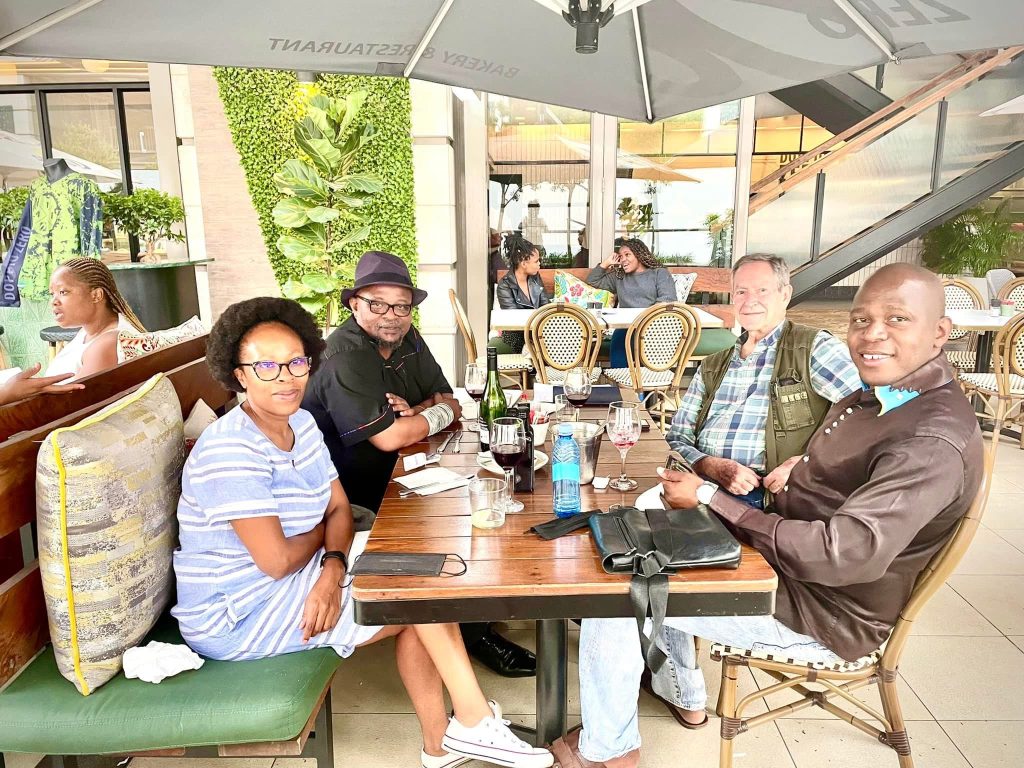
*** The ex-Heinemann crew – Joyce Mushi, Saul Molobi, uncle Frank and Dustin Ramahanedza – met for lunch in 2024 ***
I often recalled the words of Gwede Mantashe, who, in responding to those who criticised the appointment of Gill Marcus as Governor of the South African Reserve Bank on the basis of race, remarked that she was “more African” than many of her critics – pointing to how she embraced African identity in her everyday life, even wearing dashikis while others adorned themselves in imported luxury brands. Uncle Frank lived this ethos not as rhetoric, but as daily practice.
When many white residents – and indeed some of us in the black middle class – fled the Hillbrow-Berea precinct amid the influx of African migrants, uncle Frank chose to remain in Yeoville. He saw not threat, but humanity. He would laugh at the irony that some of us, his own black friends, were too afraid to visit him – perceiving Yeoville as dangerous precisely because it had become more African.
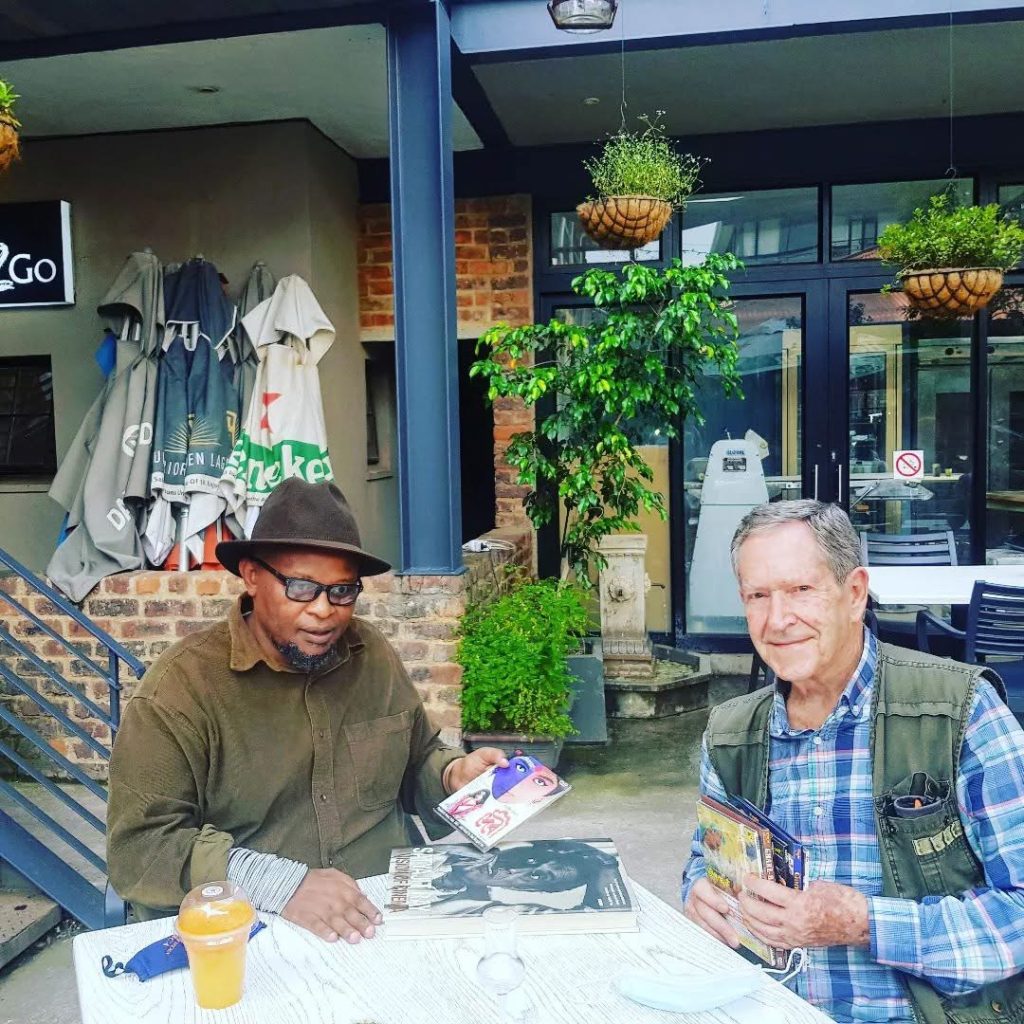
There are many anecdotes that capture his spirit. I recall a moment when our colleague, Rochelle, upset with her partner, joined uncle Frank and me in conversation. After sharing her concerns, she asked, “How are men?” Without hesitation, uncle Frank responded, “I don’t know, ask Mike.” Mike, overhearing his name, joined in, and when we explained, he replied with a smile, “Because I’m gay, you think I know how men are?” I could not contain my laughter. It was a moment of wit, humility, and shared humanity.
A more recent memory stands vividly in my mind. Two years ago, at my mother’s funeral, Dustin – now a priest – went shopping and bought sherwanis for both himself and uncle Frank. When they arrived, the church service had already begun. The ushers, seeing their attire, directed them to sit among the clergy behind the pulpit. With a white “priest” now among them, interpretations became necessary, and Dustin rose to perform them. Uncle Frank simply played along – quietly assuming the role. Little did the congregation know that he was, in truth, delighting in the music, listening attentively as the entire gathering sang from memory.
After the burial, villagers gathered around him. Children, wide-eyed with curiosity, touched his hand – some encountering a white person for the first time. Unemployed adults approached him with hope, seeing in him a possibility, perhaps even a future job opportunity. His presence transformed the moment. For me, it made my mother’s funeral unforgettable. For him, it was equally profound – to witness nearly 500 people gathered to honour the life of an ordinary woman, not a political figure, but deeply loved.
In 1998, when I was working on a film project for my MA Dramatic Art practicals, uncle Frank stepped in as one of the main actors. The film was based on Dawn Garisch’s A Quick Trick. His willingness to participate spoke volumes about his generosity of spirit – always ready to support, to show up, to give of himself.
Although I left Heinemann in December 1999, I remained very close to uncle Frank. He played a crucial role in my life. African traditions dictate that an uncle occupies a central place in a nephew’s romantic life – often more so than the father. It is uncles who lead lobola negotiations, and it is to them that one turns when navigating marital challenges. True to this tradition, uncle Frank became my first port of call during the turbulences of my own marital journey. Though he was never married, he was deeply insightful – equipping me with survival tactics for both marriage and, later, my post-divorce life. He was a safe space where I could reveal my vulnerabilities. He would critique me without judging or condemning me.
As life took me from Yeoville to Midrand, Polokwane, and Pretoria, uncle Frank understood that those spaces were his homes too. The only home of mine he never visited was in Milan, during my diplomatic posting – but even then, our conversations remained constant. We spoke often, updating each other, sustaining a bond that distance could not diminish.
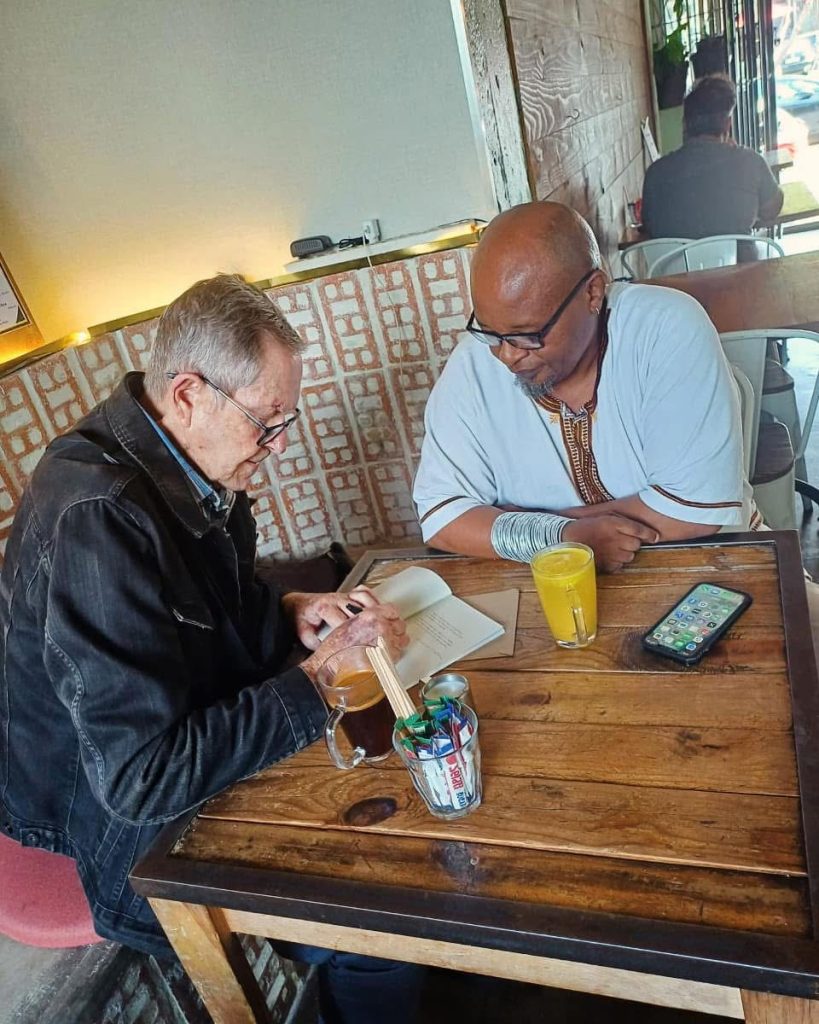
In 2020, when I made the decision to go into business full-time, uncle Frank was among the first people I consulted. By then living in Norwood, I introduced him to Loof Coffee – an unassuming gem that serves what I still consider the finest ginger tea in Johannesburg, if not the entire country. That café became our weekly meeting place, a quiet sanctuary for reflection, conversation, and continuity.
It was also within this phase of my life that our professional relationship found new expression. My company, Brandhill Africa, was conceived as a vehicle to manage the reputations of personalities, corporates, and places – each as integral components of the broader brand Africa narrative. Our delivery platforms – marketing and communications consulting, publishing, and event management – were all anchored in advancing economic diplomacy through the deliberate crafting and telling of compelling brand stories.
In this journey, uncle Frank – an accomplished author, illustrator, and publisher – offered me unwavering and unqualified support. More than that, he provided the kind of rigorous, honest critique that every author hopes for but few are privileged to receive. His feedback was never ornamental; it was precise, thoughtful, and always in service of excellence.
Five years into this journey, uncle Frank’s imprint became indelible – his name appearing across all my publications, not only as a meticulous proofreader but also as a strategic sales and marketing mind. He was not merely contributing; he was co-shaping the intellectual and commercial architecture of the work.
To say that I am intellectually poorer without him would be a profound understatement.
That was uncle Frank: unpretentious, principled, deeply human – a bridge between worlds, and a living embodiment of dignity, humility, and belonging.
Today, I find myself reaching for those very words, not in imitation, but in recognition of a similar void. For in mourning the passing of uncle Frank, I am confronted with the quiet, immeasurable absence of a man whose mind was in constant motion – observing, interrogating, refining, and giving meaning to the world around him. He may not have stood on the grand stages of political philosophy, but in the intimate theatres of publishing, human relationships, and everyday life, he was every bit the thinker – precise, reflective, and disarmingly honest.
A great thinker has indeed ceased to think.
And in that silence, those of us who had the privilege of engaging with him – of being sharpened by his critique, steadied by his wisdom, and warmed by his humanity – must now come to terms with a loss that is both deeply personal and profoundly intellectual.