
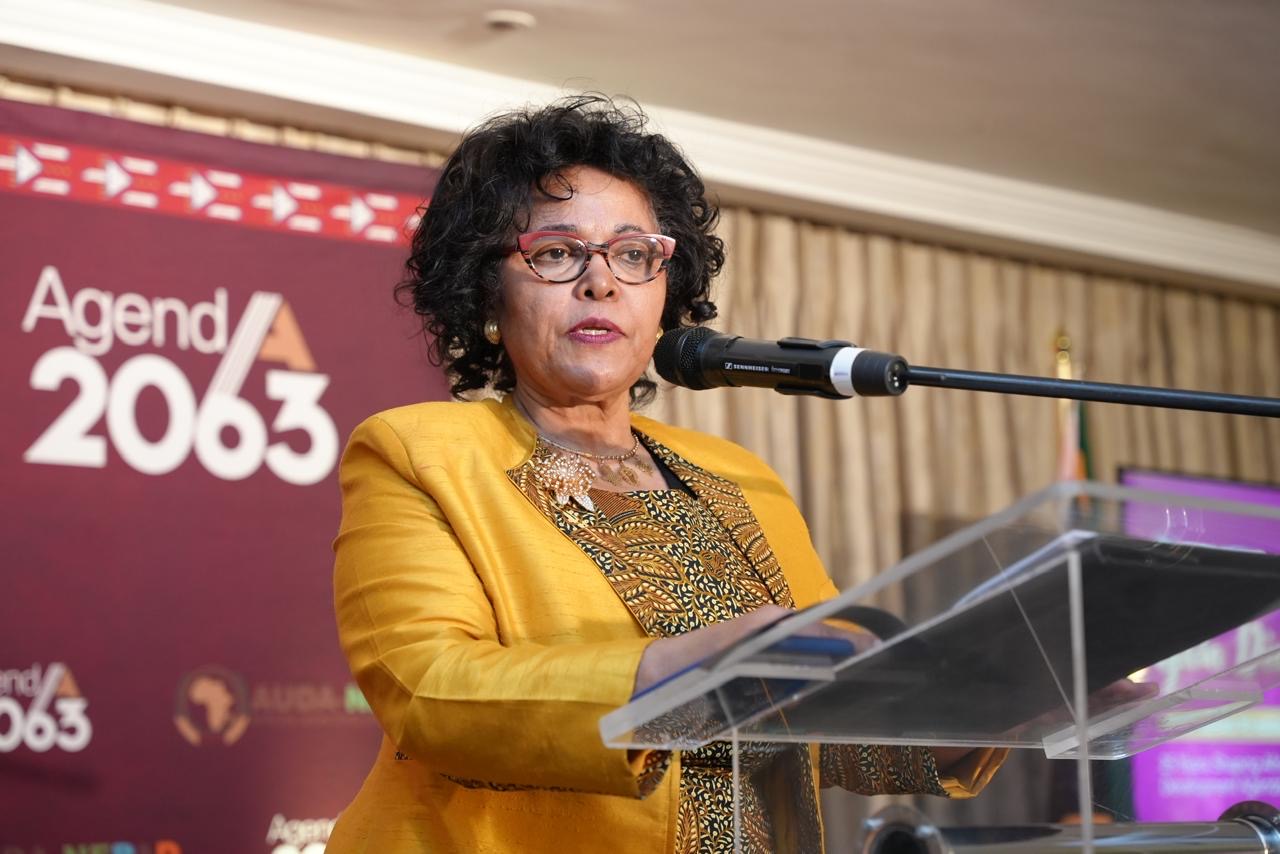
This is a speech delivered during the Gala Dinner on 14 May 2026 was held on the sidelines of the 74th Ordinary Session of the AUDA-NEPAD Steering Committee – convening in Johannesburg…
This is not a small occasion. Twenty-five years is a measure of time, yes — but it is also a measure of resolve.
It is a reminder that institutions are not built in a single moment. They are built through conviction, through continuity, through difficult choices, and through the discipline of carrying an idea across generations.
Tonight, therefore, is not only a celebration. It is a moment of reflection and renewal.
We gather to honour a choice made in 2001 — a deliberate, political and intellectual choice by a generation of African leaders who believed that Africa could no longer be spoken for, planned for, or developed from the outside.
In 2001, Africa was at a crossroads. The continent had lived through decades of structural adjustment, fragmented institutions, debt distress, and development models designed elsewhere and imposed here.
Too often, Africa was discussed in terms of what it lacked. Too often, partnership meant conditionality without ownership, projects without programmes, and financing without full alignment to African priorities.
It was in that context that a group of remarkable leaders made a different choice. President Thabo Mbeki, President Olusegun Obasanjo, President Abdelaziz Bouteflika, President Abdoulaye Wade, President Hosni Mubarak, and their colleagues across the continent, declared that Africa must author its own development story.
They called it the New Partnership for Africa’s Development — NEPAD.
And the word “partnership” mattered. NEPAD did not reject partnership. It redefined it. It said partnership could only be genuine if it was rooted in African ownership, mutual accountability and respect.
It said Africa would be accountable first to its own people. It said the continent would strengthen governance, subject itself to African peer review, build regional integration as an economic and political necessity, and engage the world with confidence.
That was the founding vision. And twenty-five years later, that vision still carries force.
Excellencies,
Over the past quarter century, NEPAD — and now the African Union Development Agency— has contributed measurably to reshaping how Africa acts on its own development.
AUDA-NEPAD has helped institutionalise Agenda 2063 by translating the African Union’s long-term vision into programmes, frameworks and country-level delivery support.
Through PIDA, we have helped build a continental infrastructure pipeline aimed at connecting economies that were once structurally isolated from each other.
Through CAADP, we have supported the shift from agriculture as subsistence to agriculture as transformation, food security and economic opportunity.
In health, the work on African Medicines Regulatory Harmonisation has helped countries move toward stronger regulatory systems and a more coherent African voice on medicines and vaccines — a lesson made urgent by the inequities exposed during the COVID-19 pandemic.
In science, technology, innovation and youth development, AUDA-NEPAD has continued to support the capabilities Africa needs to compete, produce and solve its own challenges.
Excellencies,
These efforts have done more than produce programmes and frameworks. They have helped change the terms on which Africa speaks about its own development. NEPAD helped move the continent from a language of dependency to a language of ownership; from aid as the centre of ambition to investment as an instrument of transformation; from national isolation to regional integration; and from declarations of intent to frameworks for implementation.
That is a legacy worth recognising.
But the purpose of an anniversary is not only to affirm what has been achieved. It is also to ask, with honesty, whether our institutions are moving with the speed, scale and discipline that Africa’s realities now demand.
And here, we must be clear: the distance between continental ambition and delivery on the ground remains too wide.
Too many infrastructure projects are still underprepared and unfinanced. Too much intra-African trade remains constrained by fragmented systems, weak logistics and limited productive capacity. Too many African resources still leave the continent raw, with too little value retained in African economies. Too many young people remain outside productive employment, skills pathways and digital access. Too many institutions are expected to deliver transformation without adequate authority, capacity or financing. And too much of Africa’s development financing is still shaped from outside the continent.
This does not diminish what NEPAD has achieved. It defines the work that AUDA-NEPAD must now take forward.
Because the next chapter cannot be measured only by the strength of our vision. It must be measured by the quality of our execution, the readiness of our projects, the resilience of our institutions, the capital we mobilise, and the results our people can see and feel.
That is why the transformation from NEPAD into AUDA-NEPAD was not simply a change of name. It was a change of gear — from planning to execution, from coordination to delivery, from aspiration to implementation.
Our mandate today is to close the distance between policy and reality. It is to take the architecture of Agenda 2063, the AfCFTA, PIDA, CAADP and other continental frameworks, and help convert them into projects, systems and results that can be financed, built, measured and felt by African citizens.
That is the work. And in this next chapter, implementation is now the test of sovereignty.
If Africa is to shape its future, AUDA-NEPAD must help accelerate regional integration and industrialisation, because our future depends on processing, producing and trading more within our own continent. We must help deliver infrastructure and energy connectivity, because no economy industrialises in the dark. We must strengthen food systems and climate resilience together, because climate change is not a future risk for Africa; it is a present reality affecting harvests, livelihoods, infrastructure and fiscal space.
We must invest in health sovereignty and human capital. We must support young people not only as beneficiaries of development, but as builders of Africa’s productive future.
We must mobilise African domestic resources and African capital, because Africa cannot outsource its development ambition. And we must build stronger institutions, because capacity is the hard infrastructure of delivery.
The world has changed since 2001. Climate pressure, debt distress, geopolitical competition, technological disruption, supply chain restructuring and the energy transition are reshaping the global landscape. Africa’s population will continue to grow rapidly in the decades ahead.
The question is whether that growth will be accompanied by productive capacity, industrialisation, employment and dignity.
That is why the next 25 years must be judged not only by the quality of our visions, but by the discipline of our delivery.
To the founders of NEPAD, we owe gratitude. But more than gratitude, we owe outcomes.The truest tribute is not this dinner.
It is the infrastructure that connects communities. It is the farmer with better markets. It is the young entrepreneur with access to finance and technology.
It is the medicine manufactured in Accra, Durban, Kigali or Cairo, approved through strong African regulatory systems, and distributed without external gatekeeping. It is the regional corridor that carries not only goods, but jobs, industry and opportunity.
That is the tribute that matters.
To our Member States, the African Union, the Regional Economic Communities, development partners, private sector leaders, and the staff of NEPAD and AUDA-NEPAD past and present — thank you.
You have carried this institution through different phases of its journey. You have kept the idea alive. And now, together, we must make the next chapter more concrete, more disciplined and more decisive.
Twenty-five years ago, NEPAD declared that Africa could lead its own development.
Today, AUDA-NEPAD must help prove that Africa can finance, build, industrialise, integrate and deliver its own development.
That is our mandate. That is our mission. And that is where the next chapter begins.
Thank you.
***
Mrs Nardos Bekele-Thomas is the Chief Executive Officer of AUDA-NEPAD