
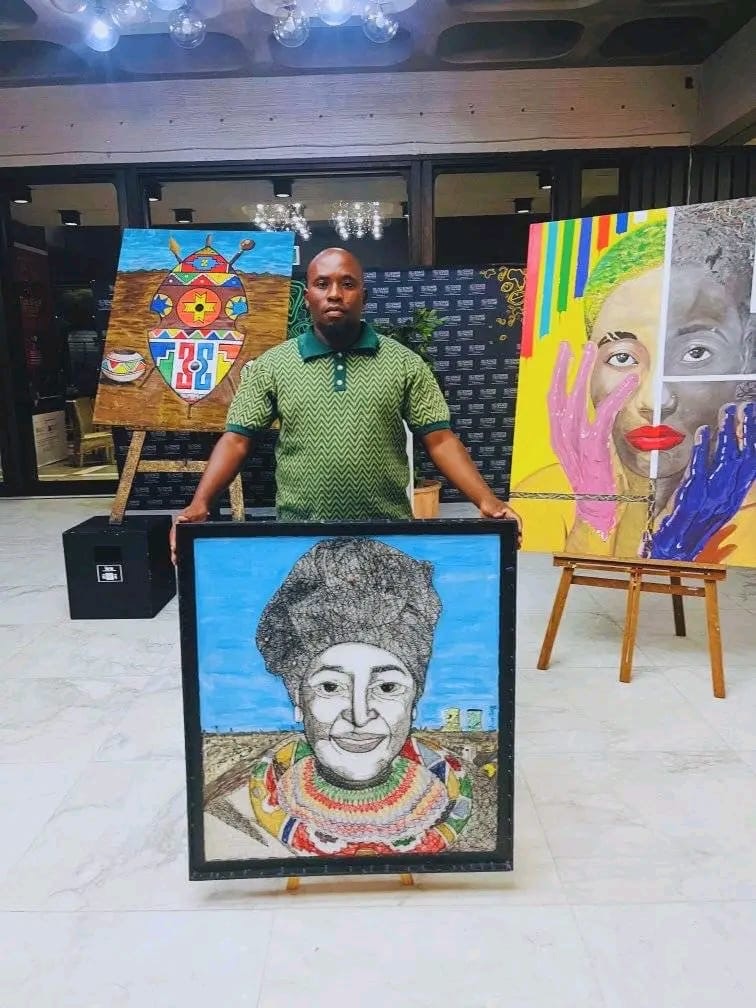
Our Publisher, SAUL MOLOBI, profiles LUCAS NDALA who rose from the dusty streets of Winterveld to the frontiers of contemporary African art
“Every work of art begins long before the first brush touches the canvas. It begins in memory, in struggle, in identity and in the dreams of a child who believes that imagination can transform the ordinary into the extraordinary.”
Few stories capture the resilience of South Africa’s creative spirit more powerfully than that of Lucas Ndala. His journey is not simply the story of an artist building a successful career. It is the story of a young boy who transformed scarcity into creativity, tradition into innovation and personal talent into a vehicle for community empowerment.
Today, Ndala stands among a new generation of African creatives redefining what it means to be both an artist and an entrepreneur. Through painting, sculpture, charcoal, digital illustration, string art, fashion customisation and community development, he has demonstrated that artistic excellence can coexist with business innovation and social impact.
His work is unmistakably African, unapologetically contemporary and deeply rooted in the cultural traditions that shaped his identity.
Yet, behind every colourful canvas and meticulously customised sneaker lies a remarkable story of perseverance.
Where the journey began
Lucas Ndala was born on 11 August 1982 in Winterveld, north of Pretoria, where the foundations of his artistic life were quietly being laid.
Growing up in a family of ten children, he was the youngest among four brothers and three sisters. Material resources were limited, but imagination was limitless. The dusty gravel roads of Chokwe became his first sketchbook, while the sand became his earliest canvas. Long before formal art education entered his life, he was already telling stories through simple drawings of stick figures etched into the earth.
When the family later moved to Beirut, near Mabopane, the young Ndala’s creativity only intensified. School exercise books, household walls and any available surface became opportunities for artistic expression.
For many children, drawing is a pastime. But for Ndala, drawing became a calling.
Creativity born from necessity
The story of Ndala challenges one of the greatest myths surrounding artistic success – that great art requires expensive tools.
Growing up in modest circumstances, purchasing professional art materials was often impossible. Instead of accepting these limitations, he simply redefined them.
Old household paint became artistic pigment. HB pencils became instruments of precision. Discarded newspapers evolved into papier-mâché sculptures. Wood became sculpture. Indeed, every available object became raw material waiting to be transformed.
This ability to see possibility where others saw limitation would later become one of the defining characteristics of both his artistic philosophy and entrepreneurial thinking.
There is something profoundly African about this approach.
Across the continent, innovation has often emerged from necessity rather than abundance. African creativity has historically flourished through adaptation, improvisation and resourcefulness. Ndala’s artistic development reflects this broader cultural tradition.
Discovering purpose
School competitions provided the first public recognition of his extraordinary talent.
Winning first prize in an art competition that culminated at Mmabana in Mahikeng marked a turning point in his young life. Recognition validated what he had already begun to believe – that art could become more than a hobby. It could become both a profession and a life’s mission.
Many gifted artists abandon their passion because society often presents creative careers as uncertain.
Ndala chose a different path.
He committed himself to mastering his craft while simultaneously learning how artistic talent could generate sustainable livelihoods.
That decision would ultimately shape every chapter of his career.
Beyond the traditional canvas
What distinguishes Lucas Ndala from many contemporary artists is his refusal to be confined by conventional definitions of visual art.
His artistic practice spans painting, charcoal drawing, pencil sketching, sculpture, string art, mixed media and digital illustration. Each medium serves as another language through which stories can be told.
Rather than specialising in only one discipline, he embraces creative diversity.
This multidisciplinary approach reflects the realities of twenty-first century African art, where boundaries between fine art, design, fashion, technology and entrepreneurship continue to dissolve.
For Ndala, the question has never been, “What medium should I use?” Instead, it has always been, “What is the best way to communicate this idea?”
The influence of Ndebele heritage
Every great artist draws from a well of cultural memory.
For Ndala, that well is his Ndebele heritage.
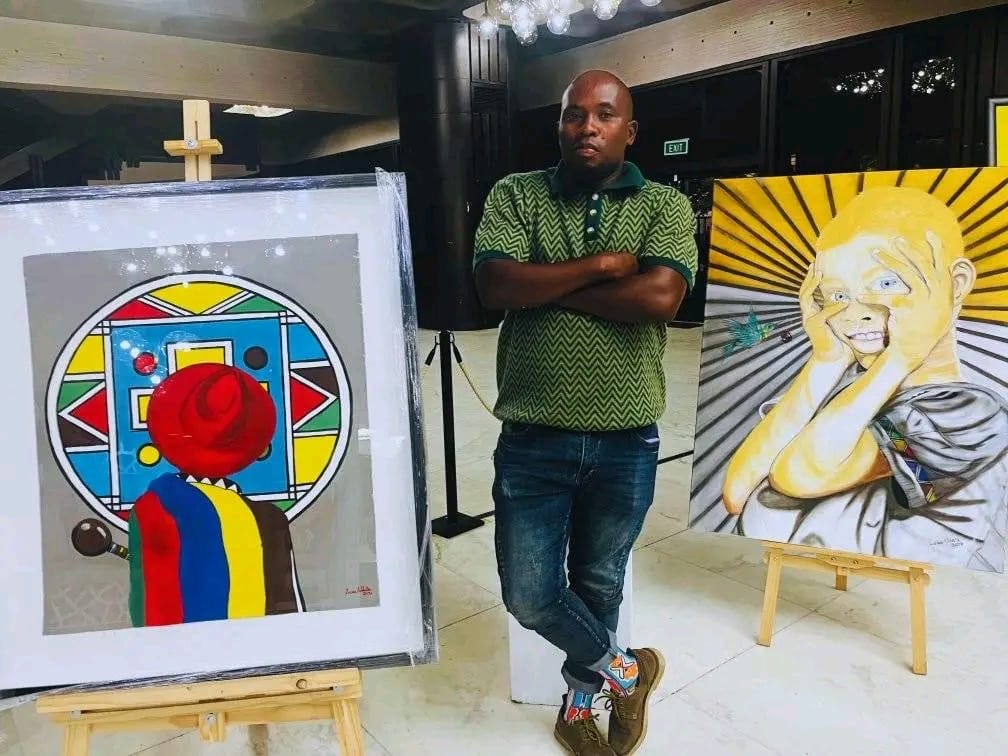
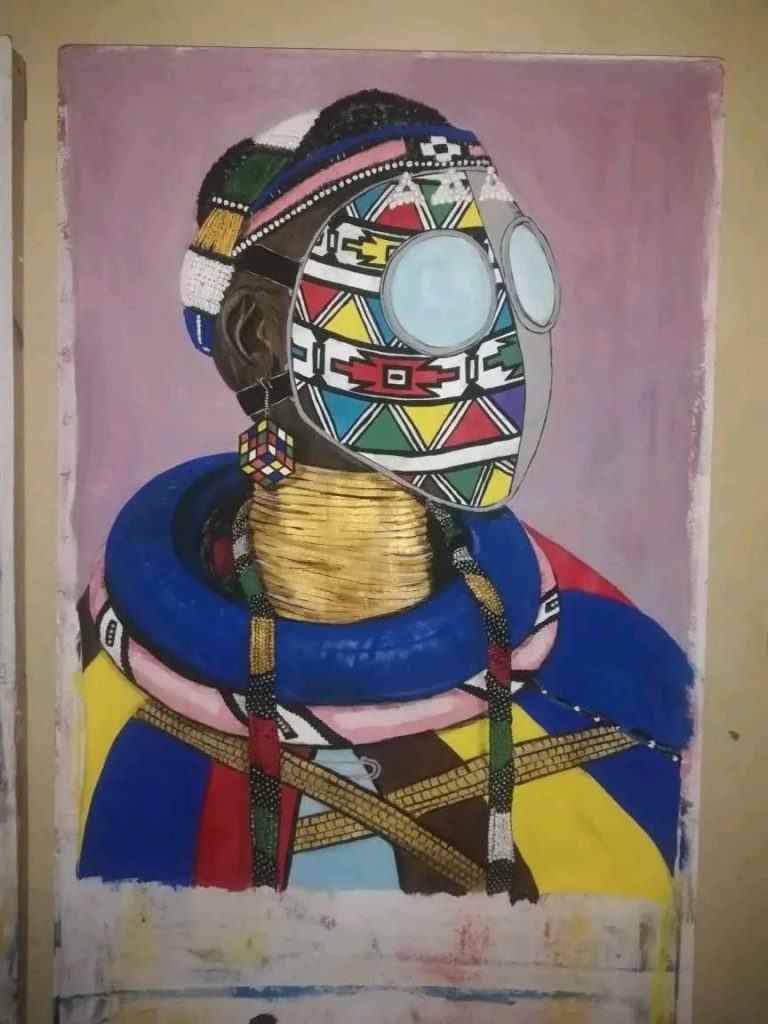
Among his greatest inspirations is the legendary South African artist Esther Mahlangu, whose groundbreaking work elevated traditional Ndebele mural painting onto the global stage.
The geometric patterns of Umgwalo – traditionally painted by Ndebele women on their homes – have long symbolised identity, beauty and cultural continuity.
Ndala honours this tradition while simultaneously expanding its possibilities.
Where previous generations decorated walls, he decorates canvases. Where traditional artists painted homes, he paints fashion. Where heritage once occupied fixed spaces, he allows it to travel with people through customised sneakers, jackets, caps and wearable art.
His work demonstrates that cultural preservation does not require cultural stagnation. Tradition survives precisely because each generation discovers new ways to express it.
Colour as emotional language
Spend time observing Ndala’s work and one characteristic becomes immediately apparent. Colour dominates. Not merely as decoration, but as emotional communication.
He believes colour has the power to transform environments and influence human emotion. Bright compositions invite optimism, warmth and celebration while simultaneously expressing the vibrancy associated with African visual culture.
His philosophy is remarkably simple. Art should make people feel. Sometimes that feeling is joy. Sometimes reflection. Sometimes healing. Sometimes hope.
He speaks of seeing people smile – and even cry – when engaging with his work, affirming his belief that art possesses extraordinary emotional power.
Kanvas Arts: Building more than a business
In 2016, Ndala established Kanvas Arts, turning years of artistic experience into an organised creative enterprise.
The business emerged almost organically. Parents began requesting art lessons for their children. Young aspiring artists sought mentorship. Communities wanted exhibitions. Collectors expressed interest in purchasing his work.
Ndala recognised an important truth.
The greatest value of an artist is not measured only by the artworks they create, but also by the opportunities they create for others.
Kanvas Arts therefore became much more than a commercial studio.
It became a platform for nurturing emerging talent, organising community exhibitions, hosting competitions, facilitating fundraising initiatives and contributing to local cultural development.
Its long-term vision extends beyond individual success towards building sustainable creative ecosystems.
The sneaker that changed everything
Innovation often begins accidentally. For Ndala, one unexpected paint spill changed the trajectory of his career.
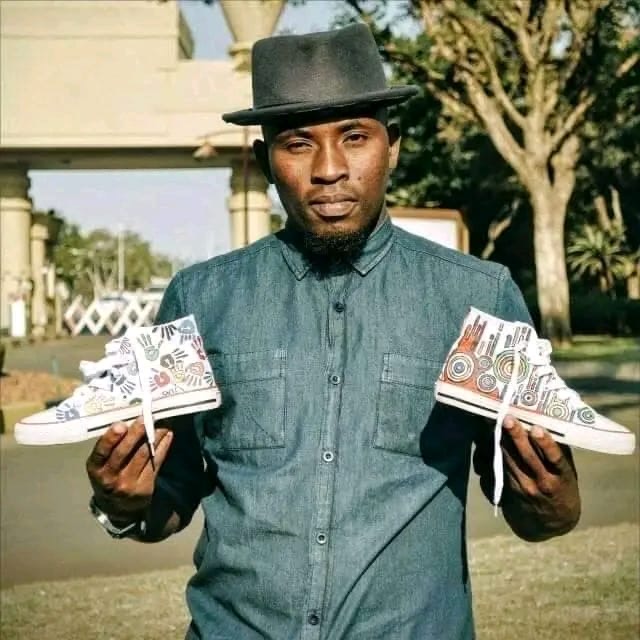
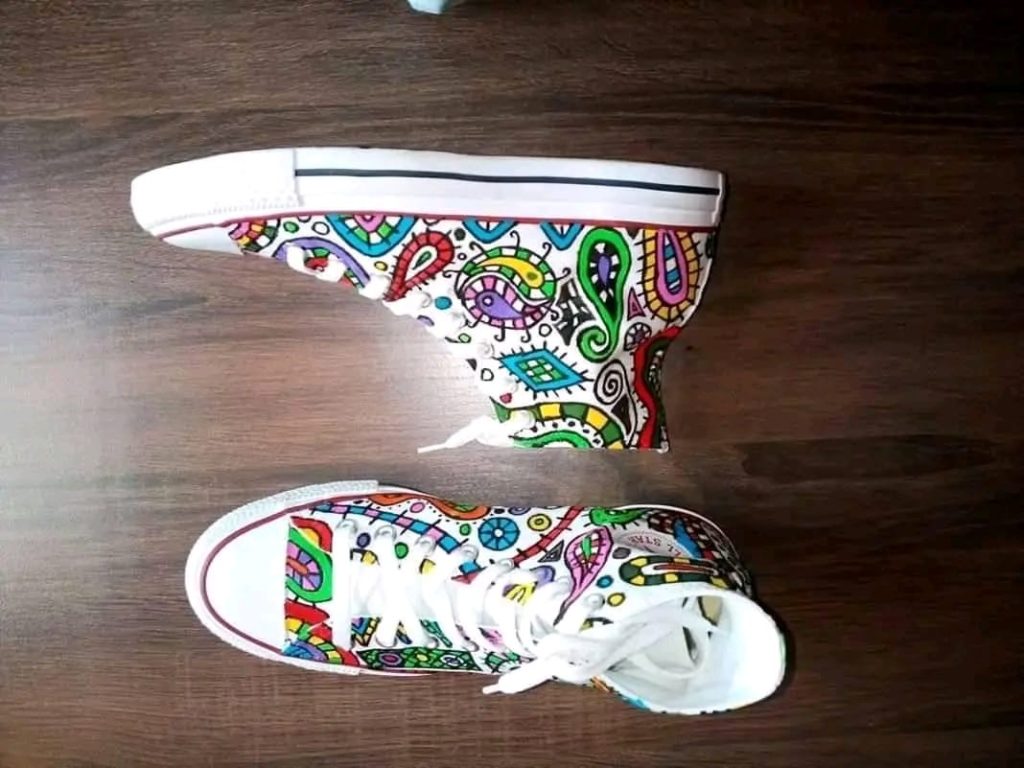
When paint accidentally landed on a pair of Converse All Stars, he faced a simple choice: Throw them away. Or transform them. He chose transformation. And the result was extraordinary.
The customised sneakers attracted widespread attention, leading to commissions from clients eager to own wearable artworks.
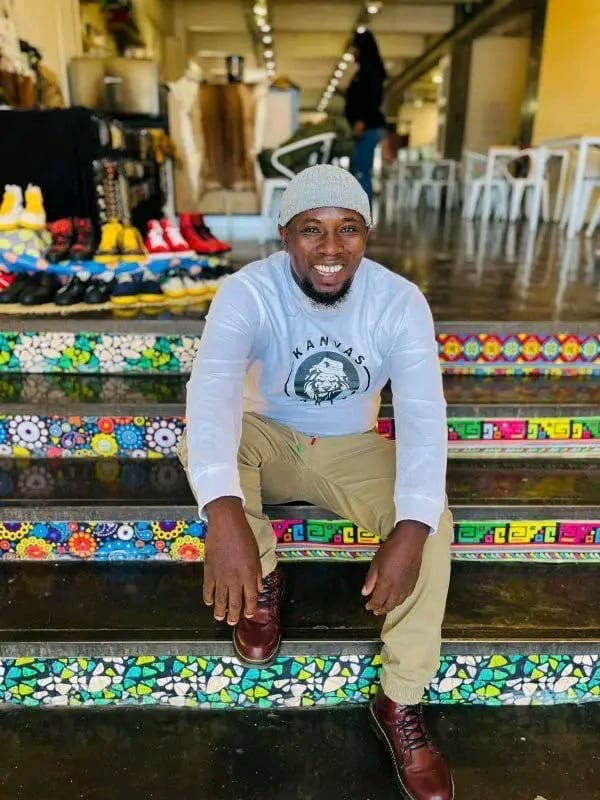
Soon he was transforming not only sneakers but also heels, denim jackets, T-shirts and caps into moving canvases inspired by African aesthetics.
One customised sneaker was later exhibited in Germany through Manduwe, while another received recognition through the Innibos National Arts Festival Craft Awards publication.
What began as an accident evolved into an entirely new artistic discipline.
Technology expands the artist’s horizon
Ndala belongs to a generation of African artists equally comfortable with traditional craftsmanship and digital innovation.
His portfolio now includes digital illustration, animation and book illustration, demonstrating his willingness to continually learn and evolve.
Completing training in Digital Arts and Animation further expanded his creative capabilities, ensuring his work remains relevant in an increasingly digital creative economy.
Rather than replacing traditional techniques, technology has become another brush in his artistic toolkit.
Recognition that reflects consistency
Recognition has followed years of disciplined work.
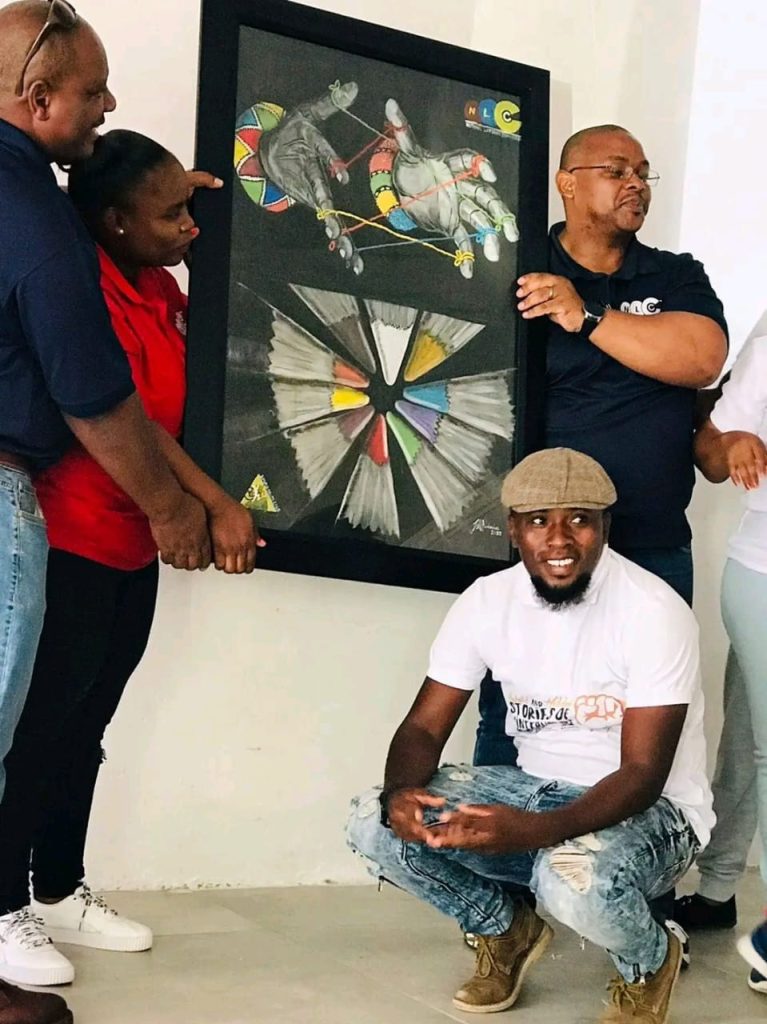
Among numerous honours are the South African Men of the Year Award in Arts and Culture, the Golden Shield Award, Heritage Day recognition from Tshwane University of Technology, participation in the Gauteng Touring Gallery Exhibition, Business Person of the Year recognition at Mabopane Square, a commissioned unity artwork for the National Lotteries Council and his successful first solo exhibition in Maboneng during 2024.
These accolades represent milestones rather than destinations.
They affirm a career built through persistence rather than overnight success.
Art as economic development
South Africa’s creative economy continues to expand, creating opportunities for artists to become entrepreneurs, educators and employers.
Ndala represents precisely this emerging model. His career illustrates that artists need not choose between creative integrity and commercial sustainability.
By combining studio practice with education, community engagement, exhibitions, commissions and product innovation, he demonstrates how creativity can generate economic opportunity while preserving cultural heritage.
His work also reminds policymakers that investment in the arts is ultimately investment in people, communities and future industries.
Inspiring the next generation
Perhaps the most enduring aspect of Ndala’s legacy will not be measured by awards or exhibitions.
It will be measured by the young artists who discover confidence because someone believed in their talent.
It will be measured by communities that see creativity as a pathway to dignity.
It will be measured by children who learn that greatness can emerge from the simplest beginnings.
Like the stick figures once drawn into the sand of Winterveld, every masterpiece begins with a single mark.
The difference is that Ndala never stopped drawing.
Today, his canvases hang in galleries, his customised fashion travels beyond South Africa’s borders, his students carry forward his knowledge and Kanvas Arts continues to expand opportunities for future generations.
His journey embodies a timeless African truth: that creativity is not merely the production of beautiful objects. It is the transformation of lives.
In Ndala, South Africa has not only produced an accomplished visual artist.
It has produced a cultural entrepreneur, an innovator, a mentor and a custodian of African heritage whose greatest masterpiece may well be the inspiration he leaves for generations still to come.