
By Saul Molobi
There are songs that entertain, songs that comfort, songs that tell stories – and then there are songs that become part of the cultural memory of a nation.
The music of Caiphus Semenya belongs firmly in the latter category.
For decades, Semenya’s compositions have occupied a distinctive place in the South African musical landscape. His work has travelled across generations and continents, finding expression in intimate love songs, powerful reflections on identity and belonging, and compositions that captured the emotional complexity of a society undergoing profound political and social transformation.
His music has been sung, recorded and performed by some of the most celebrated artists of South Africa and beyond. Yet its endurance lies not simply in the stature of the performers who have interpreted it. It lies in the strength of the songwriting itself – music capable of carrying deeply personal emotions while simultaneously speaking to broader experiences of a people and a country.
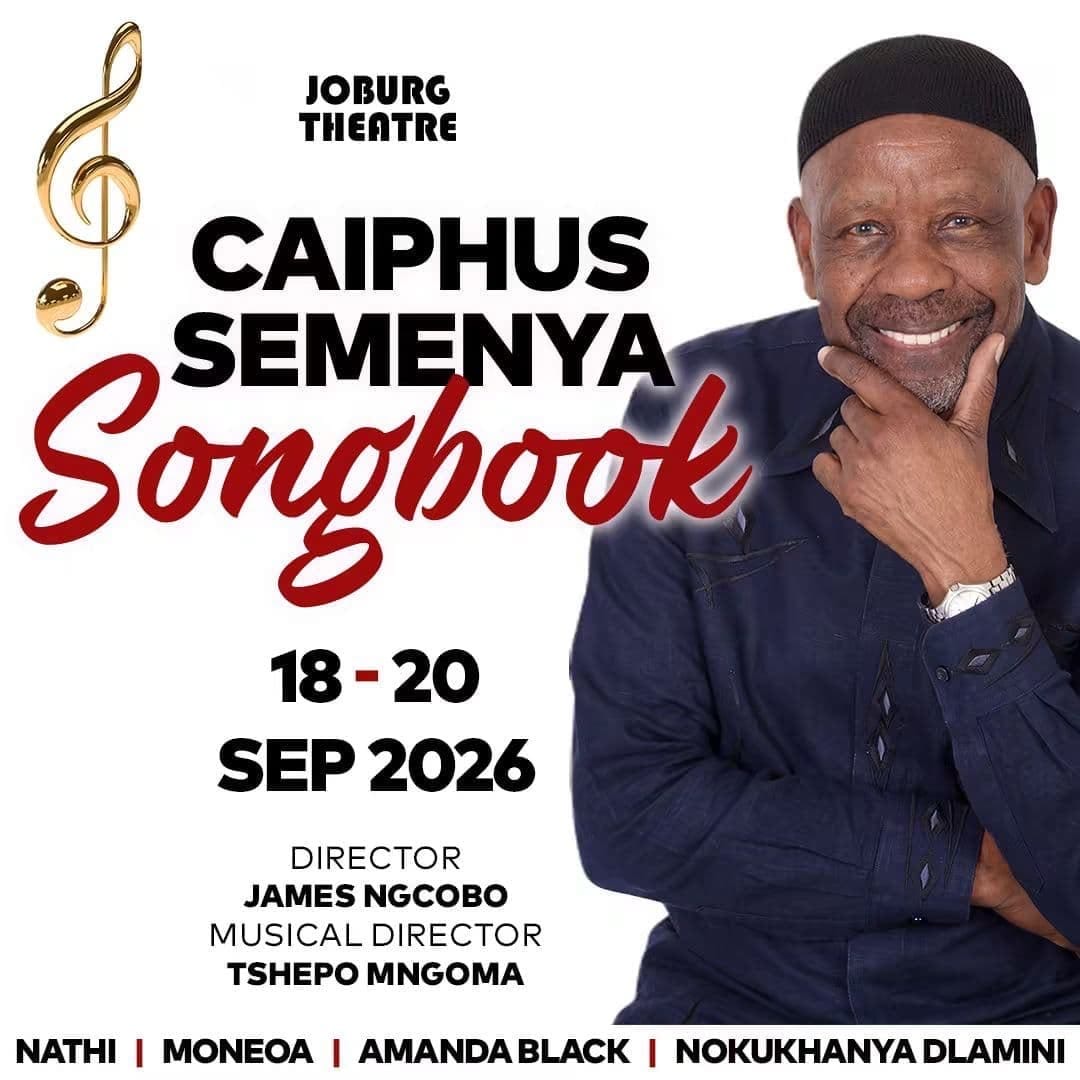
It is this extraordinary body of work that will receive a major theatrical celebration when Caiphus Semenya Songbook takes to the stage at Joburg Theatre from 18 to 20 September 2026.
The three-day production brings together an impressive contemporary line-up – Nathi, Moneoa, Amanda Black and Nokukhanya Dlamini – to interpret the repertoire of one of South Africa’s most respected composers, musicians and songwriters.
Rather than presenting Semenya’s music as a museum piece, the production seeks to place it in conversation with the present.
And that distinction matters.
A songbook that transcends generations
Music has a remarkable capacity to preserve experiences that might otherwise disappear from collective memory. A melody can transport an audience to a particular time. A lyric can revive an emotion that seemed forgotten. A familiar chorus can reconnect people with places, relationships and moments that shaped their lives.
Semenya’s music possesses precisely this quality.
His songbook is rooted in the South African experience, yet it has never been confined by geography. His compositions have demonstrated how stories emerging from a particular cultural and historical context can acquire universal resonance.
Love, loss, hope, separation, belonging, struggle, aspiration and home are not uniquely South African experiences. What makes Semenya’s contribution distinctive is the manner in which he has articulated these universal themes through an unmistakably African sensibility.
His music therefore occupies an important space between the personal and the political, the intimate and the collective, the local and the international.
This is why Caiphus Semenya Songbook arrives at an interesting moment in South Africa’s cultural life.
At a time when questions of heritage, identity and cultural ownership continue to occupy public conversation, revisiting the work of artists who helped shape the country’s musical identity becomes more than an exercise in nostalgia. It becomes an opportunity to ask what South Africa remembers, what it chooses to celebrate and how it carries its cultural inheritance into the future.
From memory to movement
The production’s central proposition is that musical heritage is not static. A song remains alive when somebody sings it. A composition acquires another life when a new generation interprets it.
And a musical legacy becomes truly enduring when audiences who were not present when the work was originally created can still find meaning in it.
This philosophy sits at the centre of Caiphus Semenya Songbook.
For audiences who encountered Semenya’s music during their formative years, the production promises a return to a familiar soundscape – an opportunity to hear songs associated with particular moments in their lives and perhaps rediscover meanings that have changed with time.
For younger audiences, however, the experience is different.
They encounter Semenya not simply as an artist from another era, but as a composer whose work can still speak to contemporary questions of identity, love, belonging, human relationships and the continuing search for an authentic African voice.
The stage consequently becomes a bridge between generations.

*** The show’s musical director, Tshepo Mngoma ***
Four contemporary voices, one extraordinary songbook
The choice of performers gives the production an important contemporary dimension.
Nathi, Moneoa, Amanda Black and Nokukhanya Dlamini each bring a distinctive musical personality to Semenya’s compositions. Their individual approaches ensure that the repertoire will not simply be reproduced but reimagined through contemporary voices.
This is particularly significant when dealing with a songwriter whose music has already accumulated layers of interpretation over the decades.
The challenge is not merely to sing the songs correctly. It is to understand what gives them emotional power and then find an authentic way of communicating that power to an audience today.
Each performer therefore becomes, in a sense, both interpreter and custodian. They inherit the songs, but they also temporarily become responsible for carrying them forward.
The production’s contemporary cast allows Semenya’s compositions to encounter different vocal textures, performance traditions and generations of listeners. Familiar songs can consequently acquire new emotional colours without losing the essential qualities that made them memorable in the first place.
It is this interaction between inheritance and reinvention that promises to give the Songbook its particular energy.
Where music meets theatre
The production is directed by acclaimed theatre-maker and Joburg City Theatres Artistic Director James Ngcobo, whose involvement adds another layer to the celebration.
Ngcobo approaches the repertoire not merely as a concert set-list but as material capable of generating a theatrical narrative.
Under his direction, music becomes a vehicle for memory and storytelling.
The songs can evoke periods, relationships, places and experiences, while the theatrical framework allows those associations to exist within a larger cultural narrative.
This creates an opportunity to explore an important question: What happens when the soundtrack of several generations is placed on a theatre stage and experienced as a collective story?
The answer lies in the space between performance and memory.
An audience member may arrive knowing every note of a particular song, only to encounter it differently because of the context in which it is presented. Another may hear a Semenya composition for the first time and discover that a song written decades ago speaks directly to a contemporary experience.
That is one of theatre’s most powerful possibilities – the ability to make the familiar unfamiliar again.
The musical architecture of the songbook
Musical direction comes from Tshepo Mngoma, whose role will be central to shaping the sonic identity of the production.
Working with a repertoire as rich and established as Semenya’s requires more than technical musical competence. It requires sensitivity to the character of the compositions and an understanding of what should be retained, what can be reinterpreted and how different performers can be brought into a coherent musical conversation.
Mngoma’s musical direction will provide the framework through which the contemporary performers encounter Semenya’s compositions.
The result is expected to preserve the emotional and musical integrity of the repertoire while allowing the arrangements to breathe within a contemporary performance environment.
In this sense, the Songbook is neither a reconstruction nor an imitation. It is an act of musical conversation.
Caiphus Semenya and the idea of home
One of the most powerful themes running through South African cultural history is the idea of home.
For generations of South Africans, home has carried meanings far beyond geography. It has represented belonging, memory, family, identity and, at times, a place from which people were separated by political circumstances.
Semenya’s generation of musicians understood this complexity intimately.
His career and creative journey developed against a backdrop in which South African music was increasingly becoming a vehicle through which artists could articulate experiences that could not always be expressed directly through conventional political discourse.
Music could cross borders. It could carry memory into exile. It could maintain connections between people separated by distance.
And it could return home carrying stories accumulated elsewhere.
This gives Semenya’s songbook an additional historical significance. His compositions can be heard not only as individual works of musical craftsmanship but also as part of a broader African cultural conversation about identity, displacement, belonging and the meaning of home.
A legacy beyond the songs
To celebrate Caiphus Semenya is ultimately to celebrate the contribution of the composer to South Africa’s cultural imagination.
Popular music is sometimes treated as ephemeral – something consumed, enjoyed and quickly replaced. Yet the work of composers such as Semenya demonstrates the opposite.
Songs can outlive the circumstances in which they were written. They can travel further than their creators ever imagined.
They can become part of weddings, funerals, celebrations, political gatherings, family memories and personal soundtracks.
Eventually, the distinction between the song and the memory attached to it begins to disappear. The song becomes the memory. And the memory becomes part of the culture.
This is why the preservation and reinterpretation of South Africa’s musical heritage is so important. A country does not preserve its cultural history only through monuments, archives and museums. It also preserves it through performance.
Every time an old song is performed for a new audience, cultural memory is renewed. When a younger artist interprets the work of an earlier generation, a bridge is created between past and present. And when an audience rediscovers a song, the cultural archive becomes alive again.
The responsibility of a new generation
Caiphus Semenya Songbook consequently carries a significance beyond its three-day run.
It speaks to the responsibility of contemporary artists and cultural institutions to ensure that South Africa’s extraordinary creative inheritance does not become disconnected from the generations that follow.
There is an abundance of musical history in South Africa, but history that is not heard can eventually become history that is forgotten.
The task is therefore not simply to honour legends after the fact. It is to keep their work in circulation. To reinterpret it. To interrogate it. To introduce it to new listeners.
And, ultimately, to allow it to become part of the cultural vocabulary of another generation.
That is what makes the Songbook an important cultural intervention.
It places Semenya’s work back into the public sphere – not as a relic of a bygone era, but as a living body of music capable of generating new conversations and new interpretations.
A celebration, not a retrospective
For Joburg Theatre, the production also reinforces the theatre’s role as a custodian and platform for South African cultural expression.
The stage has historically been a place where South Africans have encountered themselves – their stories, conflicts, aspirations, humour, music and history.
Caiphus Semenya Songbook continues that tradition by bringing together music and theatre in celebration of an artist whose contribution extends across both popular and cultural memory.
The production invites audiences to listen differently. To remember differently. And perhaps, most importantly, to understand that cultural heritage is not something that belongs exclusively to the past.
It belongs to the present – and to the future.
For three days, from 18 to 20 September 2026, Joburg Theatre will provide a stage for that conversation.
With Nathi, Moneoa, Amanda Black and Nokukhanya Dlamini interpreting Semenya’s repertoire, and James Ngcobo and Tshepo Mngoma providing the theatrical and musical vision, the production brings together different generations of South African artistry around one extraordinary songbook.
In doing so, Caiphus Semenya Songbook offers more than an evening of music. It will be an encounter with memory, heritage and the continuing power of the South African song.
And, above all, an opportunity to celebrate Caiphus Semenya – a composer whose music has not merely accompanied South African history, but has helped give voice to the emotions, experiences and aspirations of generations.
His songs have travelled. They have endured. And now, at Joburg Theatre, they will live again.
********
Saul Molobi presents “Sunset Serenade” – a jazz show on 101.9 Chai FM on Sundays 17:00 to 19:00, and publisher & co-writer with Siphiwe Mhlambi of the book, “Rhythms in Black and White: A Virtual Journey Through the World of Jazz”,