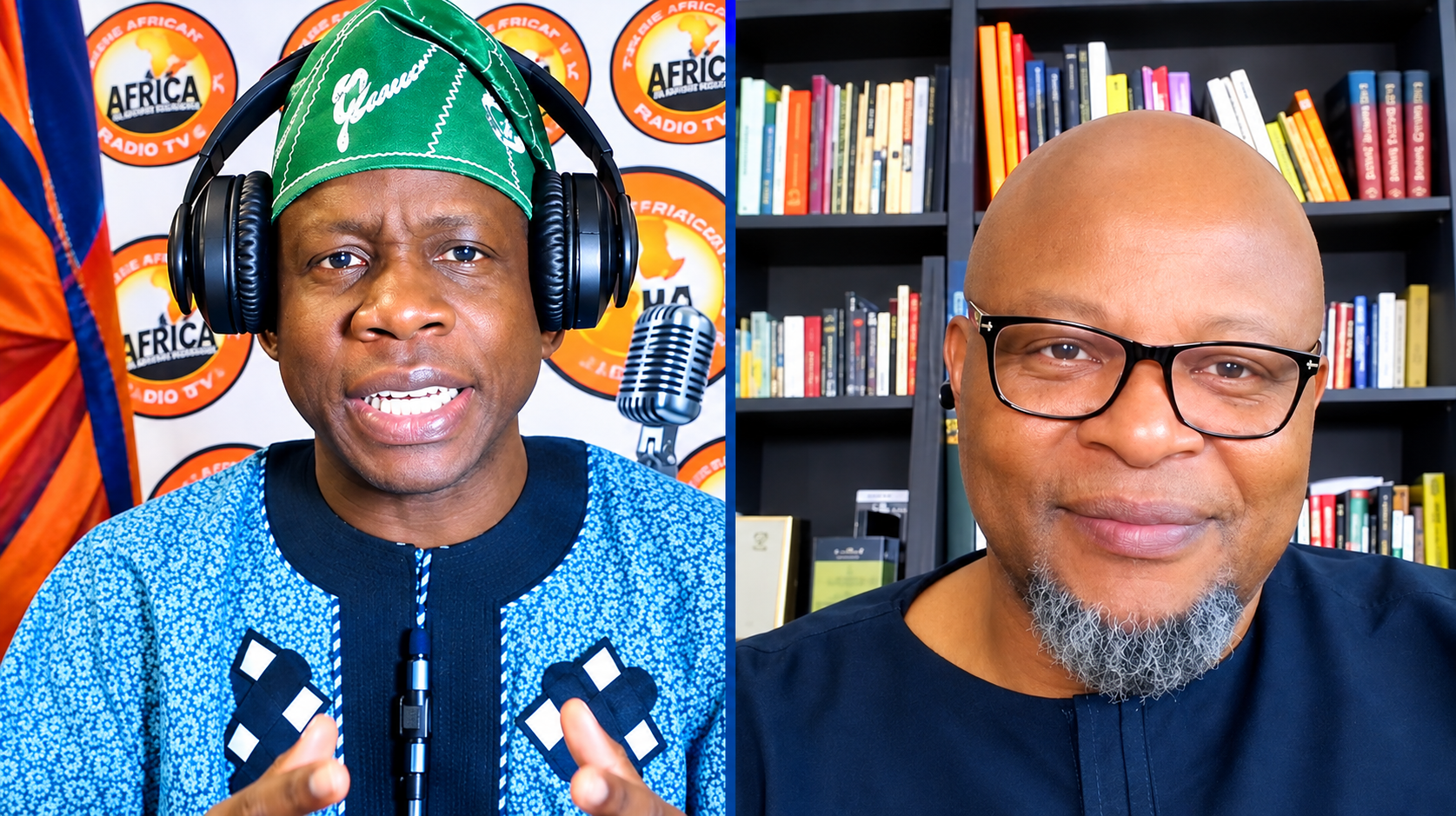
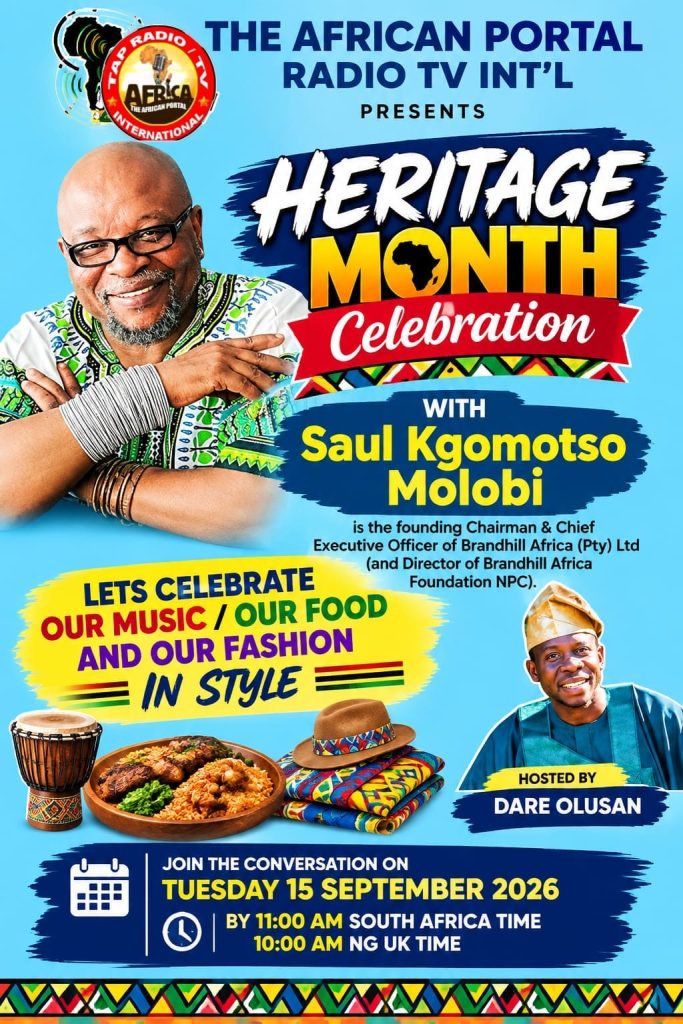
A Conversation between Joshua Oludare Olusan and Saul Molobi of Brandhill Africa™ on African Portal Radio TV International on 15 September 2026
Joshua Olusan:
Good morning to everyone. I greet you, no matter where you are or the country you reside in. I greet you according to your time zone and according to your language. In South Africa, Dumela to everyone; in Central, East, West and Southern Africa, greetings to everyone; and in the northern part of Africa, Assalamualaikum warahmatullahi wabarakatuh to everyone, no matter where you are.
Bonjou Africa. Welcome to African Portal Radio TV.
We are celebrating Heritage Month on African Portal. This month is special because it is where we celebrate who we are, our originality, our roots, our music and our food.
I have a great leader in the house, someone doing great work across Africa and beyond. He is a voice for the voiceless and an advocate for Africa.
Today, we are going to have a conversation about heritage. What is our heritage? Why are we celebrating heritage? What do we need to pass on to the incoming generation? Why is it important that we keep it real and keep it raw, especially our jazz music, African rhythms and the beauty of this great continent, Africa?
If you are connecting and you are part of Africa, this conversation is for you. Let’s celebrate our diversity. Let’s celebrate Africa.
I always say, what unites us is stronger than what divides us. Love is stronger than hatred. So let’s embrace love and believe in ourselves. This is one of the greatest continents in the world, so let’s embrace ourselves and celebrate ourselves.
Joining us is one of our very own, Saul Molobi, former Consul-General of South Africa in Milan, Italy, and Chief Executive Officer of Brandhill Africa. I am privileged to have you with us, my leader. How are you this morning?
Saul Molobi:
Thank you for the opportunity to join you
Joshua Olusan:
Thank you very much. I really appreciate you being here and connecting with us on African Portal Radio TV International.
Brandhill Africa is doing great work across Africa. Let me start with this: if we should count, how many African countries have you been to?
Saul Molobi:
Usually, when people ask me how many countries I have been to, I say it would be easier if they asked how many countries I haven’t been to.
I had the privilege of working for the Department of International Relations and Cooperation as Head of Public Diplomacy, and that meant that I had to be part of all the ministerial and state visits, not only across the continent but all over the world.
So it is safe to say there are very few countries across the continent that I haven’t been to, and I hope to visit the few that I haven’t been to.
Joshua Olusan:
This month is special in South Africa. We are celebrating our heritage. The government has officially declared September our Heritage Month. At the same time, if you look at the Ethiopian calendar, this is the beginning of the new year.
What is heritage, and why do we need to celebrate our heritage?
Saul Molobi:
For me, Heritage Day and Heritage Month in South Africa should be seen as a moment of celebration and, at the same time, a moment of reflection.
We reflect on our heritage. Perhaps let me say that I am a student of dialectics and a practitioner of dialectics.
We celebrate what we used to be, and based on that, we should be able to say who we are evolving into. This is what we call the dialectics of culture.
If we look back, we draw inspiration from our heritage. This heritage, plus our engagement with various other cultures, has made us what we are today.
Because we are evolving, we will still engage with other cultures, other heritage and other artistic creations of other nations. That means that we will evolve into something else.
I know there is a symbolism of Sankofa in some parts of Africa, where we say we appreciate our history, our heritage and where we come from, and we take all the great lessons from this background to inform who we are today.
So we need that reflection.
Indeed, as Africa, our heritage is very rich, and it is important that whilst we engage with other cultures, we make sure that we are not assimilated.
I believe strongly in the principle of cross-pollination, where cultures synergise with each other.
As a student of dialectics, dialectics says this is your current self, which they call the thesis. Then you engage with another culture, which is the antithesis. The cross-pollination and engagement between the two cultures give birth to a completely new synthesis.
There is this academic, Gupta, who calls it a transvergent culture. I have been engaging with you as a South African and you as a Nigerian, and from our engagement as the two of us, new personalities are born. Those are Pan-African personalities born out of our engagement as South African and Nigerian cultures.
This is how culture develops and brings into existence a completely new personality.
From those many years when I first met you to today, I believe that the two of us have enriched each other and have even given birth to new Pan-African personalities born out of our joint experiences.
Joshua Olusan:
Thank you very much. The good thing about this conversation is that you are very sound and knowledgeable when it comes to culture, Afrocentricity and Africa as a continent.
Let’s look beyond Africa and bring in other parts of the world. Let’s look at their cultures. Is there any similarity?
In Africa, we have the concept of Ubuntu, which is essentially that we are because others are. In Yoruba land, there is what they call Omoluabi. The Omoluabi culture is almost the same as Ubuntu. It speaks to who you are, who you appear to be, your background, where you are coming from, and why where you are should not take away your originality.
You have travelled all over the world. Do we have any similarities between African culture and other parts of the world?
Saul Molobi:
Yes.
Remember, our heritage is the DNA of our identity as a people.
Through colonialism, and perhaps even before colonialism, if we go back to the turn of the century, Pliny the Elder, after touring Africa, came up with a very catchy phrase, Ex Africa Semper Aliquid Novi, which basically says, “Out of Africa, always something refreshingly new comes out.”
He was impressed with Africa, which means Africa influenced him. That is why he was so positive about the continent.
There was also Africa’s engagement with Asian countries, especially China.
If we look at the Mapungubwe Kingdom in the 11th century, the kingdom controlled and centralised trade from the Namibian shores to Mozambique and across Southern Africa, including countries such as Zimbabwe, Botswana, Lesotho and Eswatini.
That is why the first map of Africa was drawn by the Chinese.
We engaged with Asians long before we engaged with the West, and there were cultural synergies between our two cultures.
If I give you an example, the Chinese came to Mapungubwe with glass beads. Mapungubwe, which started mining in the 11th century, then produced beads from gold.
This means that the Asians introduced glass beads into our culture, and that is why today many indigenous African communities regard beads as part of our indigenous culture.
Even today, glass beads are largely imported from Asia. Very few people know that.
I know in South Africa there was Mme Sarah Masunga, through her cooperative, who started manufacturing beads, but unfortunately, because of competition and, to a large extent, the dumping of Asian glass beads into the market, her business did not survive.
I have also learned about a cooperative in Ghana that is producing glass beads.
Our interaction with the Asians influenced our culture, but we also influenced them.
If you look at the English dictionary today, I would say English is the most bastardised language, and that is why it is regarded as such a sophisticated language: because it borrows from other cultures.
You are talking about Ubuntu. Ubuntu is now included as an English word in the English dictionary.
Induna is also accepted as an English word because it is in the English dictionary.
We shouldn’t talk about ourselves as having been defeated culturally, because we have also enriched world cultures.
Take, for example, the bag that our women used to carry babies on their backs. We call it thari in Setswana. It is made from a cowhide. What did they do? People from the West took it, appropriated it and introduced it as their own, and we started buying it from retail shops.
That comes from us.
If you were to look at the critical role that Egypt, Alkebulan or Kemet, as other people may use its original names, played in world civilisation, then you realise that we are not making a hollow claim when we say that Africa is the cradle of civilisation.
You have Pythagoras, who came to study mathematics in Egypt, and after studying the structures of the pyramids, he came up with the Pythagorean theorem.
So we need to value our heritage. We need to share it with our children so that ultimately they can see the immense contribution that Africa’s cultures and heritage have made to world cultures.

*** Scan the QR Code to watch the full video recording of this interview ***
Joshua Olusan:
Why is it important for Africa to preserve and celebrate its cultural heritage?
Saul Molobi:
Look, I was saying that we need to guard against being assimilated. I am going to be very controversial, and these are my own observations.
In South Africa right now, the heritage that is under siege, the heritage that is being conquered, is mainly the heritage of indigenous Africans and the heritage of the Coloured community.
The Indian community values its heritage. They value their religion.
White people do the same thing. You have Anglican culture and Roman Catholic culture. The Jew value their heritage. Afrikaners are also preserving their heritage.
Now there is this unfortunate thing with us indigenous Africans in South Africa: we think that we are universal.
The truth is that any universality in anyone’s culture has to be anchored in their heritage and history.
That is why we see people, even some of our children, not being able to speak their indigenous African languages, their mother tongues.
That is why I say we have to strengthen our voices to ensure that we are not culturally assimilated.
Your heritage is the DNA of who you are, because ultimately your identity is a reflection not only of your personality, but also of your family, your community and your country.
The history of your people is engraved in the identity that you portray to the outside world.
It is important that we inculcate our heritage in our children, and that we use all the tools for knowledge production to impart our heritage to them.
In the olden days, there were fireside stories told by our grandmothers. In traditional meetings, there were praise poets, and those praise poems carried the history and heritage of the people.
Nowadays, we are fortunate because we have technology that is much more advanced, and we should use it to inculcate positive messaging from our traditions and arts into our children, so that ultimately they know who they are and what their real identity is.
You cannot be universal without being local or national.
Joshua Olusan:
Let’s look at the educational system in Africa, using South Africa as a case study.
In almost every area in South Africa, you will see Afrikaans schools where the medium of communication is Afrikaans. But it is very hard to see any African language being used as the medium of communication in schools.
I have been in many countries in Africa and have hardly seen schools, whether primary, secondary or tertiary, where the medium of communication is one of the African languages.
What do we need to do to introduce or borrow the idea of Afrikaans-medium schools from primary through secondary school, where the medium of communication is an African language, to make sure that the language remains alive?
Saul Molobi:
Educational research has shown that learners in the first three grades of schooling who learn through the medium of their mother tongue stand a better chance of performing well in higher grades.
Unfortunately, if you look at our education system in South Africa, that isn’t happening.
There is a compromise that says you may teach through the medium of English, but the learner also has to pass their mother tongue, usually called a first language.
I also know, because I have many friends and relatives who are in education, of one case study in Polokwane, Limpopo, when I worked there, where indigenous African families agreed that they did not want their children to be taught in their mother tongue.
At that school, they opted for English as a first language and Afrikaans as a second language.
I remember the MEC then, who is now our current Minister of Health, Dr Aaron Motsoaledi, fought very vigorously to say that it should not be Afrikaans, but one of the indigenous African languages that the school should encourage learners to take.
We do have instruments such as the Pan South African Language Board (PanSALB), which advocates for multilingualism and has some resources to advance multilingualism.
But because of austerity measures arising from the economic crisis that South Africa and many other countries are going through, those resources are not enough.
People always say we need to decolonise our minds. Ngũgĩ wa Thiong’o spoke about this.
Unfortunately, the general perception amongst our people in South Africa is that if they see a child who is very articulate in English, they assume that the child has a very high IQ.
Across the world, you may speak in your own language and still have a very high IQ. Look at China and India, where people are taught in their mother tongue.
But again, it is the legacy of apartheid that has ensured that our languages were never developed alongside economic and technological developments taking place all over the world.
As a result, if I were to translate such a concept as AI into my Setswana language, it would require a whole paragraph.
It is simply because what they used to call the language boards under apartheid did not ensure that new lexical terms were developed to explain some of the new technological phenomena that we were experiencing.
That is where the danger to heritage comes in.
Heritage should not be frozen in time. It shouldn’t be frozen in the first or second century.
Heritage should be so dynamic that it is able to advance with societal development. That is why we have to create new terms and new vocabulary that will be able to speak to current developments.
Many people say: “I have to study English because if I am going to look for a job, they will want me to be competent in English.”
Our economy is, to a large extent, English-mother-tongue dominant, so that is why.
Even our literature has not advanced to the level where our people are able to read texts in their mother tongues that make sense and speak to contemporary South Africa, contemporary Africa and the contemporary world.
These are the issues.
As a result, across Africa we end up communicating through English, French, Portuguese and some Arab languages.
We do not have one Pan-African language that can unite us.
There was an attempt with Kiswahili, and my disappointment is with those South Africans who were in exile in countries where Kiswahili was spoken and who also spoke Kiswahili. When they came back home in the early 1990s, they never advocated for Kiswahili to be introduced into the South African curriculum or linguistic landscape.
That decision was only taken a few years ago when the Minister of Basic Education said Kiswahili would be introduced, alongside Mandarin and French.
If we had done that over 30 years ago, in 1994, we could have been developing a Pan-African language that would allow us to speak to Africans from non-English-speaking countries.
Ideologically, I also have a problem when we demarcate Africa along linguistic lines and say we have Anglophone, Francophone and Lusophone Africa.
We should be having one Africa.
Unfortunately, because we haven’t developed linguistic tools that could be common across the entire continent, we end up using languages that were imported into the continent.
Joshua Olusan:
From where we are right now, what is the solution going forward?
Saul Molobi:
The solution is that we need to invest, as government, the private sector and civil society, sufficient resources into mass awareness campaigns on the importance of mother-tongue teaching and learning.
We also need to invest those resources into developing learner-support materials.
We need to produce literature in our indigenous languages so that ultimately we understand that African-language materials or literature are not just for educational purposes.
I should be able to find a very decent Setswana novel that I can read without having to write exams or tests on it, just for fun.
We need to be doing that.
I know Tanzania did very well. The government decided that the medium of instruction throughout primary schooling was going to be Kiswahili, and as a result Tanzania became one of the most literate countries in Africa.
But there was another study that said there was a huge dropout rate into secondary schooling when learners had to switch to English as a medium of instruction.
We have learned that lesson, and we should be able to ask how we avoid those mistakes.
The danger with African countries is that we don’t learn from each other’s mistakes. We only celebrate each other’s successes.
If I give you an example with education, in 1994 South Africa adopted outcomes-based education (OBE), which is a construct from the United Kingdom.
Zimbabwe did the same thing after gaining independence and went through the struggle to domesticate outcomes-based education.
When we were implementing outcomes-based education as a policy, we could have spoken to Zimbabwe and said: “You’ve been doing this since 1980. What were the challenges and how did you deal with them?”
People don’t know that Zimbabwe used to have the best education systems across the continent.
It was only with the financial crisis that hit the country that they no longer had sufficient resources to invest in their education.
The truth is that Zimbabwe is a model country.
We jumped over Zimbabwe and went to the UK, and then encountered the same teething problems that Zimbabwe had encountered.
If we had said; “Zimbabwe, come on board. This is what we want to do. We are adopting it. What is your experience? Tell us about the pitfalls and challenges and how you dealt with them,” we could have done much better.
That is why, since 1994, we’ve been bringing in different reconfigurations of outcomes-based education, basically without deviating from its core.
Joshua Olusan:
How can we encourage young people to learn about the traditions and history of Africa? And do you think African cultures are receiving enough recognition in modern society?
Saul Molobi:
With culture, they say charity begins at home. In this instance, it starts with us not only telling our children about our heritage, but also having them see us using our heritage as a point of reference.
In that way, they will be able to value it themselves.
We are also lucky because nowadays we live in a world of online platforms that impart as much information as possible to their audiences and readers.
We should be able, as cultural activists, to ensure that our cultural outputs are anchored in our traditions. They should not just celebrate who we are today, but should also draw on the experience of what we used to be.
I may sound a bit critical, but we have a television channel here at home called Moja Love. You look at some of the stories there, and I get so depressed.
I’ll give you an example of a programme where a child wants to know from their single mother who their biological father is. They write to the TV channel, and then the mother has to identify a possible father to that child.
They conduct a paternity test live on television, and then announce the results live on television.
They may then say, “Think about another possible father,” and another person may come forward.
For me, these were family secrets that were supposed to be dealt with by the elders in the family with the child.
Here we are, with a major channel on DStv exposing these things to our children.
That is why I worry about our children, and that is why I call for responsibility on our part as cultural activists.
We need to do better so that we can contribute to the kind of society that we want to see.
At this rate, we are in trouble.
You look at the mainstream media; they sensationalise everything and demean our traditions.
You look at the film sector. There was a series on Netflix, “The Polygamist”, about a polygamist that did very well and was ranked number one in many countries.
The truth is that it bastardised the practice of polygamy because it equated polygamy to sexual mischief. That is not what polygamy is about.
Personally, I don’t believe in polygamy, but I respect people who practise it, and I know polygamy does not mean or equate to sexual promiscuity.
People who practise it can be quite responsible.
The whole world was misled through this series to believe that polygamy is about that, and this is how Africans are. That is very unfortunate.
There are traditional protocols on how you get married to your second or third wife.
The law in South Africa also says that if I am married and want to take a second wife, the first wife has to give written consent that she agrees that I can take a second wife.
In an instance where a man is simply on a sexual rampage, don’t call that polygamy.
Joshua Olusan:
That clarity is one of the things I believe we are going to have more time to discuss because one of the challenges we are facing is that most African cultures, through our movies and television series, are being misinterpreted, giving another interpretation to people across the globe.
Let’s look at two more questions.
How can African cultures come together while maintaining their uniqueness? Is it possible for us to come together while maintaining our uniqueness?
And how has migration and globalisation affected African culture and tradition?
Saul Molobi:
I think two or three years ago, the African Union declared a year of culture, cultural integration and the celebration of our arts and heritage. I remember at the time the Chairperson of the African Union was President Félix Tshisekedi of the DRC.
For me, the key word is coherence.
We need to develop cultural coherence arising from 55 nation-brand cultures.
The African Union has 55 member states, and we should be able to say this is South African culture, this is Zimbabwean culture, this is Nigerian culture, and so on.
All our nation-brand cultures have to engage with each other.
I gave an example with the two of us. You are Nigerian and I am South African. We engage, and we should be able to forge a Pan-African cultural identity.
The identity is already there.
For instance, if you are in Europe, Asia or the Americas and you are African and are invited to a meeting, naturally, if you go into that hall and see an African, you will find yourself moving towards that African to greet them because you see yourselves as Africans.
There is this thinker, Frederich Nietzsche, who said every object is a multiplicity of identities.
I meet an indigenous African person, a Black person, and I identify with them. It is that Pan-African identity that brings us together.
Then, when we talk, I say, “By the way, I’m from South Africa.” You tell me you are from Nigeria. That is another subjectivity.
Someone else may say, “I’m from Botswana.”
I speak Setswana and they speak Setswana, so in that instance there will be another subjectivity between myself and that person.
Even though you are African and Nigerian, it is highly possible that you don’t speak Setswana.
Ultimately, there will be affinity between the two of us, and it also goes with gender.
So we engage amongst ourselves through multiple identities.
For instance, if I speak about Kiswahili, Kiswahili has expressions such as Hakuna Matata. It is, to a large extent, an amalgamation of many African languages.
It is sad that an American company attempted to appropriate “Hakuna Matata” by seeking to register it as a trademark when it belongs to us.
There is a responsibility on us as cultural activists to forge a Pan-African cultural identity through our outputs, through our literature and through our music.
We should also take the diaspora into consideration because the diaspora is officially the sixth region of Africa, as declared by the African Union.
Once we have this global Pan-African identity, we will be able to engage with other cultures, and we will influence them as much as they influence us.
That will ultimately mean there is social cohesion across the continent.
I am happy that the BRICS Summit held over the past weekend in India re-emphasised and recommitted itself to forging people-to-people cooperation.
This is also one of the principles of South Africa’s foreign policy: people-to-people contact.
That is the best way of integrating culturally and socially.
If I put it bluntly, if I get married to a Nigerian woman, I introduce her to my Setswana and South African culture. She introduces me to her culture. As a result, there is that people-to-people contact.
Having said this, it becomes very important for all of us across the continent to ensure that we get our governments to sign and ratify the African Union’s Protocol on Free Movement of Persons.
Take SADC, for example. It developed the SADC Protocol on Free Movement of Persons in 2006.
South Africa was the first country to sign and ratify it.
“Sign” is when a country’s government says, “Yes, we agree.” “Ratify” is when the government takes that protocol to its Parliament for endorsement.
South Africa did that.
But out of the 16 SADC member states, only nine have signed and only 7 have ratified the protocol.
My argument is that if all 16 SADC member states were to sign and ratify it, we wouldn’t even be having the migration crisis that we have today in South Africa because everybody would be legal to be in any of the SADC member states.
Once we have achieved that, we also need to push it at continental level, with an AU-wide majority of member states signing and ratifying the protocol on free movement.
We are doing very well in terms of the free movement of goods through the African Continental Free Trade Area (AfCFTA) because almost 54 African countries have signed the agreement and 49 have ratified it. Yes, every family has one, and our one is Eritrea which is yet to sign the AfCFTA.
As much as we are saying goods should travel freely from one African country to another, so should people travel freely from one African country to another.
Integration works.
You look at the European Union; it is working for them.
You look at the United Kingdom post-Brexit. They voted for Brexit, and afterwards there was a huge interest in understanding what Brexit meant.
People voted without fully understanding Brexit because they had these narrow nationalistic tendencies and sensibilities that politicians had whipped up.
That is the danger of populism, and that is the danger that we should guard against as African countries.
We know here at home that we have that danger of populism, and we have to deal with it because ultimately it will have a damaging effect not only on our culture but also on our economy.
A major telecommunications company on the continent indicated at a seminar that I attended recently that a large proportion, 80%, of its revenue comes from other African countries.
This demonstrates how economically interconnected we are.
If we allow populism to cause tensions in our bilateral relationships, we are the ones who stand to lose.
I am also saying that perception is reality nowadays. This is what the art and science of marketing tells us.
We may argue around constructs and say we shouldn’t call this that or should call it something else, but the reality is that the perceptions circulating across the world will be that South Africans are xenophobic.
Unfortunately, only a section of South Africans may hold those views, and they do not represent me.
But that will still advance negative messaging about us.
Joshua Olusan:
Our time is fast running out. I know I am still going to bring you back because I believe we need to have this conversation not only in September. We should be having conversations like this every now and then to sensitise our communities and give people an opportunity to understand these issues.
Many people don’t know about these things, and many are not interested in them. But talking about them gives people the opportunity to listen and learn.
Let’s quickly go to the final aspect of this conversation.
We believe that our roots, our food and our music are some of the best things we need to sell to the rest of the world.
You are doing a great job in jazz. What does the future hold for jazz in Africa?
Saul Molobi:
Jazz is a music genre with a very positive revolutionary agency, just like reggae.
The most powerful thing about jazz is that even when it is only instrumental, it still communicates revolutionary messaging.
It is easier with reggae because you can hear Bob Marley and others, and the lyrics are very radical.
I will illustrate it with Winston Mankunku Ngozi.
Winston Mankunku Ngozi produced the song Yakhal’ Inkomo in 1968. It was a protest song when there was a political lull after Mandela and many others were imprisoned and others went into exile, representing various national liberation movements.
When he composed that song, the system knew that it was a protest song.
It is about the bellowing of a bull, and that song is still relevant even today.
Since 1968, there have been two or three other artists who composed lyrics for the song, and Mankunku said they had done excellent work, but that was not what he had in mind when he composed the song.
If you look at the origins of jazz in the United States among African-American communities, it was essentially a protest against slavery.
It came to South Africa in 1922, in a small town in the Eastern Cape called Queenstown.
Queenstown was then given the nickname “The Little Town of Jazz.”
From Queenstown, jazz spread to Johannesburg and Cape Town, especially because of ships docking in Cape Town.
Someone once said to me, “Saul, it was born in Queenstown, but it was perfected in Johannesburg, basically Sophiatown.”
There is an element of truth in that.
Jazz carries the aspirations of people. It carries the cries of people.
We talk about the jazz tree. There are many jazz idioms coming from countries all over the world, and those idioms, the national idioms, form the branches of this tree.
Basically, I am saying there is no such thing as pure jazz.
There are various streams and branches of jazz.
In South Africa, we have our own jazz idiom, which is anchored in our heritage. In Nigeria, you have your own jazz idiom, which is anchored in your heritage, and every country has its own.
That is why I speak about de/constructing jazz idioms in my radio show: jazz idioms from South Africa, across the continent and globally.
For instance, Sadao Watanabe in Japan is a jazz musician, but he is playing a Japanese idiom of jazz, a Japanese domestication of jazz.
That sound is domesticated.
Fela Kuti in Nigeria did the same thing, and here at home we also have our own jazz idiom.
You look at a song such as Malaika, which originates in Kenya. It became an international hit, not promoted by the original Kenyan musicians, but promoted by Miriam Makeba.
It reached international stardom when Miriam Makeba sang it. Angelique Kidjo has also sung it and has her own interpretation.
I hope that at the Joy of Jazz concert next weekend she will be able to play Malaika because we just love the song across the continent.
Jazz is the musical language expressing our protest against injustice, colonialism, slavery and all forms of oppression that anyone may be subjected to.
It is also against xenophobia, sexism and racism.
The agency of jazz is about tackling all of those societal ills.
The agency of jazz is about peace, but the agency of jazz also knows that music is not always peaceful.
Sometimes you have to embark on a struggle, including armed struggle, to restore peace and harmony amongst humanity.
I love the foreign-policy slogan of South Africa that says our intention is to build a better country, a better Africa and a prosperous and just world.
For me, this speaks to what jazz is all about.
Jazz is about bettering the lives of ordinary people.
Jazz is about giving voice to the voiceless.
Jazz is about voicing anger against injustice.
Joshua Olusan:
Thank you very, very much.
On jazz, we are going to have a special programme, and I really appreciate you coming out to be part of this conversation.
Before we call it a day, Brandhill Africa is a brand that is growing across Africa. Tell us briefly about Brandhill Africa and the projects you are currently working on.
Then I want you to round up in a South African language. You know how to speak several African languages, so perhaps use some of them.
We are speaking in English now because it allows us to communicate, but we can also do something differently.
Saul Molobi:
Brandhill Africa is a nation-brand agency, very Pan-African in outlook.
We specialise in economic diplomacy. Basically, we promote opportunities accruing from the African Continental Free Trade Area.
We ask: How does this continental economic integration benefit us?
We also look at cultural industries development. This comes in the form of our publishing programme and quarterly events.
We develop content, and that content consists of narratives that are re-engineering brand Africa.
We know Africa and her countries are always presented negatively in the mainstream media, simply because that mainstream media is foreign-owned.
For instance, if you look at the top broadcasters across the continent, many of them are foreign-owned and they shape images of Africa across the world.
You have CNN, CNBC, BBC, France 24 and Al Jazeera.
They are among the biggest broadcasters, and they are not African-owned.
We say we need to develop our own authentic voices so that we can tell our own stories.
That is why we are publishing. We are also hosting events, and then from there we look at brand management.
Brand management is about building “Made by Africa” brands, not just “Made in Africa”.
For instance, with “Made in Africa”, you have BMW and Mercedes-Benz. They are made in Africa in the sense that they are assembled in Africa, but we want “Made by Africa” brands that are owned by us as Africans.
We promote those brands and consult for a number of companies and state-owned entities, and we do some work for governments.
Basically, we say we build brands so that we are able to compete successfully with foreign brands, and we also encourage our people to embrace “Made by Africa” brands.
You look at the annual Brand Africa survey, and when it was launched in 2010, 34% of “The Top 100 Most Admired Brands” were Made by Africa.
Today, that proportion has declined considerably to 11%.
Many Africans consume, celebrate and prefer foreign brands over their own.
Our responsibility is therefore to re-engineer brand Africa and ensure that Africa’s authentic voices, cultures, products, stories and brands are recognised and valued both at home and globally.
Joshua Olusan:
Thank you very, very much. I really appreciate that.
One good thing about our languages is that when we speak them, they give us more spirit and energy. It is as if we are invoking the spirit of the reality of who we are.
During our conversation, you mentioned that in times past, grandmothers used to tell us stories and praise poetry, and sometimes we would play during the full moon, with children sitting down while the adults told them stories.
These are the things that are fading from our societies, communities and Africa.
As we round up, I also want to take you back to my great country and my great tribe, the Yoruba.
I am also going to round up this section by saying it in my language.
Thank you to everyone connecting to African Portal Radio. I really appreciate your time.
I am simply praising myself from where I was born, from my hometown in Ijebu-Igbo, taking it back to where my forefathers came from, and extending it to the city where I was born, and speaking about the Yoruba people and Nigeria.
If you don’t understand it, it is not a problem.
Believe me, you and I are going to get there, Africa.
Let’s keep celebrating our culture. Let’s keep believing in ourselves. Let’s keep pursuing unity of purpose, and we can get there.
Thank you once again, sir, for coming out to be part of this.
I am going to be on your neck, and we are going to be doing more, especially on jazz. I see that you are so knowledgeable in this area, and I believe we can explore it further and gain more knowledge from you.
Historically, you have a lot to tell.
I really appreciate your time. Thank you for your time.
Keep well. God bless you. Bye for now.
Saul Molobi:
Thank you so much.
Click here to watch the full video recording: