
By Mpho Moloele
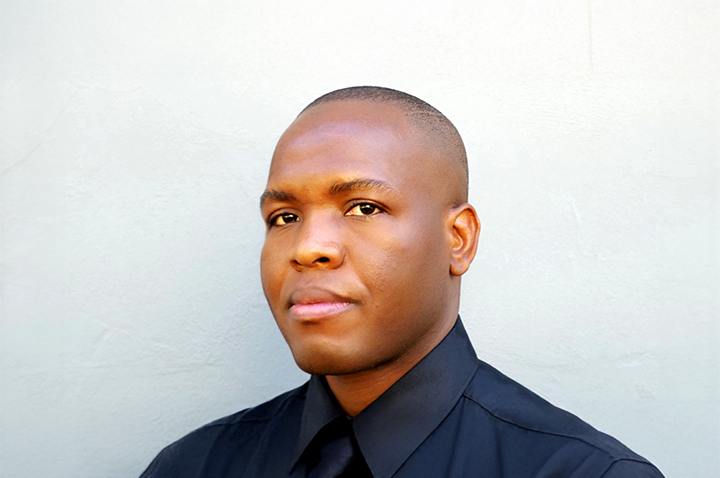
Growing up surrounded by mining landscapes, the escarpments, such as the Folovhodwe magnesite mine dumps, the Tshikondeni coal mine and the De Beers Diamond Mine in Musina, fostered a profound curiosity that ultimately guided Dr Khodani Matshusa’s pursuit of Earth Sciences – Geology.
Matshusa is a professional natural scientist (geological science) at Unisa’s Department of Environmental Sciences in the College of Agriculture and Environmental Sciences. His academic qualifications include a PhD in Tourism and Hospitality from the University of Johannesburg and an MSc in Earth Sciences – Geology from the University of Venda.
“I am recognised as a leading expert in geoheritage and geotourism, notably being the first Black African to achieve a PhD in this field,” says Matshusa.
His scholarly contributions and leadership in projects funded by national and international organisations have significantly influenced research, policy and governance.
With 15 years of experience spanning research, academia, mining and consulting, he is currently leading several initiatives at Unisa, encompassing geoheritage, geo-mining heritage, geotourism and mine closure. In this capacity, he cultivates collaborations, mentors students and champions geoconservation and social sustainability throughout sub-Saharan Africa.
Fostering innovation and dealing with tangible global challenges
The experiences of visiting the Ruhr Museum in Germany during 2011/2012 and the Barberton Makhonjwa Mountains in 2007 were transformative for Matshusa. “Witnessing the revitalisation of a former coal mining region and standing upon geological formations exceeding 3.5 billion years in age profoundly shifted my perspective,” he reflects.
These experiences underscored that geology and mining encompass not only the extraction of minerals, but also a rich tapestry of geodiversity and the story of the Earth.
Subsequently, he recognised that research and development offered an ideal environment for fostering innovation and addressing tangible global challenges.
Matshusa has spearheaded initiatives to address about 6 000 abandoned mining legacies in South Africa and their environmental repercussions, including the derelict and ownerless mines project, while empowering local communities.
“Consequently, my investigative curiosity and passion for social sustainability motivated me to formulate sustainable solutions for issues stemming from mining legacies,” he says.
These solutions include integrating geotourism, geoparks and geomineral heritage to generate employment and promote sustainable development.
Creating awareness for change
Matshusa’s research endeavours contribute significantly to policy development, the creation of new employment opportunities, market diversification, and the promotion of social and environmental sustainability.
“My research on geoheritage, geotourism and geoparks serves as a foundational reference for policy formulation in Africa and globally,” says Matshusa. “Additionally, my research has raised awareness within government departments, protected area management, education, geoscience research and mining sectors regarding under-researched topics in geotourism, geoparks and geoconservation.”
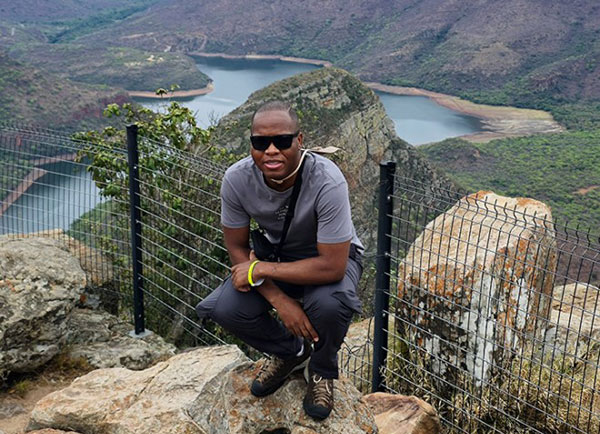
Dr Khodani Matshusa at Blyde River Canyon, a geological marvel in Mpumalanga, South Africa
This awareness has been cultivated through numerous invitations from national government departments, private organisations and research organisations. He consistently serves as a guest speaker at conferences, workshops and online talks, locally and internationally.
His research significantly contributes to the international agenda on sustainable development, as evidenced by frequent requests for expert advice from national and international organisations concerning geotourism, geoparks and geoconservation. Matshusa is also an active member of several international organisations, where he leverages his expertise to benefit society.
In February 2025, he was appointed Chair of the Geoscience and Society (Geoheritage) Division and Council Member at the Geological Society of South Africa (GSSA), recognising his extensive research expertise and contributions to the geoscience field.
“My research bridges the complex challenge of reconciling mining operations with geoconservation efforts, thereby ensuring that economic imperatives do not supersede the critical importance of natural and cultural preservation,” he says.
Honoured to be recognised as an NRF-rated researcher
Inspired by Prof Llewellyn Leonard, Distinguished Research Professor in the Department of Environmental Sciences, who recognised the significant impact of his research, Matshusa applied for a Y National Research Foundation (NRF) rating, which he successfully received in 2025.
The rating recognises his potential to establish himself as a researcher within five years following the evaluation, based on his performance and the quality of his research outputs.
“As a researcher under 40 years old, I am deeply honoured to have received this NRF rating, a distinction as the only NRF-rated researcher in my field. I extend my gratitude to Unisa for providing research platforms and resources, and I am hopeful that Unisa will harness and reward young NRF-rated researchers through long-term career progression,” he says.
**** Mpho Moloele is in PR and Communications, Department of Research, Innovation and Commercialisation. This article first appeared here.