
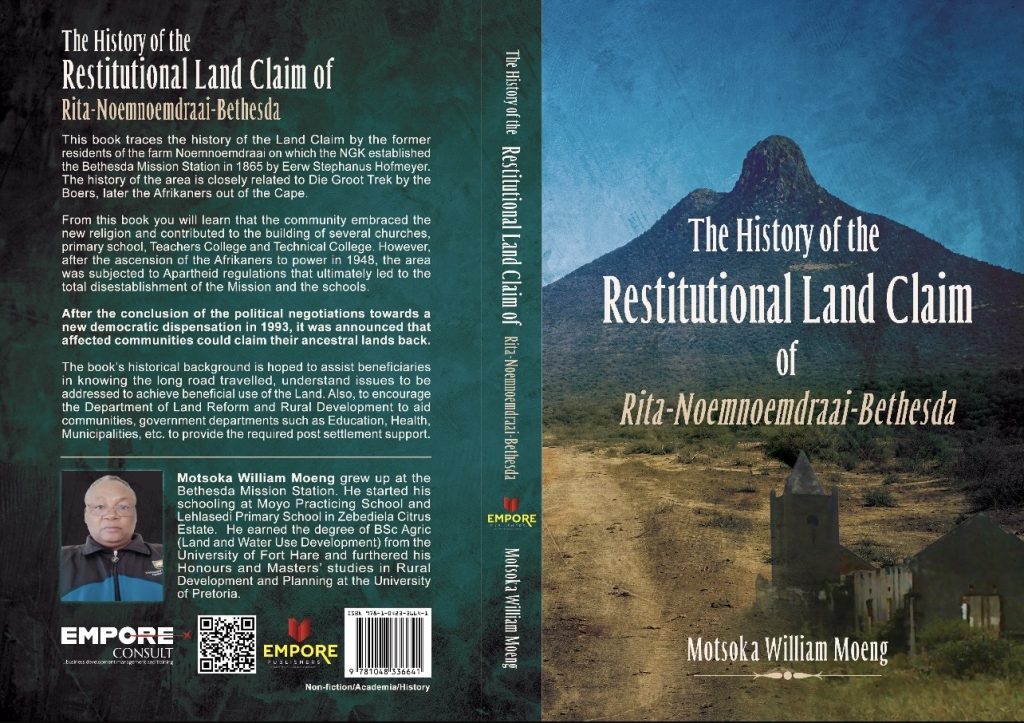
The history of Rita-Noemnoemdraai-Bethesda is, in many respects, a history of South Africa itself. It is a story of land and belonging, of faith and community, of education and development, but also of dispossession, forced removal and the long struggle for restitution and dignity.
This book seeks to preserve and document the history of the former residents of the farm Noemnoemdraai, today known as Bethesda 208 LS, and their journey towards the restoration of their ancestral land. It is a journey that stretches across generations and encompasses some of the defining moments in the history of the region and of South Africa.
The story begins long before the land claim itself. The history of the area is intertwined with the Great Trek of the Boers, later known as Afrikaners, from the Cape. Two Voortrekker groups, led by Louis Trichardt and Hans van Rensburg, passed through the area along the Hout River on their way towards the Soutpansberg, searching for a route to the port of Delagoa Bay.
The subsequent establishment of the Zuid-Afrikaansche Republiek between the Vaal and Limpopo rivers brought about a new political and territorial order. This expansion occurred in territories that were already inhabited by established African communities. The resulting contestation over land, political authority and resources contributed to a history of conflict and warfare that profoundly shaped the region.
It was within this complex historical landscape that the Bethesda Mission Station emerged.
In 1865, the Dutch Reformed Church (NGK), under the leadership of Reverend Stephanus Hofmeyer, established the Bethesda Mission Station on the farm Noemnoemdraai. The arrival of the Mission Station introduced a new religious and institutional dimension to the life of the Rita community.
The community embraced Christianity and, over the years, became active participants in the development of the Mission and its institutions. Churches were built. Schools were established. Moyo Primary School became part of the educational landscape of the community. Bethesda Normal Teachers College and the Technical College subsequently emerged as important centres of education and skills development.
These institutions were much more than buildings. They became instruments of social transformation.
They contributed to the educational, religious and social development of the wider Soutpansberg region, which was subsequently known as the Far Northern Transvaal and is today part of Limpopo Province. Through them, generations of young people acquired education and skills that enabled them to contribute to their families, communities and the wider society.
Bethesda therefore became a place of learning, worship, community and aspiration. It was precisely this flourishing community that was eventually disrupted by apartheid.
Following the accession of the National Party government to power in 1948, apartheid legislation progressively penetrated every aspect of South African life. Land ownership, settlement, education, movement and community organisation became subject to racial classification and control.
For Rita-Bethesda, the consequences were devastating. The Mission Station was eventually disestablished. The schools were removed or closed. The community that had developed around the farm was subjected to forced removal and severe economic and social disruption. Families were uprooted from the land on which generations had lived, worked, worshipped and built institutions.
The Teachers College was relocated to Seshego and renamed Kwena Moloto College, while the technical section was merged with the former Ambag Skool.
The relocation of these institutions was not simply an administrative exercise. It represented the fragmentation of a community and the displacement of an established social and educational ecosystem.
The people of Rita-Bethesda were scattered across the Polokwane area. A community that had once possessed a strong institutional foundation was deprived of the physical environment that had sustained its collective identity.
The story of restitution must therefore be understood against this history of dispossession.
Following the political negotiations that culminated in the democratic transition, communities affected by historical land dispossession were given the opportunity to reclaim their ancestral land. In 1994, the Rita community commenced the process of lodging its land claim with the assistance of Lawyers for Human Rights.
The Restitution of Land Rights Act was promulgated in November 1994, providing the legislative framework through which dispossessed communities could seek the restoration of land or alternative forms of redress.
For the Rita community, however, restitution was not an immediate or straightforward process.
The Land Claims Commission only engaged with the community in 1997. Thereafter, a series of negotiations took place involving the landowner, the NGK, and its business partner, Yskor. There was considerable opposition to the restoration of the land to the claimants.
The community nevertheless persisted. Their perseverance eventually bore fruit. Following the conclusion of the neighbouring Kranspoort land claim through the Land Claims Court, an agreement was reached for the restoration of the Rita-Bethesda land.
On 4 April 2004, the land was formally handed over to the bona fide claimants. This was a historic moment.
After decades of dispossession, displacement and uncertainty, the descendants of those who had been removed could once again stand on the land from which their community had been forcibly displaced.
Yet restitution is not the same as restoration.
The return of land is an important beginning, but it does not automatically restore the social and economic conditions that existed before dispossession. Nor does the transfer of a title or ownership interest, by itself, guarantee development.
The experience of Rita-Bethesda demonstrates this distinction with particular clarity.
Like many land reform projects in South Africa, the project has faced significant post-settlement challenges. One of the most serious has been a lack of information among beneficiaries regarding their rights and responsibilities. This has been compounded by inadequate and inconsistent post-settlement support from the state and other relevant institutions.
It is important, therefore, to dispel the misconception that land restitution is a process through which anyone may claim an interest in a restituted property. Restitution is governed by legislation and is intended to benefit those who meet the statutory requirements for restitution.
Section 25(7) of the Constitution and Section 2 of the Restitution of Land Rights Act provide an important framework in this regard. Understanding these provisions is essential if beneficiaries are to exercise their rights responsibly and if land reform projects are to be managed in accordance with the law.
The difficulties experienced by Rita-Bethesda have also been aggravated by conflict, crime and inadequate law-enforcement interventions. In several land reform projects, the absence of effective crime prevention and the failure to resolve internal disputes have contributed to prolonged conflict, litigation and delays in development.
The Communal Property Association Registrar’s Office has an important role to play in addressing these challenges. Its re-establishment and strengthening should be treated as an institutional priority. Beneficiaries require not only land but also the governance structures, information, institutional support and protection necessary to use that land productively.
Despite these challenges, the Rita-Bethesda story is not one of failure.
There have been important achievements.
Land Use Planning was successfully undertaken, while Settlement Planning, although severely delayed, was eventually concluded around October 2011 following a prolonged process involving sector departments and the Tribunal.
Perhaps one of the most encouraging examples was the Nguni cattle project.
The community received a herd of Nguni cattle from the Limpopo Department of Agriculture. The project was well managed and ultimately became the best provincial project of its kind. Most significantly, the loan was repaid in a record period of three years.
This achievement demonstrates an important truth about restitution: given appropriate resources, capable leadership, institutional support and accountability, restituted communities can transform land into productive economic assets.
The challenge, therefore, is not whether land restitution can work. It is whether the institutions responsible for supporting restitution are prepared to ensure that it works.
The role of the Uniting Reformed Church, formerly the NGKA, also deserves renewed consideration. The historical relationship between the Church and the Bethesda Mission Station cannot simply be reduced to the history of a religious institution. The Mission formed part of the social, educational and developmental fabric of the community.
The Church therefore has an opportunity to participate constructively in the renewal of Rita-Bethesda. Such participation should not be understood merely as an act of institutional nostalgia. Rather, it should be viewed as recognition of a shared history and an opportunity to contribute to rebuilding a community whose development was so profoundly interrupted by apartheid.
The Department of Land Reform and Rural Development, together with other government departments, public entities and the municipality, must similarly recognise that restitution does not end with the handover of land.
Post-settlement support is not a favour to beneficiaries. It is an essential component of making land reform meaningful and sustainable.
Beneficiaries need access to appropriate planning, infrastructure, agricultural and economic support, governance assistance, security, market access and technical expertise. Without these interventions, the transfer of land can become an administrative event rather than an instrument of social and economic transformation.
Rita-Bethesda should therefore be reconsidered as a Ministerial Project, as it was before 2009. The project possesses a remarkable historical legacy. It was once an important centre of religious education, teacher training, technical education and community development. Its history predates apartheid, survived forced removals and culminated in the restoration of ancestral land after a lengthy restitution process.
That history gives Rita-Bethesda an unusual opportunity.
The land can become more than a symbol of what was lost. It can become a platform for what can still be built.
The objective should not simply be to recreate the past. History cannot be reversed. The task is to draw from the strengths of the past while creating a sustainable future for present and future generations.
Rita-Bethesda could once again become a centre of learning, agriculture, culture, heritage and economic activity. Its historical association with education and the Church could provide the foundation for a broader heritage and development programme. Its agricultural potential could support livelihoods and enterprise development. Its history could become a tourism and heritage asset. Most importantly, its beneficiaries could become active custodians and economic participants rather than passive recipients of land reform.
The restoration of land should ultimately lead to the restoration of opportunity. That is the deeper meaning of restitution.
The Rita-Bethesda story reminds us that land is never merely soil beneath our feet. Land carries memory. It carries identity. It carries the graves of ancestors, the footprints of children, the buildings of institutions, the stories of families and the dreams of generations.
To restore land without restoring the capacity of people to use it meaningfully is to leave the work of restitution incomplete.
The journey of Rita-Noemnoemdraai-Bethesda has therefore not ended with the handover of the land on 4 April 2004. In many ways, that moment marked the beginning of a new chapter.
The task before the beneficiaries, government, the Church, traditional and community leadership, civil society and development partners is to ensure that the restored land becomes a living testimony to the resilience of the people who once occupied it.
The history recorded in this book should consequently not be read merely as an account of dispossession and restitution. It should be read as an invitation to remember, to understand and, ultimately, to act.
Rita-Bethesda has travelled a long road — from mission station to forced removal, from dispossession to restitution, and from restitution towards the still-unfinished promise of development.
Its next book must be written by a community that knows its history, understands its rights, accepts its responsibilities and is equipped to turn its ancestral land into a sustainable asset for generations to come.
That is the unfinished work of restitution. And that is the promise of Rita-Bethesda.